

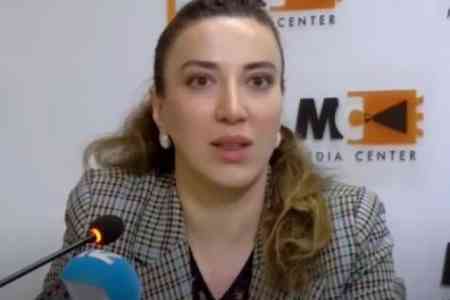
ArmInfo. International law specialist and lawyer Siranush Sahakyan responded to the statement by Azerbaijan's Human Rights Commissioner, Sabina Aliyeva.
The lawyer's statement, in particular, notes that on September 19, 2026, the office of the Azerbaijani Human Rights Commissioner called the questions raised by Ruben Vardanyan regarding himself and other Armenian prisoners held in Umbaki "groundless." This response is notable not so much for what it answers as for what it avoids. Specifically, a number of complaints are simply omitted from the response: lack of video communication; access to education; regular ICRC access; visits with family; letters and parcels; diplomatic or consular access; the humanitarian visit proposed by Veronika Zonabend. The silence about family visits and the proposed humanitarian visit is telling. The office claims that contact with the family is being facilitated. Since her arrest, not a single family visit has taken place. The only existing contact is by telephone, and not even for everyone. Requests to facilitate Veronika Zonabend's visit were sent to the Commissioner's office in June and July. They remain unanswered. Meanwhile, Azerbaijani media openly suggest that if she comes to Baku, she could be arrested. This is what "contact with the family is being facilitated" means in practice.
"On other issues, the answer is given to a question no one asked. The notary service provided to Arayik Harutyunyan does not explain why Ruben Vardanyan cannot issue his own powers of attorney. Books are not responding to a complaint about a newspaper subscription. The medical examination does not confirm that the specific diagnostic tests Vardanyan requested were performed or that their results were communicated to him. Where the Commissioner's version of events diverges from the facts presented by Vardanyan, the lack of documentation is conspicuous. The office claims that every call to the 916 hotline was responded to in a timely manner. Vardanyan was allowed one such call—on June 19. No confirmation of this response was provided. Neither were substantive responses to written requests sent on his behalf provided. If weekly calls are truly available to every prisoner, why does Ludwig Mkrtchyan wait anywhere from one and a half to more than two months for the next call? Call logs could answer this question immediately. Vardanyan repeatedly sought access to a notary to draw up powers of attorney or access to forms to sign them himself. Neither was granted. Therefore, on August 20, a lawsuit was filed with the Baku Administrative Court, which was only recently registered. From June to August, at least six written requests were sent to the Commissioner's Office—requests for medical examinations, videoconferencing, the 916 hotline, meetings with the Commissioner, and visits with family. None of them received a response. The same applies to access to a defense attorney. A local lawyer was repeatedly denied access to Vardanyan. On September 16, access was denied due to the absence of the facility's director. On September 19, the Commissioner announced that prisoners' rights were being ensured. On September 22, access to a defense attorney was again denied for the same reason. Consequently, the case had to be taken to court: a lawsuit was filed against the facility's administration for the denial of access. The Commissioner also relies heavily on visits conducted by her office. The uncomfortable irony, however, is that the very institution that cites these visits as evidence of effective oversight has already been criticized by the UN Committee against Torture for failing to “effectively perform its functions” in responding to credible allegations of serious violations—a failure that the Committee said “demonstrates a lack of independence.” If Ruben Vardanyan’s allegations are truly “baseless,” the answer is simple: produce documentation for every Armenian prisoner in Umbaki—records of family visits, consular access, telephone call logs, written responses to their inquiries, notarial records, and records of access to an independent lawyer. "A categorical denial, no matter how resolute, is not proof," Siranush Sahakyan noted, adding as a postscript that the prisoners' request for a meeting with the Commissioner, conveyed by Ruben Vardanyan, remains unanswered. As do—inconveniently—the questions her statement still leaves unanswered.
It should be noted that the exact number of Armenian prisoners of war and hostages held in Azerbaijani prisons remains unknown. Experts estimate the number to be several hundred. Today, Azerbaijani authorities confirm the presence of 19 Armenians in their custody. Among those held in Azerbaijani captivity are eight former and current members of the military-political leadership of Artsakh. These are the former presidents of Artsakh Arkady Ghukasyan, Bako Sahakyan, Arayik Harutyunyan, former Foreign Minister Davit Babayan, as well as Parliament Speaker Davit Ishkhanyan, former Commander of the Artsakh Defense Army, General Levon Mnatsakanyan, General David Manukyan, and former State Minister Ruben Vardanyan. In February, a Baku puppet court sentenced Arayik Harutyunyan, David Babayan, David Ishkhanyan, David Manukyan, and Levon Mnatsakanyan to life imprisonment on trumped-up charges, and Bako Sahakyan, Arkady Ghukasyan, and Ruben Vardanyan to 20 years in prison. The so-called court sentenced the remaining Artsakh residents to up to 15 years in prison.









 Armenian Political Scientist: The approaches, methods, rmphases and content of today’s struggle in Armenia Cannot Remain the Same
 Political scientist: Armenians will live peacefully in their homeland only when they can once again set national goals for themselves, such as Artsakh
 Armenian Historian: People Like Magdalena Grono Should Be Kept Away from the Thresholds of Armenian Shrines
 Azerbaijani studies expert: Armenia’s Foreign Ministry could use the ICC against Aliyev’s Armenophobic statements
 An Armenian political analyst exposed Hajiyev’s lies and attempts to mislead diplomats accredited in Azerbaijan in occupied Artsakh
 Russian Security Council: In Armenia, they want to force Russian asset owners to dispose of their assets
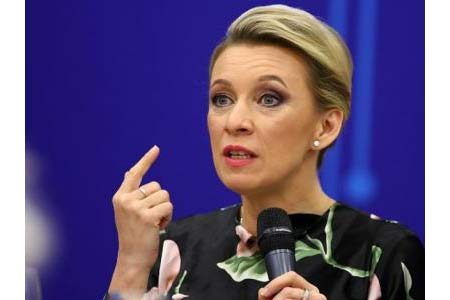 Zakharova: Russia ready to discuss with Armenia the prospects for expanding military cooperation as part of a review of bilateral ties
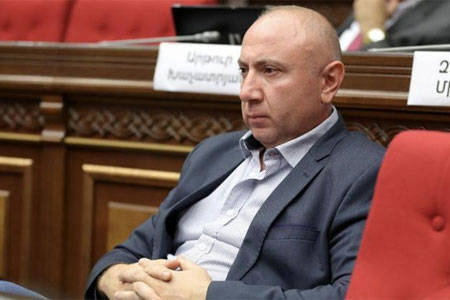 Tevanyan: Armenia, like Ukraine and Moldova, is being drawn into the EU’s global war
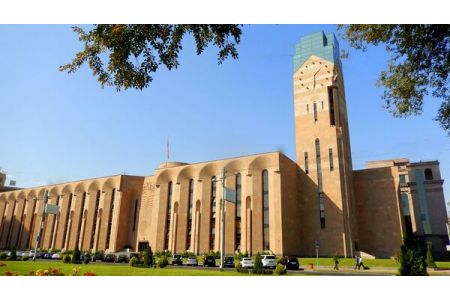 Yerevan City Hall is considering introducing a valet parking system in the city
 Expert: The circus surrounding the “Albanization” of Armenian culture in the presence of foreign ambassadors in occupied Artsakh is genocide
 Political scientist: If Russian-Armenian relations are destroyed, Turkey will take Russia`s place
 Political scientist: The Armenian public is simply obliged to significantly change the entire content of public discourse and struggle
 Cross tattoos are being removed from the skin of Christian prisoners in Azerbaijan by fire, according to a human rights activist.
 Zakharova: Armenia`s likely introduction of visas with Russia will be a step against Yerevan itself
 Putin: Armenia`s recognition of Karabakh as part of Azerbaijan in Prague has given Russia`s position on this issue an ambivalent character
 Putin: Armenia`s adoption of the law on EU accession means an announcement of its withdrawal from the Eurasian Economic Union
 Medvedev: Yerevan will never become an EU member, but it will permanently damage relations with the Eurasian Economic Union, including with Moscow.
 Aram Vardevanyan: Public demands solutions, not apology scandals in Parliament
 Arrested Armenian oligarch on economy and new jobs
  "In Baku, we gave a worthy rebuff to the false claims regarding the past and present of our people" – Former Artsakh Parliament Speaker from Baku captivity