
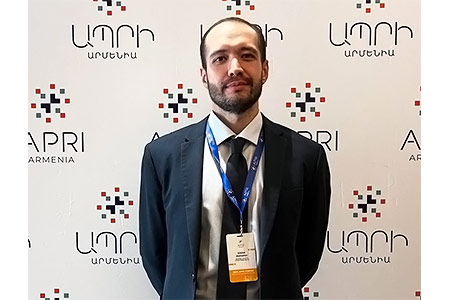
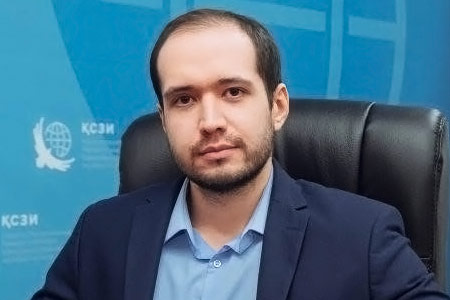
ArmInfo. Activating the European track is a sovereign choice of the Armenian leadership. On September 24, in a conversation with an ArmInfo correspondent on the sidelines of the APRI Armenia 2026 forum, Alisher Abdreshev, leading expert at the Department of European and American Studies at the Kazakhstan Institute for Strategic Studies (KISS), commented on Kazakhstan's position on Armenia's aspirations to join the European Union (EU).
"The position here is quite clear. Activating the European track is a sovereign choice of the Armenian leadership. We respect Yerevan's recent steps in terms of diversifying its foreign policy. Most recently, Armenian Prime Minister Nikol Pashinyan announced a new ideology for Armenia's positioning – the concept of 'Real Armenia.'" "And I think this is Armenia's own internal choice," the expert noted.
At the same time, as Abdreshev noted, from an expert perspective, it is important to evaluate the pros and cons for Armenia if it continues to maintain a complex dialogue with the Eurasian Economic Union (EAEU). According to him, it is currently difficult to imagine how Armenia, while remaining in the EAEU, will simultaneously pursue a course toward rapprochement and accession to the European Union. "So far, we, as experts, do not see how Armenia plans to balance these directions. But we cannot react to this negatively or in any other way. As I have already said, this is a matter of Armenia's national choice. Astana, in turn, will continue to develop relations with Yerevan regardless of its foreign policy transformation," the leading expert from the Institute of Strategic Studies (KISI) noted.
Overall, according to him, Armenia is currently in a very active phase of its foreign policy. "Many events are taking place around integration processes in the post-Soviet space. We also know that Armenia has suspended its participation in the CSTO. At the same time, we understand the rationale behind these decisions and understand Armenia's position. Of course, we will continue to support the work process and interaction with our Armenian colleagues, despite their desire to join other international organizations," Abdreshev concluded.
As a reminder, on January 9, 2025, the Armenian government approved a draft law on the start of the process of joining the European Union, proposed by the "Eurakve" civic initiative. The draft was sent to the Armenian parliament for approval. On March 26, the parliament adopted it in its final reading and sent it to the president for signature. The document was signed on April 4 of that year. Moscow stated that Russia had conveyed to Armenia that simultaneous membership in the Eurasian Economic Union and the European Union was impossible. On May 9, Russian President Vladimir Putin, speaking to journalists, suggested that Armenia decide on its membership in the EU and the Eurasian Economic Union (EAEU) as soon as possible, expressing its readiness to "begin a civilized divorce" if necessary. Yerevan responded by stating that it would leave the EAEU when it deemed it necessary. And on May 29, the heads of state of four of the five EAEU member states adopted a resolution recommending that Armenia hold a referendum on its continued membership in the EAEU. That same day, the Russian president stated that Armenia could not afford to stagnate on both sides and needed to make a choice as soon as possible.





 Armenian Political Scientist: The approaches, methods, rmphases and content of today’s struggle in Armenia Cannot Remain the Same
 Political scientist: Armenians will live peacefully in their homeland only when they can once again set national goals for themselves, such as Artsakh
 Armenian Historian: People Like Magdalena Grono Should Be Kept Away from the Thresholds of Armenian Shrines
 Azerbaijani studies expert: Armenia’s Foreign Ministry could use the ICC against Aliyev’s Armenophobic statements
 An Armenian political analyst exposed Hajiyev’s lies and attempts to mislead diplomats accredited in Azerbaijan in occupied Artsakh
 Russian Security Council: In Armenia, they want to force Russian asset owners to dispose of their assets
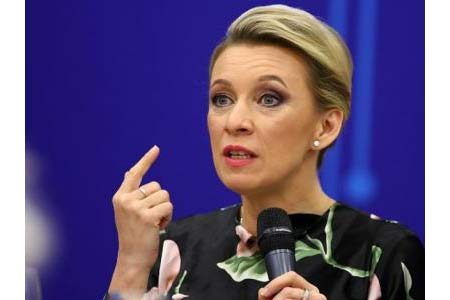 Zakharova: Russia ready to discuss with Armenia the prospects for expanding military cooperation as part of a review of bilateral ties
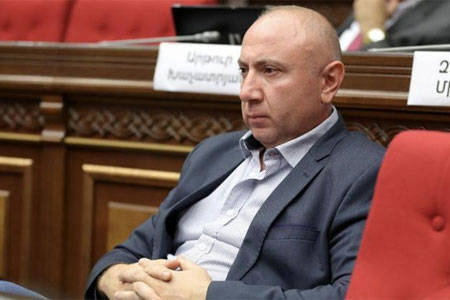 Tevanyan: Armenia, like Ukraine and Moldova, is being drawn into the EU’s global war
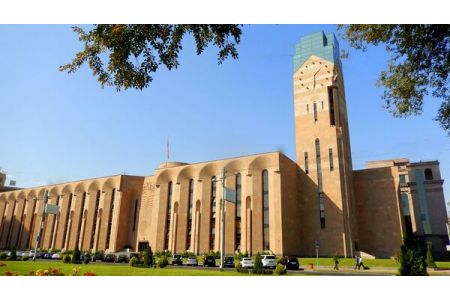 Yerevan City Hall is considering introducing a valet parking system in the city
 Expert: The circus surrounding the “Albanization” of Armenian culture in the presence of foreign ambassadors in occupied Artsakh is genocide
 Political scientist: If Russian-Armenian relations are destroyed, Turkey will take Russia`s place
 Political scientist: The Armenian public is simply obliged to significantly change the entire content of public discourse and struggle
 Cross tattoos are being removed from the skin of Christian prisoners in Azerbaijan by fire, according to a human rights activist.
 Zakharova: Armenia`s likely introduction of visas with Russia will be a step against Yerevan itself
 Putin: Armenia`s recognition of Karabakh as part of Azerbaijan in Prague has given Russia`s position on this issue an ambivalent character
 Putin: Armenia`s adoption of the law on EU accession means an announcement of its withdrawal from the Eurasian Economic Union
 Medvedev: Yerevan will never become an EU member, but it will permanently damage relations with the Eurasian Economic Union, including with Moscow.
 Aram Vardevanyan: Public demands solutions, not apology scandals in Parliament
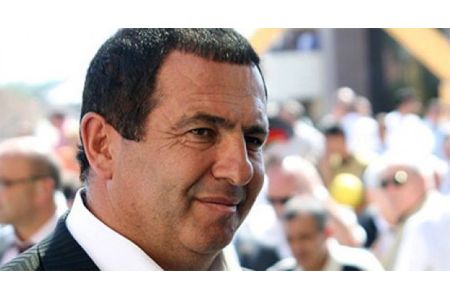 Arrested Armenian oligarch on economy and new jobs
 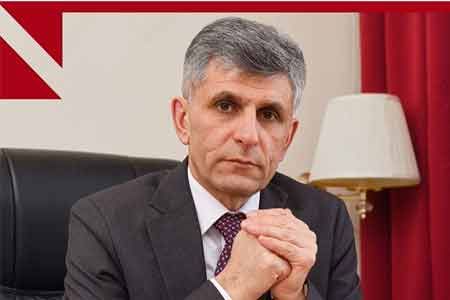 "In Baku, we gave a worthy rebuff to the false claims regarding the past and present of our people" – Former Artsakh Parliament Speaker from Baku captivity