
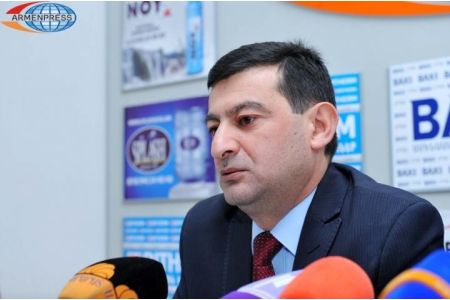
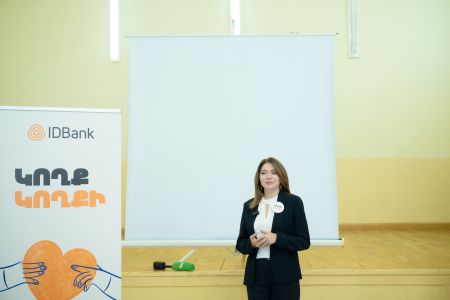
ArmInfo. The issue of preserving Artsakh's cultural heritage is not a matter of the past, but a matter of human rights. Former Artsakh Minister of Culture Sergey Shahverdyan stated this on September 23 at a hearing entitled "Socio-Economic and Legal Problems of the People of Artsakh and Their Solutions."
He noted that after the forced displacement, the people of Artsakh lost not only their homes and property, but also the cultural environment in which their language, traditions, and historical memory were formed. "That is why the issue of preserving Artsakh's cultural heritage is not a matter of the past, but a matter of human rights. This issue cannot be closed simply because of the loss of a place of residence." "On the contrary, in the context of forced displacement, the need to protect this right becomes even more pressing," Shahverdyan noted.
In this regard, he recalled that in November 2023, the Armenian government approved the "Strategy for the Preservation, Development, and Popularization of the Culture of the Republic of Armenia for 2023-2027" and its implementation program. Within the framework of this strategy, Shahverdyan recalled, the need to protect and inventory the intangible cultural heritage of the forcibly displaced people of Artsakh was identified as one of the priority tasks. According to Shahverdyan, at the time, this was an important recognition by the Armenian government. "However, today it is important to talk not only about the commitments the government has made, but also about which of them have been implemented." "Unfortunately, there is no point in talking about achievements in this direction today," the former Artsakh minister noted.
He went on to clarify that inventorying heritage in itself does not necessarily mean realizing the right to it. As Shahverdyan explained, if a people is deprived of the opportunity to pass on their cultural heritage to future generations, the people's heritage gradually ceases to exist as a living culture. "Therefore, today we need to transition from a policy of preserving individual objects to a policy of protecting cultural rights and reproducing our own culture," Shahverdyan believes.
In this regard, he also touched on the government's program for 2026-2031, which views culture as a key tool for preserving identity. In his opinion, this raises an important question: if culture is seen as a tool for preserving identity, then how should this policy work for people who have lost their natural cultural environment as a result of forced displacement? In this regard, he noted that cultural rights do not receive a separate toolkit within the framework of existing programs, despite the fact that culture is an independent component of the environment in which human identity is formed and preserved. Speaking about the steps that need to be taken today, Shahverdyan emphasized that the cultural rights of the Artsakh people should be perceived not as a separate humanitarian program, but as one of the areas of state policy. In particular, in his opinion, a separate interdepartmental unit for the preservation and implementation of the cultural heritage of Artsakh should be included in the government program. "Secondly, it is necessary to conduct an audit of the initiatives already being implemented. In addition, a systemic program for the transfer of cultural heritage to future generations should be developed. This includes, in particular, the creation of specific educational programs. Another important step should be the creation of a unified digital resource. "It is fundamentally important that the people of Artsakh themselves participate in decisions about how to preserve this heritage and to whom it should be accessible," the former NKR minister noted.
Shahverdyan also emphasized that the cultural heritage of the Artsakh people should not be reduced solely to monuments and material objects. He noted that it also includes dialect, traditions, cuisine, customs, and other elements of intangible culture. He noted that without systematic action, resolving these issues will become significantly more difficult in just five to six years. In this regard, he called for parliamentary oversight of the implementation of relevant programs.
"Our task is to ensure that the memory of the cultural heritage of the Artsakh people continues to exist, develop, and be passed on to future generations," Shahverdyan concluded.








 Armenian Political Scientist: The approaches, methods, rmphases and content of today’s struggle in Armenia Cannot Remain the Same
 Political scientist: Armenians will live peacefully in their homeland only when they can once again set national goals for themselves, such as Artsakh
 Armenian Historian: People Like Magdalena Grono Should Be Kept Away from the Thresholds of Armenian Shrines
 Azerbaijani studies expert: Armenia’s Foreign Ministry could use the ICC against Aliyev’s Armenophobic statements
 An Armenian political analyst exposed Hajiyev’s lies and attempts to mislead diplomats accredited in Azerbaijan in occupied Artsakh
 Russian Security Council: In Armenia, they want to force Russian asset owners to dispose of their assets
 Zakharova: Russia ready to discuss with Armenia the prospects for expanding military cooperation as part of a review of bilateral ties
 Tevanyan: Armenia, like Ukraine and Moldova, is being drawn into the EU’s global war
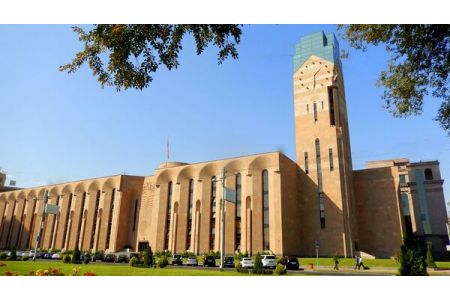 Yerevan City Hall is considering introducing a valet parking system in the city
 Expert: The circus surrounding the “Albanization” of Armenian culture in the presence of foreign ambassadors in occupied Artsakh is genocide
 Political scientist: If Russian-Armenian relations are destroyed, Turkey will take Russia`s place
 Political scientist: The Armenian public is simply obliged to significantly change the entire content of public discourse and struggle
 Cross tattoos are being removed from the skin of Christian prisoners in Azerbaijan by fire, according to a human rights activist.
 Zakharova: Armenia`s likely introduction of visas with Russia will be a step against Yerevan itself
 Putin: Armenia`s recognition of Karabakh as part of Azerbaijan in Prague has given Russia`s position on this issue an ambivalent character
 Putin: Armenia`s adoption of the law on EU accession means an announcement of its withdrawal from the Eurasian Economic Union
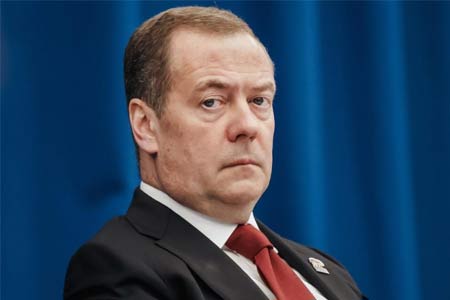 Medvedev: Yerevan will never become an EU member, but it will permanently damage relations with the Eurasian Economic Union, including with Moscow.
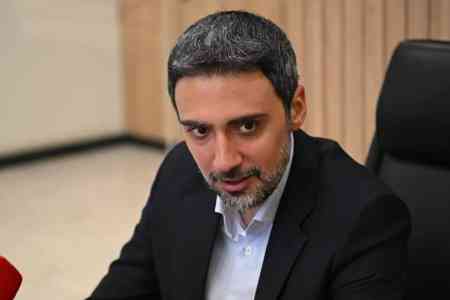 Aram Vardevanyan: Public demands solutions, not apology scandals in Parliament
 Arrested Armenian oligarch on economy and new jobs
 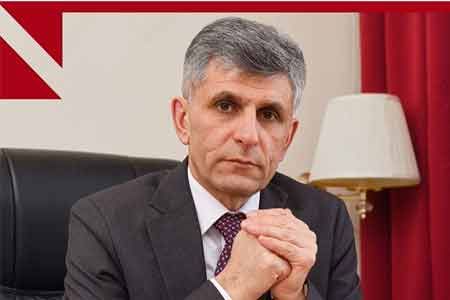 "In Baku, we gave a worthy rebuff to the false claims regarding the past and present of our people" – Former Artsakh Parliament Speaker from Baku captivity