

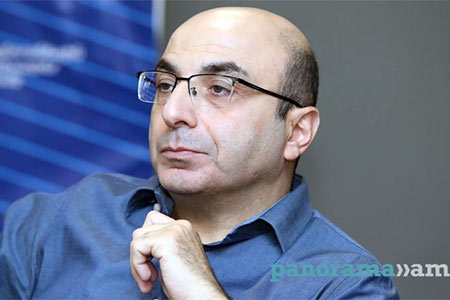
ArmInfo. The approaches, methods, emphases and content of today’s struggle in Armenia cannot remain the same. Political scientist and co-founder of the “Alternative Projects” group Vahe Hovhannisyan writes this in an article published on his Facebook page.
He noted that the phrase “the struggle continues” can periodically be heard from political associations, public and political figures, and honest people. Meanwhile, in his words, a moment comes when it becomes necessary to pose the question differently. In particular, as Hovhannisyan explained, it is necessary to ask: a struggle against what kind of prospect and for what kind of prospect, a struggle in what environment, based on what public demand? “After all, a struggle must have a vision, deadlines, a structure, mechanisms for ongoing evaluation, resources—human, intellectual, material—and other parameters. There was an activist named Vardges Gaspari who, as a form of protest, would simply lie down (in the street). In that format of struggle, he was understandable and organic. Looking at it from the outside, one gets the impression that today’s political struggle here has more or less turned into one big ‘Vardges Gaspari.’ We are fighting, and that’s it,” the political scientist noted.
He drew attention to the fact that today the struggle continues at the individual level: both in prisons and in detention, outside parliament and in the National Assembly. However, as the political scientist observed, this is not an institutional struggle, and therefore it is difficult to say how great its chances of success are. “The ‘tomorrow of Armenia’ is being shaped today. We need to clearly understand and explain just as clearly: where is Armenia heading? Today, our national, state, political and public agenda is an agenda of individual episodes that are not united into a single, comprehensive picture. Tigranashen, the Constitution of Armenia, the Armenian Apostolic Church (AAC), the 102nd Russian military base, various demands and steps by Azerbaijan—all of these, taken separately, cannot become an agenda. The struggle of 2021-2026 cannot continue today, after the 2026 elections, in an unchanged form. The approaches, methods, emphases and content cannot remain the same,” Hovhannisyan stressed.
According to him, after a difficult five-year period, it is impossible not to undergo personal and social growth, not to reassess one’s life, and not to go through other serious transformations. “A single-issue struggle will lead to the same result. Roughly speaking, if we become fixated on Tigranashen or any other single issue—the Constitution or some other village being surrendered—the authorities will play out the same scenario every time: ‘if we do not do this, there will be war.’ And in the end, they will achieve the desired result. We must look without fear at the results of the next parliamentary elections of 2026 and break out of the scenario we ourselves have invented, according to which ‘our legally conscious and most honest society is perishing in the hands of oppressors.’ At the 2021-2026 stage, everything was said and explained. The consequences of 2021-2026 are our shared history, unfolding before everyone’s eyes. And if, after all this, the election result turns out to be exactly this, then that part of society which truly possesses legal awareness and is ready to fight must undergo profound changes—and thereby become sought after,” the expert continued.
In other words, as the political scientist noted, genuine politics is about today’s Armenia and about the tomorrow of Armenia, which is being created today. For this, as the expert explained, it is necessary to understand the situation without being afraid to change and clarify the very way the questions are posed, to develop unified approaches without hesitating to offer the wider public new approaches and new content, and, most importantly, to offer them in a new language, with a new tone.
“In this atmosphere, in this environment, in this uncertainty—how many so-called ‘Kyarkis’ or entire regions will society surrender without thinking, and then continue living its ordinary life the next day? How can we get out of this state? How can we change the social dominance of ‘eating and drinking’ into state-minded thinking and civic behavior? The agenda of today’s struggle cannot be yesterday’s. From within and, even more painfully, from outside, our primitiveness will be exploited in such a way that we will be unable to escape it for the next hundred years. And here the most crucial problem emerges—internal dialogue, intra-civic dialogue, dialogue among different electoral groups,” the political scientist concluded.












 Armenian Historian: People Like Magdalena Grono Should Be Kept Away from the Thresholds of Armenian Shrines
 Azerbaijani studies expert: Armenia’s Foreign Ministry could use the ICC against Aliyev’s Armenophobic statements
 An Armenian political analyst exposed Hajiyev’s lies and attempts to mislead diplomats accredited in Azerbaijan in occupied Artsakh
 Zakharova: Russia ready to discuss with Armenia the prospects for expanding military cooperation as part of a review of bilateral ties
 Tevanyan: Armenia, like Ukraine and Moldova, is being drawn into the EU’s global war
 Yerevan City Hall is considering introducing a valet parking system in the city
 Expert: The circus surrounding the “Albanization” of Armenian culture in the presence of foreign ambassadors in occupied Artsakh is genocide
 Political scientist: If Russian-Armenian relations are destroyed, Turkey will take Russia`s place
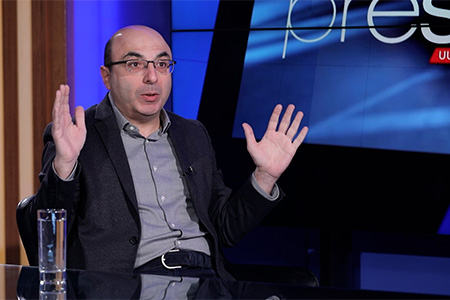 Political scientist: The Armenian public is simply obliged to significantly change the entire content of public discourse and struggle
 Cross tattoos are being removed from the skin of Christian prisoners in Azerbaijan by fire, according to a human rights activist.
 Zakharova: Armenia`s likely introduction of visas with Russia will be a step against Yerevan itself
 Putin: Armenia`s recognition of Karabakh as part of Azerbaijan in Prague has given Russia`s position on this issue an ambivalent character
 Putin: Armenia`s adoption of the law on EU accession means an announcement of its withdrawal from the Eurasian Economic Union
 Medvedev: Yerevan will never become an EU member, but it will permanently damage relations with the Eurasian Economic Union, including with Moscow.
 Aram Vardevanyan: Public demands solutions, not apology scandals in Parliament
 Arrested Armenian oligarch on economy and new jobs
  "In Baku, we gave a worthy rebuff to the false claims regarding the past and present of our people" – Former Artsakh Parliament Speaker from Baku captivity
