
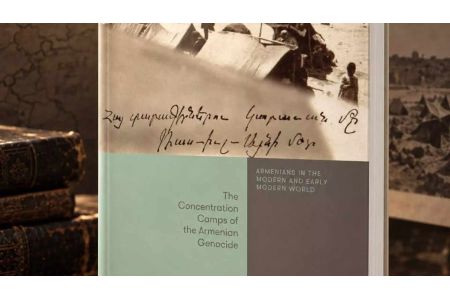
ArmInfo. Bloomsbury has published the collection The Concentration Camps of the Armenian Genocide, edited by Professor Bedross Der Matossian and genocide studies specialist and former head of the Armenian Genocide Museum-Institute Edita Gzoyan.
As Gzoyan reported on her Facebook page, the publication is 500 pages long. "The book was published as part of the book series Armenians in the Modern and Early Modern World, edited by Professor Bedross Der Matossian of the University of Nebraska–Lincoln. Despite the significant progress made in research on the Armenian Genocide in recent decades, the system of concentration camps established by the Ottoman authorities, particularly in the territory of present-day Syria, remains insufficiently studied to this day," the specialist noted.
According to her, this is the first collection to offer a comprehensive and in-depth study of these camps. Gzoyan noted that the collection examines the formation and development of the camp system and documents the crimes committed in Deir ez-Zor, Ras al-Ayn, Meskene (the main centers of the concentration camps—ed.) and other locations.
As Gzoyan explained, the collection includes twenty-one chapters written by historians and social scientists from Armenia, France, Germany, the United States, the United Kingdom, Lebanon and Australia. According to her, special attention is devoted to the testimonies of genocide survivors—their memoirs and diaries document the experiences they endured during deportation and in the camps.
"The history of this volume began in 2023, when Bedross Der Matossian and I discussed the prospects for developing the Armenian Genocide Museum-Institute as a research institution. We decided to engage in international publishing as well and began with the topic of a conference held several months earlier. Our goal was to hold an annual conference devoted to an important but relatively understudied topic and then publish a corresponding volume based on the conference materials. I was especially pleased that this volume was to include the research of many of my colleagues: at last, our voice was to be heard," Gzoyan wrote.
The project was implemented with the support of the Friedman Foundation, the Hyman Rosenberg Professorship Program and the Department of History at the University of Nebraska–Lincoln.











 Expert: The circus surrounding the “Albanization” of Armenian culture in the presence of foreign ambassadors in occupied Artsakh is genocide
 An Armenian historian harshly criticized the visit of Western coalition diplomats to occupied Artsakh
 Armenian expert: TRIPP and European integration are incompatible
 Azerbaijani studies expert : Ruben Vardanyan’s wife threatened with arrest if she visits Baku
 Political scientist: If Russian-Armenian relations are destroyed, Turkey will take Russia`s place
 Political scientist: The Armenian public is simply obliged to significantly change the entire content of public discourse and struggle
 Cross tattoos are being removed from the skin of Christian prisoners in Azerbaijan by fire, according to a human rights activist.
 Zakharova: Armenia`s likely introduction of visas with Russia will be a step against Yerevan itself
 Putin: Armenia`s recognition of Karabakh as part of Azerbaijan in Prague has given Russia`s position on this issue an ambivalent character
 Putin: Armenia`s adoption of the law on EU accession means an announcement of its withdrawal from the Eurasian Economic Union
 Medvedev: Yerevan will never become an EU member, but it will permanently damage relations with the Eurasian Economic Union, including with Moscow.
 Aram Vardevanyan: Public demands solutions, not apology scandals in Parliament
 Arrested Armenian oligarch on economy and new jobs
  "In Baku, we gave a worthy rebuff to the false claims regarding the past and present of our people" – Former Artsakh Parliament Speaker from Baku captivity
  NA Vice Speaker candidate believes his wife`s salary as director of HayPost is the lowest in the company`s history
 RF Permanent Representative: There is no CSTO-Armenia conflict
 Moscow: NATO seeking to "Pull" Armenia away from CSTO Allies
  Political analyst: Russia intends to determine which "Camp" Armenia will choose through a referendum
 Narek Karapetyan will give up his parliamentary salary in favor of charitable contributions.