ArmInfo. The “Digital House of Artsakh Culture” digital platform — artsakhian.org — was presented in Yerevan. It was created to collect, preserve and promote the intangible cultural heritage of Artsakh.
According to a statement received by ArmInfo, the platform was created at the initiative of the “We Are Our Mountains” Development Agency, founded by Ruben Vardanyan, with the support of the Calouste Gulbenkian Foundation.
Following the forced displacement of the Armenian population of Artsakh in September 2023, the natural continuity of cultural heritage transmission was also disrupted. The dialect, folklore, rituals and customs, songs and music, traditional knowledge, as well as the numerous manifestations of everyday culture that were passed down from generation to generation in their natural environment, are today in particular need of preservation and documentation.
“It was important for us that Artsakh be represented in the digital space through the culture it created. In this digital house, everything is interconnected — language, memory, people, stories. Artsakh culture is presented here not as a closed page of the past, but as a living culture,” noted Narine Aghabalyan, Deputy Director of the “We Are Our Mountains” Development Agency and head of the project.
The structure of the “Digital House of Artsakh Culture” platform was formed based on UNESCO’s five main areas of intangible cultural heritage. It encompasses the oral traditions and folklore of Artsakh, performing arts, rituals and festivals, traditional knowledge about nature, as well as traditional crafts. The platform simultaneously serves as a digital repository, including a library, video library, photo library, audio library and dictionary.
Lernik Hovhannisyan, a member of the scientific team involved in creating the platform, particularly emphasized the significance of this work in the context of the threats currently facing the cultural heritage of Artsakh. “Against the backdrop of recent events, when Azerbaijan is pursuing a policy of cultural ethnocide aimed at erasing the Armenian presence in Artsakh, with the tacit consent of the international community, this platform allows us to present our homeland and ensure that the history of Artsakh — every page of it — remains open to all of us and is never closed,” Hovhannisyan said.
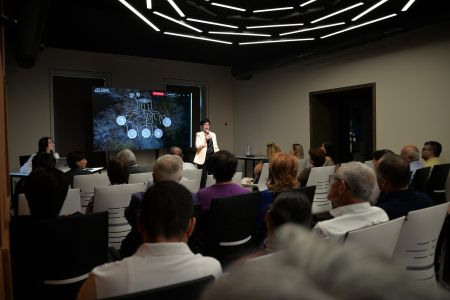
During the presentation, the idea behind the platform’s creation, its structure, the principles governing the formation of its content and its further development directions were presented. The initiative’s authors also called on Artsakh residents, researchers and families possessing personal archives to share the photographs, video recordings, audio materials, stories and other materials preserved by them, thereby contributing to the preservation of Artsakh’s cultural memory.
In his professional assessment of the platform, historian and cultural scholar Hamlet Petrosyan emphasized the importance of scientific accuracy and professional responsibility. “Our success lies in presenting our culture in detail, accurately and impartially. In these difficult conditions, a professional approach is also a moral criterion. This platform is a unique work, and I am truly impressed by what has been done,” Petrosyan noted. The work on the platform does not end with its public presentation: the “Digital House of Artsakh Culture” is entering a new stage of development. Its content and digital repositories are planned to be expanded systematically, with new scientific and personal archives, oral testimonies and other materials being added. The project’s goal is to make the platform a constantly developing, open and reliable source of knowledge that preserves the living cultural memory of Artsakh and passes it on to future generations.








 An Armenian historian harshly criticized the visit of Western coalition diplomats to occupied Artsakh
 Armenian expert: TRIPP and European integration are incompatible
 Azerbaijani studies expert : Ruben Vardanyan’s wife threatened with arrest if she visits Baku
 Political scientist: If Russian-Armenian relations are destroyed, Turkey will take Russia`s place
 Political scientist: The Armenian public is simply obliged to significantly change the entire content of public discourse and struggle
 Cross tattoos are being removed from the skin of Christian prisoners in Azerbaijan by fire, according to a human rights activist.
 Zakharova: Armenia`s likely introduction of visas with Russia will be a step against Yerevan itself
 Putin: Armenia`s recognition of Karabakh as part of Azerbaijan in Prague has given Russia`s position on this issue an ambivalent character
 Putin: Armenia`s adoption of the law on EU accession means an announcement of its withdrawal from the Eurasian Economic Union
 Medvedev: Yerevan will never become an EU member, but it will permanently damage relations with the Eurasian Economic Union, including with Moscow.
 Aram Vardevanyan: Public demands solutions, not apology scandals in Parliament
 Arrested Armenian oligarch on economy and new jobs
  "In Baku, we gave a worthy rebuff to the false claims regarding the past and present of our people" – Former Artsakh Parliament Speaker from Baku captivity
  NA Vice Speaker candidate believes his wife`s salary as director of HayPost is the lowest in the company`s history
 RF Permanent Representative: There is no CSTO-Armenia conflict
 Moscow: NATO seeking to "Pull" Armenia away from CSTO Allies
  Political analyst: Russia intends to determine which "Camp" Armenia will choose through a referendum
 Narek Karapetyan will give up his parliamentary salary in favor of charitable contributions.