
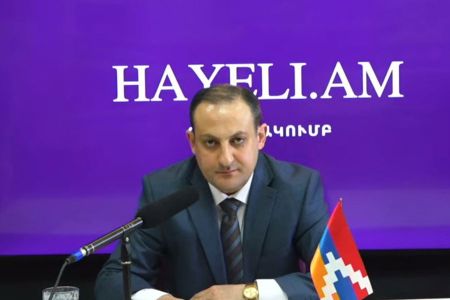
ArmInfo. Political scientist Stepan Hasan-Jalalyan, founder and chairman of the NGO “Asan-Jalalyan Council,” spoke about how Azerbaijani presidential aide Hikmet Hajiyev misled diplomats accredited in the country who visited occupied Artsakh.
According to a report received by ArmInfo, on September 12, 2026, the Azerbaijani presidential aide brought a group of diplomats accredited in Azerbaijan to the Martakert district of occupied Artsakh, specifically to the famous Armenian Gandzasar church, and there, without any grounds or facts, stated that the church had been built by the “Albanian ruler” Asan-Jalal-Dola. At the same time, as the political scientist noted, Hajiyev himself is a Caucasian Tatar born in the ancient Armenian city of Gandzak.
He then cited several facts proving the falsity and absolute groundlessness of Hajiyev’s statement. In particular, the political scientist said that Hasan-Jalal-Dola was the most prominent representative of Artsakh’s royal Aranshahik dynasty. “The 13th-century historian Kirakos Gandzaketsi, who personally communicated with Asan-Jalal-Dola, wrote the following about the construction of Gandzasar Church: ‘The great prince of Khachen in the land of Artsakh, Asan, who was affectionately called Jalal; he was a pious, God-fearing and humble man, Armenian by nationality, built the church.’ The quotation unequivocally testifies that the prince of princes of Artsakh was Armenian by nationality,” Hasan-Jalalyan pointed out.
However, as the political scientist noted, there are still researchers for whom the question of the national affiliation of the prince of princes of Artsakh remains a subject of study. Thus, he recalled the British writer and journalist Thomas de Waal (author of the book “Black Garden” - ed.), who specializes in Caucasus affairs. According to him, wishing to clarify the origin of Asan-Jalal-Dola, de Waal wrote to Professor Robert Hewsen of Rowan College in New Jersey (USA), a specialist in the history of the Caucasus in the 13th century. “On January 10, 2001, Professor Hewsen sent Thomas de Waal a detailed response. Having studied the genealogy of Asan-Jalal-Dola, the scholar concluded that it was of exclusively Armenian origin, writing, in particular, the following: ‘The ancestors of Hasan-Jalal are known as far back as the fourth century and include the following noble families: on his father’s side - the princes and later kings of Syunik. Through princesses who married his ancestors, Hasan-Jalal descended from the Armenian kings of the Bagratuni dynasty, whose capital was Ani; the Armenian kings of Vaspurakan of the Artsruni dynasty, whose capital was Van; and the princes of Gardman,’” the expert noted.
Presenting a third fact, Jalalyan spoke about how, in the summer of 1908, when the young researcher Joseph Orbeli was in Tiflis, Dr. Schmidt, assistant director of the Caucasus Museum, showed him two cold-weapon handles - hilts - kept in the museum’s ethnographic department, which the museum’s founder and director, German archaeologist Dr. Gustav Radde, had acquired in 1866 for only 10 rubles. “One of these two items, registered under number 851, greatly interested the Armenian scholar, since on the card describing the museum exhibit he read: ‘Jade sword hilt with Armenian letters.’ After a more detailed study, Orbeli deciphered the following Armenian inscription carved on the hilt: Asan Jalal, Prince of Khachen. As a result of his research, the young scholar rightly concluded that the hilt belonged to the Armenian king and 13th-century prince of princes of Artsakh, Hasan-Jalal-Dola,” the political scientist noted.
Thus, as the expert noted, it is indisputable that Asan-Jalal-Dola descended from one of the most prominent and famous Armenian families. In this connection, he also spoke about the origin of his foreign-language name and what the three non-Armenian names of this person - Asan, Jalal and Dola - mean. As Jalalyan explained, it is necessary to recall the influence of Iran and, later, especially the Arab Caliphate, and through them, foreign cultural environments, on the entire Armenian land and its people. “In ancient times, as today, in Artsakh and throughout Armenia, it was customary to name the eldest son after his grandfather. In this case, his father, Vakhtang-Tangik, named his eldest son Asan-Jalal-Dola after his own father, Asan,” the political scientist explained.
According to him, in 1261, following the tragic death of the king of Artsakh, the prince of princes Asan-Jalal-Dola, the princely house of the Lower Khachen province in Artsakh began, from the end of the 13th century, to be named after Asan-Jalal-Dola, but without the suffix “Dola” - simply Asan-Jalalyan. According to him, this surname was also borne by religious figures descended from this princely family, who, by inheritance, had concentrated in their hands from the middle of the 13th century the episcopal staff of the Lower Khachen province, and from the end of the 14th century, the Catholicosal throne of all Artsakh. “The descendants of the king of Artsakh, the prince of princes Asan-Jalal-Dola, are alive today and will certainly return to their historical homeland with the rights and status of its owners. Thus, based on the above-mentioned facts, we can assert that the Caucasian Tatar Hikmet Hajiyev lied and misled the diplomats accredited in Azerbaijan who visited the nearly 800-year-old Armenian Gandzasar Monastery on September 12, 2026, claiming that the prince of princes of Artsakh, Hasan-Jalal-Dola, had so-called Albanian origins,” the political scientist stressed.
As further proof that Azerbaijan continues to pursue a policy of erasing the Armenian trace in Artsakh, he recounted how, in a conversation with British writer and journalist Thomas de Waal, Doctor of Historical Sciences, Professor and Corresponding Member of the National Academy of Sciences of Azerbaijan Farida Mammadova stated, in particular: “The Karabakh problem cannot be solved without the Albanians.” “The quotation fully exposes the contrived and unfounded nature of Azerbaijan’s claims to Artsakh. In her statement, Mammadova acknowledged that without the false thesis about the Albanians, Azerbaijan has no grounds whatsoever to justify its claims to Artsakh, which has a thousand-year-old Armenian appearance and history. In light of Mammadova’s statement, we can assert that Hikmet Hajiyev remains faithful to the falsifications and myth-making of such notorious historians as Ziya Bunyadov, Farida Mammadova and similar ‘scholars,’” Jalalyan concluded.
It should be recalled that on September 19, 2023, Azerbaijan, under the pretext of an “anti-terrorist operation,” launched a large-scale aggression against Artsakh, which led to the complete de-Armenianization of the NKR. This was preceded by an almost 10-month blockade of the republic. As a result of the enemy aggression that began in the autumn of 2020 and ended with the complete ethnic cleansing of Artsakh in September 2023, more than 150,000 Artsakh residents were deprived of their homeland and became refugees.























 Azerbaijani studies expert : Ruben Vardanyan’s wife threatened with arrest if she visits Baku
 Political scientist: If Russian-Armenian relations are destroyed, Turkey will take Russia`s place
 Political scientist: The Armenian public is simply obliged to significantly change the entire content of public discourse and struggle
 Cross tattoos are being removed from the skin of Christian prisoners in Azerbaijan by fire, according to a human rights activist.
 Zakharova: Armenia`s likely introduction of visas with Russia will be a step against Yerevan itself
 Putin: Armenia`s recognition of Karabakh as part of Azerbaijan in Prague has given Russia`s position on this issue an ambivalent character
 Putin: Armenia`s adoption of the law on EU accession means an announcement of its withdrawal from the Eurasian Economic Union
 Medvedev: Yerevan will never become an EU member, but it will permanently damage relations with the Eurasian Economic Union, including with Moscow.
 Aram Vardevanyan: Public demands solutions, not apology scandals in Parliament
 Arrested Armenian oligarch on economy and new jobs
  "In Baku, we gave a worthy rebuff to the false claims regarding the past and present of our people" – Former Artsakh Parliament Speaker from Baku captivity
  NA Vice Speaker candidate believes his wife`s salary as director of HayPost is the lowest in the company`s history
 RF Permanent Representative: There is no CSTO-Armenia conflict
 Moscow: NATO seeking to "Pull" Armenia away from CSTO Allies
  Political analyst: Russia intends to determine which "Camp" Armenia will choose through a referendum
 Narek Karapetyan will give up his parliamentary salary in favor of charitable contributions.