

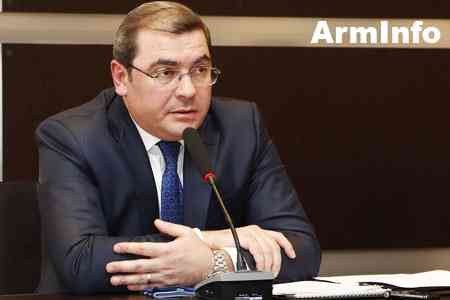
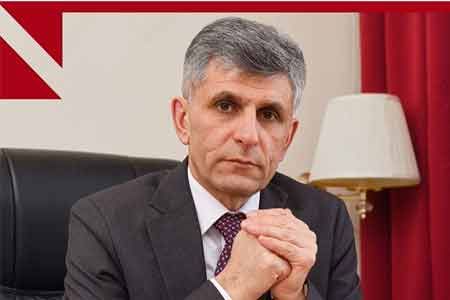
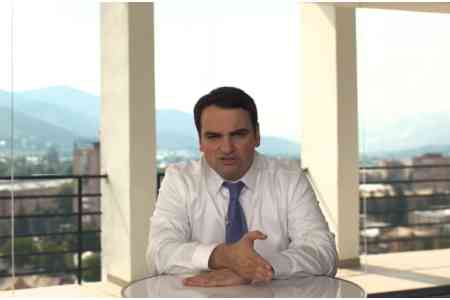
Arminfo. A process may be launched in the southern part of Armenia whose final terms are hidden from the public, but whose consequences will affect our territory, security and sovereignty for decades. Former Chairman of the State Revenue Committee of the Republic of Armenia David Ananyan writes about this in his article.
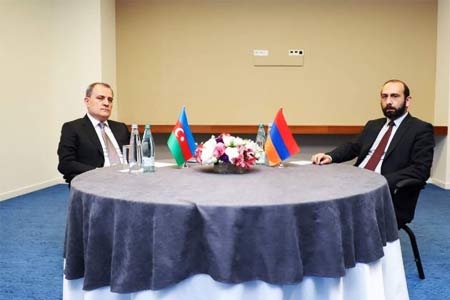
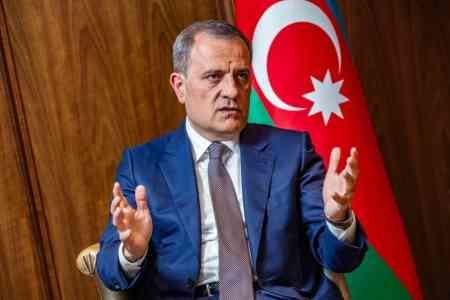
He recalled the statement by Azerbaijani Foreign Minister Jeyhun Bayramov that the delimitation of the borders should begin at the point where the Armenian-Azerbaijani-Georgian borders intersect and continue from north to south. As Ananyan noted, this is not a new condition, since the demarcation commissions of the two countries agreed on it back in January 2025. "However, Chairman of the National Assembly Committee on Foreign Relations Sargis Khandanyan did not rule out that, in order to accelerate the implementation of TRIPP, there could be a deviation from this sequence, and the sections through which the railway, oil pipeline or gas pipeline is to pass could be delimited in an unusual order. In other words, the logic of determining the state border may be subordinated not to Armenia's overall security agenda, but to the schedule of a specific infrastructure project. Moreover, as early as September 2025, the Armenian and Azerbaijani delegations discussed the issue of synchronizing demarcation, demining and the construction of communications," the former SRC chief noted.
He presented the most dangerous scenario, which could look as follows:
1. The southern strategic sector is demarcated as an emergency measure for the rapid launch of TRIPP.
2. Armenia nationalizes or expropriates the necessary land and grants it for long-term use to an Armenian-American company.
3. Azerbaijan obtains a practical connection with Nakhijevan, while Armenia's common routes remain dependent on further political decisions.
4. The withdrawal of Azerbaijani troops from other territories of Armenia is not synchronized with this process.
5. Having obtained the main infrastructure result, Baku continues to demand amendments to the Constitution of Armenia in order to sign a peace treaty.
"This, of course, is not an inevitable outcome, since at present there is no evidence that an agreement on a new territorial concession has already been reached. However, in the absence of public guarantees, taking into account the precedent of the unilateral demarcation of Tavush and the unresolved issues on Azerbaijan's part, this represents a very real risk. Therefore, the government and the demarcation commission must be required to publish the first demarcated sections and the maps used, the existence of an official decision to deviate from the sequence for TRIPP, a program for synchronizing demarcation and the withdrawal of Azerbaijani troops, a map of the southern route and a list of the affected territories, the procedure for compensating owners, the charter and shareholders' agreement of the operating company, equal conditions for mutual transit between Armenia and Azerbaijan, the powers of private operators and security services, documented agreements with Iran and Georgia, and a guarantee that amending the Constitution will not become a means of fulfilling Azerbaijan's demands. The state border cannot be "adjusted" to the political calendar of any road, pipeline or external center of power in the first place, and national interests cannot be explained after the steps have already been taken. First, the maps and commitments must be published, Armenia's territorial integrity must be ensured, Azerbaijani troops must be withdrawn, and genuine reciprocity must be secured. Only then will it be possible to build roads. Otherwise, under the guise of "peaceful infrastructure," Armenia will once again fulfill all its obligations in advance, providing Azerbaijan with the necessary strategic result and receiving in return not guaranteed peace, but yet another set of new demands," the politician emphasized.















 Political scientist: The model of allied relations between Russia and Armenia has collapsed
 Expert: The defeated authorities` position on normalizing relations with the enemy should not affect the rights of Artsakh refugees
 Expert: Fourth Republic is not to begin with Kocharyan`s arrest
 Political scientist: The Armenian public is simply obliged to significantly change the entire content of public discourse and struggle
 Cross tattoos are being removed from the skin of Christian prisoners in Azerbaijan by fire, according to a human rights activist.
 Zakharova: Armenia`s likely introduction of visas with Russia will be a step against Yerevan itself
 Putin: Armenia`s recognition of Karabakh as part of Azerbaijan in Prague has given Russia`s position on this issue an ambivalent character
 Putin: Armenia`s adoption of the law on EU accession means an announcement of its withdrawal from the Eurasian Economic Union
 Medvedev: Yerevan will never become an EU member, but it will permanently damage relations with the Eurasian Economic Union, including with Moscow.
 Aram Vardevanyan: Public demands solutions, not apology scandals in Parliament
 Arrested Armenian oligarch on economy and new jobs
  NA Vice Speaker candidate believes his wife`s salary as director of HayPost is the lowest in the company`s history
 RF Permanent Representative: There is no CSTO-Armenia conflict
 Moscow: NATO seeking to "Pull" Armenia away from CSTO Allies
  Political analyst: Russia intends to determine which "Camp" Armenia will choose through a referendum
 Narek Karapetyan will give up his parliamentary salary in favor of charitable contributions.