
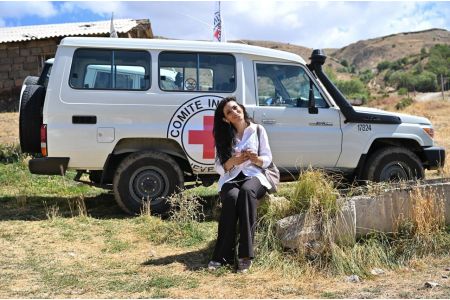
ArmInfo. The International Committee of the Red Cross (ICRC), as a neutral intermediary and humanitarian organization, was one of the first to come to the aid of residents of Armenia's border villages after the end of the active phase of hostilities in the Nagorno-Karabakh conflict zone. To prevent the outflow of the population and help them meet basic needs for a dignified life, the ICRC implemented a number of social and humanitarian programs: from helping to overcome the winter, to reclaiming degraded lands and assisting in the acquisition of fodder for livestock, to building medical facilities for emergency first aid. Against the backdrop of the established peace between Armenia and Azerbaijan, the ICRC is scaling back its programs this year, and in connection with this, the organization organized a press tour for journalists to clearly demonstrate the enormous work it has carried out in the border zone. An ArmInfo journalist also participated in the media tour.
Aid for residents of the border village of Khachik in Armenia's Vayots Dzor region
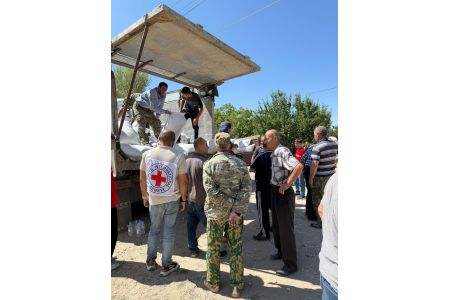
And so, the first stop was in the border village of Khachik, bordering Nakhichevan, where the ICRC provided the villagers with premium winter wheat seeds to stimulate agriculture. As they entered the village, journalists were greeted by the sight of Khachik residents—beneficiaries of the program—collecting winter wheat from an ICRC vehicle. Khachik resident Emma Grigoryan said this is the second time she has received this assistance from the ICRC, and it's been a great help. "This is the second time I've had the opportunity to participate in this program. The first time was...
The year before last, we received wheat from the Red Cross, and we've already...
harvested the harvest, and we were very happy. And now I'm waiting my turn...
to get the seeds. For me and for farms like mine, this...
is a great help. I couldn't have bought so much wheat on my own. "I'm a pensioner, I live with my son, who has health problems, and I don't have the financial means to buy that much wheat," admitted a resident of Khachik. She also expressed regret that the program was closing, noting that any assistance to village residents was greatly appreciated. Hovik Smbatyan, head of the Khachik community, noted that according to cadastral maps, the village has approximately 1,200 hectares of arable land. He added that, thanks to the ICRC, they reclaimed 100 hectares of unused land last year and planted it with spelt, and this year they are already harvesting winter wheat. "The ICRC provided us with approximately 32 tons of wheat, and we distributed the aid so that each beneficiary received enough seeds to sow one hectare of land," Smbatyan said. He added that they are using every inch of the village's land up to the border with Azerbaijan. In his words, it's as if they are carving out that border with a plow.
In turn, Stepan Grigoryan, head of the ICRC's economic security programs, said that their task was to provide emergency assistance to the population and communities affected by the conflict so they could address the pressing issues they face. "We are distributing Bezostaya 100 winter wheat here today. About 32 tons will be provided to the socially vulnerable population. The program will benefit 118 families," he said. He added that they also reclaimed unused land in the community. Grigoryan also reported that the project to distribute seeds to vulnerable populations is being implemented in seven more border villages in the republic – in the Syunik and Gegharkunik regions.
The head of communications programs for the ICRC's Yerevan delegation
Zara Amatuni noted that for the past 10 years, their organization has been working in five regions of Armenia – Tavush, Gegharkunik, Vayots Dzor,
Syunik and Ararat. "Naturally, we became more active in
Syunik, Gegharkunik, Vayots Dzor, and Ararat after the escalation in 2020, when a number of communities were granted border status," Amatuni said. According to her, the ICRC implemented an integrated approach, and assistance programs were provided to both vulnerable local populations and persons displaced from Nagorno-Karabakh after 2023.
According to her, the ICRC implemented not only the above-mentioned support programs for the population, but also those aimed at ensuring the right to health. "In remote communities, we built medical posts to provide urgent medical care to the population. In addition, in large medical centers, we implemented programs to build emergency departments and retrain medical personnel. This applies to medical centers in Jermuk, Kapan, Yeghegnadzor, and Vardenis," the ICRC representative noted. She emphasized that all their actions were aimed at ensuring that communities with increased risks of vulnerability were provided with the necessary... needs, especially regarding medical care.
"Considering that the situation has stabilized and there is no longer an urgent need for assistance in the border zone, which would bring us to the forefront as an international organization, we are now transferring this work to the communities." "We also helped our colleagues from the Armenian Red Cross Society undergo retraining, and we are passing this baton to them as an internal organization implementing humanitarian programs," Amatuni noted.
Assistance in providing the population with access to emergency medical care
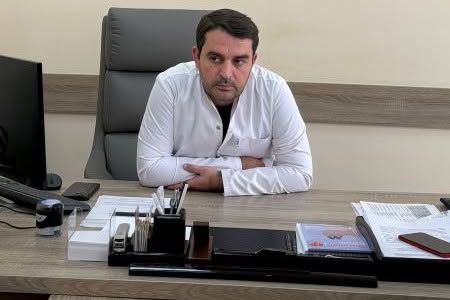
Continuing on this topic, journalists learned about the support provided The ICRC is providing assistance to the Yeghegnadzor and Kapan medical centers: from installing solar panels to reduce the hospital's financial burden to equipping them with modern medical equipment for emergency care.
Arsen Babayan, head of the Kapan Medical Center, said the hospital has developed a close partnership with the ICRC. "The ICRC's assistance covers both the technical refurbishment of the hospital and the professional development of medical staff. The organization also helped us install solar panels at the medical center, which significantly reduced the financial burden on our facility. This is the kind of assistance we feel at our multidisciplinary hospital," the head of the medical center noted.
The ICRC also supported the construction of a feldsher-midwife station in the village of Kornidzor in the Tekh community, near the Armenian-Azerbaijani border. Silva Danielyan, who has worked at the Kornidzor medical center for over 40 years, said that the conditions she had to work in before were not very favorable. "The medical center where I worked was not very functional. But thanks to the ICRC, we now have the opportunity to work in a new building, comfortable and equipped with everything necessary for providing primary medical care. The building, built with the assistance of the Red Cross, is very comfortable. "We have everything necessary to provide assistance to the population," Danielyan said.
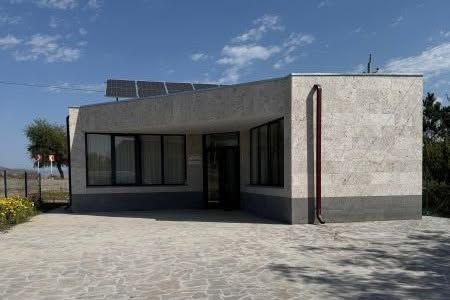
In turn, the head of the village of Kornidzor, Suren Amaryan, thanked the ICRC for its assistance in the construction of a new medical facility in the village, located directly on the border with Azerbaijan and with a population of approximately 1,300.
Regarding the situation on the front lines, the official assured that the situation is calm and the population is going about their daily lives. "Our border guards are stationed at the border. There are no shots fired in our Kornidzor; life goes on as usual," he said. He acknowledged, however, that until the border is delimited, there is always a risk of incidents, as the Azerbaijani side wants to take part of the Hakari Bridge, while the Armenian side refuses to give it up, reminding everyone that it is Armenian land. Amaryan noted that the Teh community has one of the longest borders with Azerbaijan—approximately 18 km—and only after it is delimited will it be possible to say with certainty where the border lies. Assistance in the Development of Agriculture in the Kapan Community The press tour also took journalists to two more border villages in the enlarged Kapan community—the remote villages of Srashen and Shikahogh. Here, with the assistance of the ICRC, villagers were able to expand their farming and, to some extent, improve their social welfare. After all, the once-large village of Shikahogh, which during the Soviet era housed a sewing factory, a boarding school, and its own hospital, now has a population of about 100, and unemployment is one of its residents' main problems.
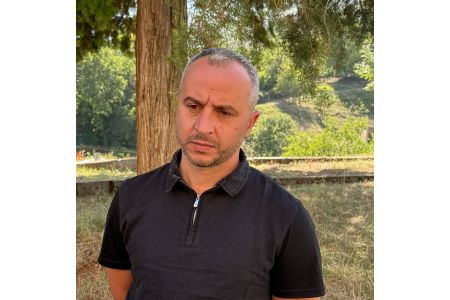
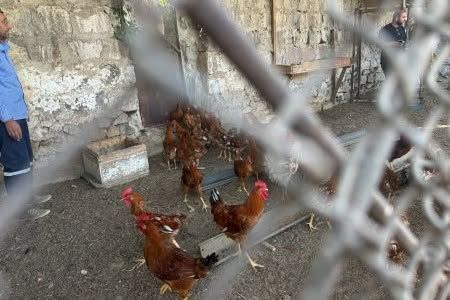
Zorik Navasardyan, head of Shikahogh, reported that the villagers received various types of assistance from the ICRC in the post-war period. "For example, the villagers took part in trainings organized by the ICRC, and the winners received funds to purchase pullet chickens. With the allocated funds, the beneficiaries of the program purchased 60 chickens, as well as feed for their upbringing. "Furthermore, some Shikahogh residents took part in a program to receive pig feed, and a number of villagers engaged in beekeeping were given the opportunity to purchase beehives," Navasardyan reported. He added that the ICRC had previously provided village residents with financial assistance to purchase firewood for the winter. He also reported that following the 2022 military operations in this direction, the Armenian side lost territory. Navasardyan noted that although the village did not lose its administrative lands as a result of these military operations, some of the arable land is now unused because it is under enemy surveillance and people are afraid to cultivate it. He also said that, with the assistance of the ICRC, land reclamation was carried out on land currently used by residents of Shikahokh.
He, like residents of other communities, noted that, thanks to the ICRC's efforts, it was possible to prevent population outflow in the post-war period and allow people to earn a living. He also expressed regret that the programs are being closed and expressed hope that other organizations will implement support programs for vulnerable populations in the future.









 Political scientist: The model of allied relations between Russia and Armenia has collapsed
 Expert: The defeated authorities` position on normalizing relations with the enemy should not affect the rights of Artsakh refugees
 Expert: Fourth Republic is not to begin with Kocharyan`s arrest
 Expert: Armenia continues to `peel away` from Russian-led military-political and economic structures
 Zakharova: Armenia`s likely introduction of visas with Russia will be a step against Yerevan itself
 Putin: Armenia`s recognition of Karabakh as part of Azerbaijan in Prague has given Russia`s position on this issue an ambivalent character
 Putin: Armenia`s adoption of the law on EU accession means an announcement of its withdrawal from the Eurasian Economic Union
 Medvedev: Yerevan will never become an EU member, but it will permanently damage relations with the Eurasian Economic Union, including with Moscow.
 Arrested Armenian oligarch on economy and new jobs
  "In Baku, we gave a worthy rebuff to the false claims regarding the past and present of our people" – Former Artsakh Parliament Speaker from Baku captivity
  NA Vice Speaker candidate believes his wife`s salary as director of HayPost is the lowest in the company`s history
 RF Permanent Representative: There is no CSTO-Armenia conflict
 Moscow: NATO seeking to "Pull" Armenia away from CSTO Allies
  Political analyst: Russia intends to determine which "Camp" Armenia will choose through a referendum
 Narek Karapetyan will give up his parliamentary salary in favor of charitable contributions.
 Armenia and France discuss further development of strategic partnership and EU cooperation