

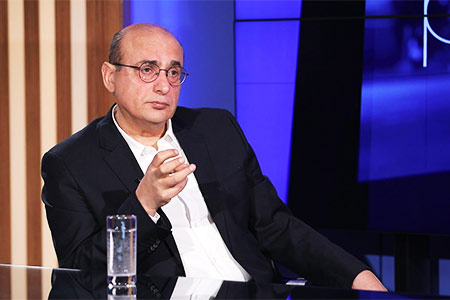
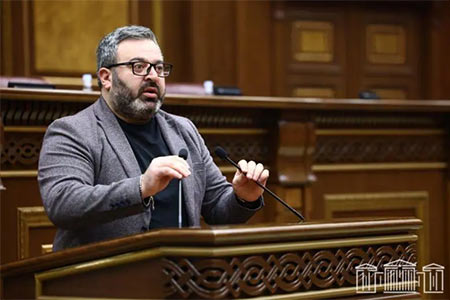
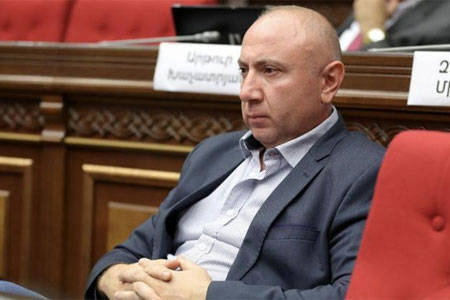
ArmInfo. The current political crisis in Armenia can be viewed not only as a struggle between the government and the opposition, but also as a clash of several successively emerging theses and antitheses. Political scientist Stepan Danielyan writes about this on his Facebook page.
As an example, he recalled how over the past 30 years, the opposition's thesis has been the fight against the "plunder of the country," while the government's thesis has been "until the Artsakh issue is resolved, the government will not change." "The synthesis of these two positions has never developed into an independent political movement. The current political crisis in Armenia can be viewed not only as a struggle between the government and the opposition, but also as a clash of several successively emerging theses and antitheses. "The problem is that Armenian politics has so far failed to transform these contradictions into a sustainable synthesis," Danielyan noted.
The political scientist recalled how, after 2018, a fundamental dichotomy emerged in the political arena: old Armenia versus new Armenia. Today, he said, an attempt is being made to transfer this logic to the dichotomy between the Third and Fourth Republics. The "old system" is presented as a system of corruption, closed elites, oligarchy, and the reproduction of power. The "new" is presented as democracy, people's power, the rule of law, and the fight against corruption. However, no true synthesis has emerged here. The new government has not created a political system that could take the effective governance mechanisms of the previous system and combine them with new democratic institutions. Moreover, within the "new" "Our own contradictions began to emerge," Danielyan noted.
One of the most difficult contradictions in modern Armenia, according to him, arose after the war: the priority of security versus the priority of peace. One side, Danielyan explained, proceeds from the thesis: "without security, peace is impossible," while the other responds: "without peace, it is impossible to ensure Armenia's security." "This is a much deeper contradiction. Because the first position assumes the priority of power and defense policies, while the second assumes the normalization of relations with Azerbaijan and Turkey and the building of a long-term peace without guarantees. But a true synthesis would not be a choice between "security" and "peace," but the creation of a peace that forms a new security system. That is, peace must become an instrument of security, and security a prerequisite for peace. "And again, there's no synthesis," the political scientist noted. Danielyan noted that another standoff has arisen in Armenia's foreign policy: Russia versus the West. According to him, one side sees Armenia within the Russian security system, while the other sees it as more closely integrated with the EU, the US, and Western security and economic systems, and in fact, with Turkey. But even here, according to the political scientist, the logic of "either-or" often applies. "Whereas a real synthesis could lie not in choosing between 'Russia or the West,' but in Armenia pursuing a sovereign foreign policy that would take from various centers of power what it needs for the country's security, economy, and sovereignty. This would be a third path—not geopolitical neutrality, but multi-vector sovereignty." But such a synthesis is significantly more complex, as it requires its own strategy, strong state institutions, and a long-term vision," the expert believes.
Danielyan noted that national memory and the new political reality are also contrasted. For example, according to him, one of the most painful contradictions in Armenian society is related to Artsakh. At one pole, as Danielyan recalled, is historical memory, national law, and the memory of the victims; at the other, is the new reality, a peace treaty, and the strengthening of Armenia's internationally recognized borders. "If politics dwells solely on the first position, it may fail to recognize the changed geopolitical reality. If it completely relies on the second position, it risks losing an important part of historical memory and the national identity of society. The synthesis should not have consisted of denying the past, but rather rethinking it. That is, not turning defeat into the basis of state identity, but also not erasing historical memory. Politically, this is much more complex than simply 'forgetting the past.'" "Or 'restore the past,'" the expert explained.
Danielyan noted that the oldest standoff in the Armenian political system continues to exist: the government versus the opposition. But here, too, as the political scientist noted, a third level is often missing. "The government says: 'We are the guarantee of stability and peace.' The opposition responds: 'It is the government that poses the main problem for the country's security and statehood.'" At the same time, both sides partially base their political existence on the existence of the other. A crucial paradox arises here: the government needs the opposition to justify and defend its own existence, while the opposition needs the government to mobilize its own supporters. In other words, the antithesis becomes the precondition for the existence of the thesis. And society remains trapped within this bipolarity. Why isn't synthesis emerging in Armenia? Because most political forces are struggling not around the question of 'how to create a new system?', but around the question of 'who should defeat the other?' "This is a fundamental difference," Danielyan explained.
Speaking about what an Armenian political synthesis could look like, the political scientist noted that several possible syntheses can be tentatively imagined. Thus, according to him, it is not a complete denial of the past or a restoration of the previous system, but an attempt to create institutional democracy; not a choice between "security or peace," but a refusal to capitulate under the guise of peace; and not endless military logic, but a strong defense, flexible diplomacy, and economic integration. "As for Russia and the West, there should be no subordination to one center or a mechanical transition under the influence of another, but a sovereign multi-vector approach. In the Artsakh issue, there should be no erasure of historical memory or a mechanical restoration of the political conditions of the past, but the preservation of memory and a new state strategy. "The government and the opposition must stop destroying each other; instead, there must be a change of power and continuity of state institutions," the expert noted.
Overall, according to Danielyan, Armenia lacks not so much another "strong leader" as a political system capable of transforming contradictions into institutional solutions. "Political maturity begins when society stops asking, 'Who is right—they or us?' and begins asking, 'How can we create a system in which parts of the truth from both sides can exist within a single political structure?'" This is synthesis. And this is precisely where Armenia's main problem lies. True synthesis is not the victory of one side over the other. Synthesis is a new system in which former adversaries cease to be adversaries and become different functions of the same system. And this is precisely the most difficult stage of politics. A thesis can overcome an antithesis. But only synthesis can overcome both of them,” Danielyan concluded.

















 Expert: Economic pressure on Armenia may be virtually painless for other EAEU members, but not for Armenia itself
 Expert on protests in France: Civilizations fade when society loses a vision of the future
 Turkologist: Azerbaijan is not all-powerful—its vulnerabilities should become part of Armenia’s security strategy
 Opinion: The development of the Amulsar mine near the resort town of Jermuk is the beginning of an environmental disaster in Armenia
 Expert: The arrest of opposition figures in Armenia for social media posts is a systematic attempt to intimidate the public and suppress dissent.
 The Armenian Foreign Minister commented on the country`s return to work within the CSTO.
 The Artsakh Public Council expressed outrage at the UN Secretary-General`s behavior
 Lukashenko called for Armenia to assume the CIS presidency in 2029
 Dmitry Medvedev predicted a Ukrainian-like fate for Armenia amid the country`s shift in foreign policy
 Russian Security Council: In Armenia, they want to force Russian asset owners to dispose of their assets
 Zakharova: Russia ready to discuss with Armenia the prospects for expanding military cooperation as part of a review of bilateral ties
 Tevanyan: Armenia, like Ukraine and Moldova, is being drawn into the EU’s global war
 Yerevan City Hall is considering introducing a valet parking system in the city
 Expert: The circus surrounding the “Albanization” of Armenian culture in the presence of foreign ambassadors in occupied Artsakh is genocide
 Political scientist: If Russian-Armenian relations are destroyed, Turkey will take Russia`s place
 Political scientist: The Armenian public is simply obliged to significantly change the entire content of public discourse and struggle
 Cross tattoos are being removed from the skin of Christian prisoners in Azerbaijan by fire, according to a human rights activist.
 Zakharova: Armenia`s likely introduction of visas with Russia will be a step against Yerevan itself
 Putin: Armenia`s recognition of Karabakh as part of Azerbaijan in Prague has given Russia`s position on this issue an ambivalent character
 Putin: Armenia`s adoption of the law on EU accession means an announcement of its withdrawal from the Eurasian Economic Union