
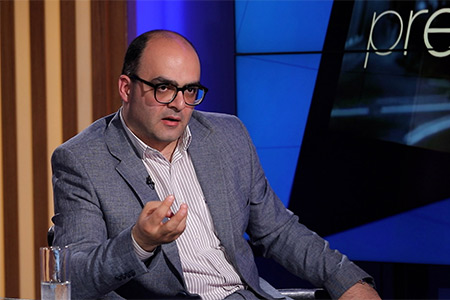
ArmInfo. The Fourth Republic doesn't begin with the arrest of Armenia's second president, leader of the opposition bloc "Armenia," Robert Kocharyan. Political scientist Vahe Davtyan writes this on his Facebook page.
"The Armenian government's Program for 2026-2031 effectively identifies the transition to the Fourth Republic as one of the goals. However, a republic is not a point in a five-year plan or a political brand for the next electoral cycle.
In a political and philosophical sense, the change in the republic's number marks a gap in the foundations of legitimacy, the structure of power, and the nature of relations between the state and society," the expert wrote on his social media.
He recalled that France's path from the First to the Fifth Republic was shaped by revolutions, wars, the collapse of political regimes, post-war reconstruction, and, finally, the profound crisis of the Fourth Republic against the backdrop of the Algerian War. The Fifth Republic emerged in 1958 not as a government programmatic mandate, but as a response to the exhaustion of the previous order.
Davtyan further noted that the Sixth Republic in South Korea was also the result not of an administrative decision, but of a mass democratic movement in 1987, which ended a period of authoritarian rule and led to constitutional reform and direct presidential elections.
The expert emphasized that in both these cases, a profound socio-political and historical transformation occurred first, and only then did a new republic emerge.
"In Armenia, the reverse sequence is being proposed: first, the Fourth Republic is proclaimed as a goal, and then it is supposed to be imbued with political and institutional content. The government can initiate reforms. It can propose a new Constitution or a model for state development. But it cannot turn the emergence of a new republic into a departmental target. Against this backdrop, the Anti-Corruption Court's decision to remand second President Robert Kocharyan for two months takes on particular symbolic significance," Davtyan believes.
He further noted that the de facto launch of the official discourse on the proclamation of the Fourth Republic coincides with the arrest of one of the key figures in the political history of the Third.
"Yes, a state governed by the rule of law does not presuppose immunity for former leaders. However, statehood can only develop within the logic of continuity, not fanatical rejection of the past and its personalized criminalization. A new republic begins not with the arrest of a former president or the rejection of the Third Republic, but with the emergence of institutions capable of accommodating the full complexity and contradictions of national history. Otherwise, we are not looking at a Fourth Republic, but at another version of the Third," Davtyan concluded.









 Expert: The arrest of opposition figures in Armenia for social media posts is a systematic attempt to intimidate the public and suppress dissent.
 Azerbaijani Studies Expert: While Azerbaijan Prepares Its Generation for War, Aliyev’s Aide Calls on Armenia to Prepare Armenian Society for “Peace”
 Turkologist: Azerbaijan will never, under any circumstances, stop pressuring the Armenian people
 Political scientist: We need to move away from the question of "when" and replace it with more important questions
 International Law Specialist: Azerbaijan intends to initiate legal proceedings against Armenia by sentencing Armenian prisoners
 Lukashenko called for Armenia to assume the CIS presidency in 2029
 Dmitry Medvedev predicted a Ukrainian-like fate for Armenia amid the country`s shift in foreign policy
 Russian Security Council: In Armenia, they want to force Russian asset owners to dispose of their assets
 Zakharova: Russia ready to discuss with Armenia the prospects for expanding military cooperation as part of a review of bilateral ties
 Tevanyan: Armenia, like Ukraine and Moldova, is being drawn into the EU’s global war
 Yerevan City Hall is considering introducing a valet parking system in the city
 Expert: The circus surrounding the “Albanization” of Armenian culture in the presence of foreign ambassadors in occupied Artsakh is genocide
 Political scientist: If Russian-Armenian relations are destroyed, Turkey will take Russia`s place
 Political scientist: The Armenian public is simply obliged to significantly change the entire content of public discourse and struggle
 Cross tattoos are being removed from the skin of Christian prisoners in Azerbaijan by fire, according to a human rights activist.
 Zakharova: Armenia`s likely introduction of visas with Russia will be a step against Yerevan itself
 Putin: Armenia`s recognition of Karabakh as part of Azerbaijan in Prague has given Russia`s position on this issue an ambivalent character
 Putin: Armenia`s adoption of the law on EU accession means an announcement of its withdrawal from the Eurasian Economic Union
 Aram Vardevanyan: Public demands solutions, not apology scandals in Parliament