

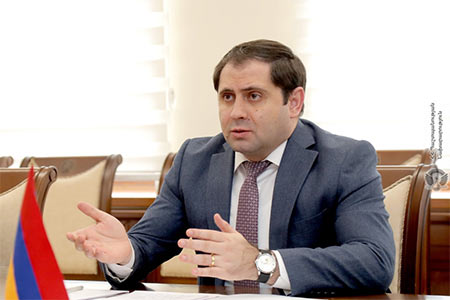
ArmInfo.Armenian Defense Minister Suren Papikyan attempted to distance himself from non-combat deaths in the country's armed forces caused by hazing, assuring that he may be at fault, but not to a significant degree.
"Regarding the intensity, I cannot say why such a high rate has been recorded in such a short period. But the fact that the Minister of Defense can be blamed for these deaths is news in the Republic of Armenia.
Why? Of course, I have always been far from looking at this issue through statistics, but the life, past, and history of the army require certain statistics," he said in a conversation with journalists when asked to comment on the increasing number of deaths in the Armenian army. According to Papikyan, throughout the history of the Republic of Armenia, throughout the history of the Armenian army, cases of murder, suicide, and hazing have always existed. In this vein, he cited statistics on suicides and murders in the country's armed forces from 2015 to 2026.
"In 2015, there were 7..., but in 2016, the number of cases sharply increased to 19, in 2017 - 13, in 2018 - 12, in 2019 - 11, in 2020 - 10, in 2021 - 10, in 2022 - 8, in 2023 - 9, in 2024 - 11, in 2025 - 2, in 2026 - 8," he stated.
The head of the Armenian Ministry of Defense acknowledged that some deaths in the armed forces are due to hazing, while others are the result of a criminal subculture. He said this is a challenge that is not his alone. Papikyan assured that a coordinated effort is needed to eradicate this problem.
Notably, while the minister was attempting to distance himself from the issue, news of another suicide in the armed forces came to light. When asked whether the minister had been informed of the death of a contract serviceman today, Papikyan denied it, promising to provide information if confirmed.
Earlier, the Vanadzor office of the Helsinki Citizens' Assembly (HCA) published a study according to which 30 deaths of military personnel were registered in the Armenian Armed Forces during the first seven months of 2026. The organization stated that 11 of these 30 were officially classified as service-related, while 19 were classified as unrelated. The HCA Vanadzor office expressed its conviction that regardless of whether a service member died while on duty, this case should be considered a loss of service, since the death of every service member must be considered in terms of the state's obligation to protect human rights. In 2026, all deaths of military personnel occurred in non-combat situations. Moreover, over the past two years and five months, no deaths in the Armed Forces have been recorded as a result of ceasefire violations; the last case was in February 2024, when four members of the Yerkrapah Volunteer Union were killed as a result of a ceasefire violation. Although no deaths resulting from ceasefire violations have been recorded since February 2024, the number of military personnel killed in action in the Armed Forces increased from 2018 to 2025 compared to 2010 to 2017.
More than a third (approximately 37%) of the 30 military personnel killed in non-combat situations in 2026 died as a result of suicide or homicide. Furthermore, 6 out of 8 suicides and 2 out of 3 homicides were related to military service.
Thus, according to research by the HCA HCAC office, 462 servicemen died in the armed forces of Armenia and Artsakh between 2010 and 2017, 163 (35%) of whom died as a result of ceasefire violations and 299 (65%) in non-combat situations. Between 2018 and 2025, 511 military personnel deaths were recorded, 84 (16%) of which were combat-related and 427 (84%) non-combat-related.
As the data shows, the number of deaths increased by approximately 11% between 2018 and 2025 compared to 2010 and 2017. Over the same period, non-combat deaths increased by 45% (49 deaths).
Regarding deaths due to suicide and homicide, it should be noted that between 2010 and 2017, 131 military personnel deaths were recorded from these causes, accounting for 45 percent of the total number of non- combat deaths.















 Expert: The arrest of opposition figures in Armenia for social media posts is a systematic attempt to intimidate the public and suppress dissent.
 Azerbaijani Studies Expert: While Azerbaijan Prepares Its Generation for War, Aliyev’s Aide Calls on Armenia to Prepare Armenian Society for “Peace”
 Turkologist: Azerbaijan will never, under any circumstances, stop pressuring the Armenian people
 Political scientist: We need to move away from the question of "when" and replace it with more important questions
 Lukashenko called for Armenia to assume the CIS presidency in 2029
 Dmitry Medvedev predicted a Ukrainian-like fate for Armenia amid the country`s shift in foreign policy
 Russian Security Council: In Armenia, they want to force Russian asset owners to dispose of their assets
 Zakharova: Russia ready to discuss with Armenia the prospects for expanding military cooperation as part of a review of bilateral ties
 Tevanyan: Armenia, like Ukraine and Moldova, is being drawn into the EU’s global war
 Yerevan City Hall is considering introducing a valet parking system in the city
 Expert: The circus surrounding the “Albanization” of Armenian culture in the presence of foreign ambassadors in occupied Artsakh is genocide
 Political scientist: If Russian-Armenian relations are destroyed, Turkey will take Russia`s place
 Political scientist: The Armenian public is simply obliged to significantly change the entire content of public discourse and struggle
 Cross tattoos are being removed from the skin of Christian prisoners in Azerbaijan by fire, according to a human rights activist.
 Zakharova: Armenia`s likely introduction of visas with Russia will be a step against Yerevan itself
 Putin: Armenia`s recognition of Karabakh as part of Azerbaijan in Prague has given Russia`s position on this issue an ambivalent character
 Putin: Armenia`s adoption of the law on EU accession means an announcement of its withdrawal from the Eurasian Economic Union