
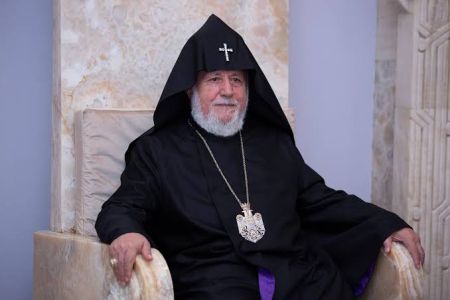
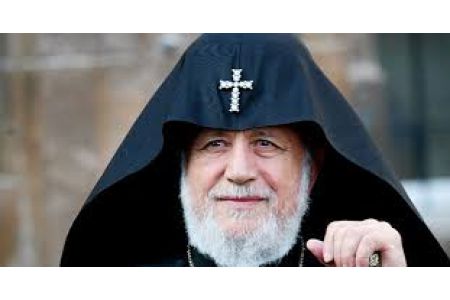
ArmInfo. The trial of Catholicos of All Armenians Karekin II calls into question the relationship between the state and the Church, which for centuries has represented one of the main forms of preserving Armenian identity. This is stated in a statement by the Forum of Armenian Associations in Europe, published in an article by the Italian website Farodi Roma.
The article notes that the statement was signed by former Slovakian Prime Minister Jan Carnogursky, former National Council Presidents Frantisek Miklosko and Pavol Hrusovsky, as well as former Deputy Prime Minister and European Commissioner Jan Figel.
The signatories of the appeal recalled their historical and personal ties to Armenia and emphasized the role of the Armenian Apostolic Church in shaping the country's national identity and preserving its spiritual heritage. Their concern is also linked to the memory of the persecution suffered by the Church in communist Europe: the experience of Czechoslovakia, they recall, was marked by the persecution and arrest of bishops and other representatives of the Catholic Church.
Former Slovak politicians emphasize that respect for pluralism, fundamental rights, justice, and democratic principles is particularly important as Armenia declares its intention to strengthen relations with the European Union and continue its path to European integration.
"In this context, it is difficult to completely separate the judicial dimension from the political one. The fact that the first trial of a Catholicos in the history of independent Armenia is beginning in the midst of an institutional crisis between the government and the Church inevitably imbues this case with enormous symbolic significance. For millions of Armenians, the Armenian Apostolic Church is, in essence, more than just a religious denomination. Its history is closely intertwined with the history of the Armenian people, with the preservation of language, culture, and national memory throughout centuries marked by invasions, persecution, deportations, and the diaspora. Etchmiadzin is not only the seat of the Catholicos: it is one of the symbolic places in Armenian history," the Slovak politicians noted in their statement.
For this reason, the signatories of the statement are convinced that the trial against Karekin II risks becoming a site of conflict over the very definition of the relationship between Church and state in modern Armenia.
"On one side is the government, which defends the state's right to enforce its judicial decisions and ensures that no institution can consider itself above the law. On the other is the Church, which defends its autonomy and interprets the judicial offensive as part of a political attempt to change leadership and limit its influence. In the middle are Armenian society and the diaspora, which is particularly sensitive to any changes in the Church's role. The most obvious risk is a new radicalization of the conflict," the statement reads.
It is noted, however, that ultimately, the real issue lies not only in the personal fate of Garegin II, but concerns the limits of political power and religious autonomy in a Republic seeking to rethink its place in the world. "If the trial ends in harsh sentences, polarization risks further deepening and fueling a crisis of trust in institutions. However, if a mediation approach prevails, the path to a new balance between state and church may open. For now, however, the signal from Etchmiadzin suggests that the conflict appears far from resolved.
And the very fact that the Catholicos of All Armenians is now appearing before the court of the Republic of Armenia represents, regardless of the outcome of the trial, a historic turning point. Because in Armenia, it's not just the court that's at stake: it's the relationship between the state authorities and the Church, which for centuries has been one of the main sources of preserving Armenian identity," reads a statement published on the Italian newspaper's website.
As a reminder, since May 2025, the Armenian authorities have launched an active anti-church policy and are seeking the resignation of Catholicos of All Armenians Garegin II, who is elected to this position for life. This campaign targets both clergy and citizens who support the Church. It should be noted that, according to the Constitution, Armenia is a secular state, with separation of church and state. The "exclusive mission" of the Armenian Apostolic Church (AAC) in preserving national identity is recognized.
Furthermore, as was reported on August 19, the issue of removing the Catholicos is included in the Pashinyan government's program for 2026-2031.








 Expert: The arrest of opposition figures in Armenia for social media posts is a systematic attempt to intimidate the public and suppress dissent.
 Azerbaijani Studies Expert: While Azerbaijan Prepares Its Generation for War, Aliyev’s Aide Calls on Armenia to Prepare Armenian Society for “Peace”
 Turkologist: Azerbaijan will never, under any circumstances, stop pressuring the Armenian people
 Political scientist: We need to move away from the question of "when" and replace it with more important questions
 International Law Specialist: Azerbaijan intends to initiate legal proceedings against Armenia by sentencing Armenian prisoners
 Lukashenko called for Armenia to assume the CIS presidency in 2029
 Dmitry Medvedev predicted a Ukrainian-like fate for Armenia amid the country`s shift in foreign policy
 Russian Security Council: In Armenia, they want to force Russian asset owners to dispose of their assets
 Zakharova: Russia ready to discuss with Armenia the prospects for expanding military cooperation as part of a review of bilateral ties
 Tevanyan: Armenia, like Ukraine and Moldova, is being drawn into the EU’s global war
 Yerevan City Hall is considering introducing a valet parking system in the city
 Expert: The circus surrounding the “Albanization” of Armenian culture in the presence of foreign ambassadors in occupied Artsakh is genocide
 Political scientist: If Russian-Armenian relations are destroyed, Turkey will take Russia`s place
 Political scientist: The Armenian public is simply obliged to significantly change the entire content of public discourse and struggle
 Cross tattoos are being removed from the skin of Christian prisoners in Azerbaijan by fire, according to a human rights activist.
 Zakharova: Armenia`s likely introduction of visas with Russia will be a step against Yerevan itself
 Putin: Armenia`s recognition of Karabakh as part of Azerbaijan in Prague has given Russia`s position on this issue an ambivalent character
 Putin: Armenia`s adoption of the law on EU accession means an announcement of its withdrawal from the Eurasian Economic Union