


ArmInfo. The Council of the National Democratic Pole (NDP) condemned and called unconstitutional Armenian Prime Minister Nikol Pashinyan's statements about the village of Tigranashen in the Ararat region and the so-called two "enclaves" in Tavush belonging to Azerbaijan.
According to a report received by ArmInfo, the NDP Council called this statement unprecedented, legally unfounded, unconstitutional, and extremely dangerous from a national security perspective. "The People's Democratic Party Council strongly condemns the statement made by Pashinyan, the self-proclaimed leader who seized power on June 7, which describes the village of Tigranashen, covering approximately 8.4 square kilometers, as being located outside the country's territory. The Council equally categorically rejects the possibility of transferring the so-called two 'enclaves' in the Tavush region, covering a total of approximately 35 square kilometers, without public proof of Azerbaijan's indisputable legal right to these territories and without the will of the Armenian people, expressed in accordance with the Constitution," the statement reads.
The People's Democratic Party noted that this statement lacks any valid legal, historical, or documentary basis presented to the public and creates a dangerous precedent for the unilateral alienation of the Republic's territory. In this regard, the Council recalled that Article 205 of the Armenian Constitution clearly states that issues concerning territorial changes in the country are resolved exclusively through a referendum.
"Therefore, no official, including the Prime Minister, has the right to declare any settlement or territory outside the Republic by personal statement, political agreement, or reference to a map that has no legal force.
The territory of Armenia is not subject to executive authority. It belongs to the people of Armenia and can be changed solely by the will of the people, expressed in the manner prescribed by the Constitution. If statements about Tigranashen or the two so-called "enclaves" of Tavush being outside the territory of Armenia escalate into decisions or actions aimed at the de facto alienation of these territories, they must be assessed under constitutional and criminal law within the framework of the Republic's legislation on the protection of state sovereignty, territorial integrity, and national security," the PDP emphasized.
The Council further recalled the strategic importance of Tigranashen, noting that it is not an ordinary border settlement. "It is located on the M-2 interstate highway, which is vital for the Republic. This highway connects the mainland of Armenia with the Vayots Dzor and Syunik regions, as well as with Iran. Establishing Azerbaijani control over Tigranashen and the adjacent section of the highway would profoundly and irreversibly threaten: secure and uninterrupted communication between the mainland of Armenia and the Vayots Dzor and Syunik regions; Armenia's transport links with Iran; Armenia's foreign trade and transit capabilities; the country's military, economic, and energy security; and Armenia's future as a sovereign transit state," the PDP noted.
In this regard, the Council called it unacceptable to transfer any section of Armenia's strategic highway to the control of a state that has pursued a hostile policy toward the Republic for decades, or to subject the country's internal communications to the arbitrary decisions of that state. The PDP also noted that the importance of Tigranashen will further increase after the full launch of the India-Iran-Armenia-Georgia- Black Sea-Europe international transport route. "The implementation of this project has the potential to transform Armenia into a vital transit hub connecting the Indian Ocean and the Persian Gulf with the Black Sea and Europe. Armenia's loss of sovereignty over Tigranashen will jeopardize not only the country's internal communications but also the security, continuity, and reliability of this strategically important international route," the PDP Council explained.
The political party also presented the consequences of transferring Armenian territories in Tavush. Specifically, it is noted that establishing Azerbaijani control over these areas deep in Armenia's northeastern region would create pockets of foreign control, disrupt or permanently threaten Armenia- Georgia interstate and intercommunal roads, access to agricultural pastures, and disrupt the normal life of border settlements.
"Such a decision could: jeopardize the security of Voskepar, Kirants, Baganis, and adjacent communities, the freedom of movement of residents, and the ability to use their property. Furthermore, it could provide Azerbaijan with new military and observation posts within or near Armenian territory; make communications in northeastern Armenia and the vital road link to Georgia vulnerable; and increase the risk of blockades, road closures, forced displacement of the population, and the advancement of new territorial demands," the PDP concluded.
Let us recall that at a briefing on August 20, Pashinyan stated that Artsvashen is the territory of Armenia, while Tigranashen (which the Armenian prime minister called by its Azerbaijani name, Kyarki - ed.), Barkhudarlu, Sofulu, and Upper Voskepar (in relation to the latter, Pashinyan again used the Azerbaijani name, Yukhari-Askipara - ed.) are not.













 Expert: The arrest of opposition figures in Armenia for social media posts is a systematic attempt to intimidate the public and suppress dissent.
 Azerbaijani Studies Expert: While Azerbaijan Prepares Its Generation for War, Aliyev’s Aide Calls on Armenia to Prepare Armenian Society for “Peace”
 Turkologist: Azerbaijan will never, under any circumstances, stop pressuring the Armenian people
 Political scientist: We need to move away from the question of "when" and replace it with more important questions
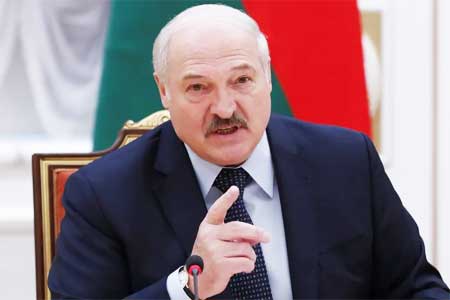 Lukashenko called for Armenia to assume the CIS presidency in 2029
 Dmitry Medvedev predicted a Ukrainian-like fate for Armenia amid the country`s shift in foreign policy
 Russian Security Council: In Armenia, they want to force Russian asset owners to dispose of their assets
 Zakharova: Russia ready to discuss with Armenia the prospects for expanding military cooperation as part of a review of bilateral ties
 Tevanyan: Armenia, like Ukraine and Moldova, is being drawn into the EU’s global war
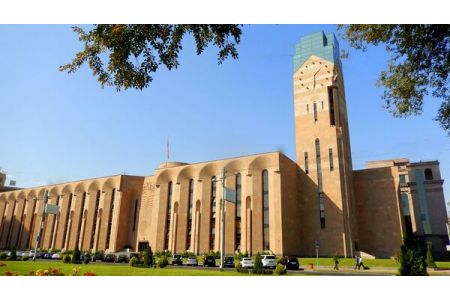 Yerevan City Hall is considering introducing a valet parking system in the city
 Expert: The circus surrounding the “Albanization” of Armenian culture in the presence of foreign ambassadors in occupied Artsakh is genocide
 Political scientist: If Russian-Armenian relations are destroyed, Turkey will take Russia`s place
 Political scientist: The Armenian public is simply obliged to significantly change the entire content of public discourse and struggle
 Cross tattoos are being removed from the skin of Christian prisoners in Azerbaijan by fire, according to a human rights activist.
 Zakharova: Armenia`s likely introduction of visas with Russia will be a step against Yerevan itself
 Putin: Armenia`s recognition of Karabakh as part of Azerbaijan in Prague has given Russia`s position on this issue an ambivalent character
 Putin: Armenia`s adoption of the law on EU accession means an announcement of its withdrawal from the Eurasian Economic Union