

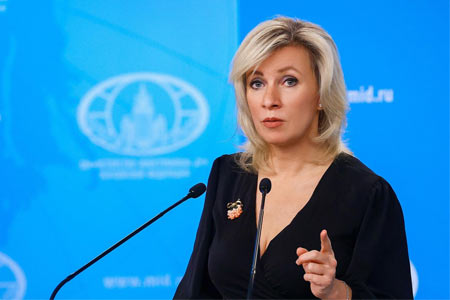
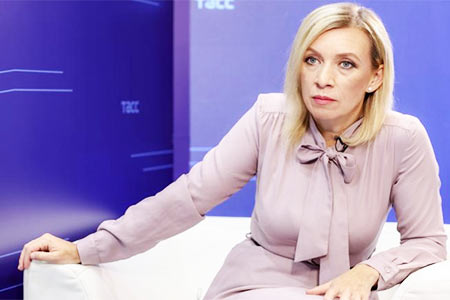
ArmInfo. The Metsamor Nuclear Power Plant (NPP) has a solid safety margin-its reactor is specially adapted to the region's high seismic activity. This was stated by Russian Foreign Ministry spokesperson Maria Zakharova, addressing claims that the Metsamor NPP in Armenia poses a security threat to the region.
The Russian diplomat noted that Moscow has taken note of statements in the foreign press regarding the safety of the nuclear power plant operating in Armenia. She added that, among other things, it has been claimed that it operates using outdated technology, poses a danger to the entire region, and should be shut down. "This is not the first time we've heard such baseless statements. It's also telling that the arguments of those making these politically charged assessments remain unchanged. Nothing of the sort has been made about some European countries that operate nuclear power plants using similar technologies.
As is well known, the Metsamor Nuclear Power Plant has a substantial safety margin-its reactor is specially adapted to the region's high seismic activity. Its reliability is demonstrated by the normal operation of its safety systems during the devastating Spitak earthquake," Zakharova noted.
The diplomat recalled that, after necessary repairs, the nuclear power plant was recommissioned in 1995. She added that Russian and Armenian specialists are currently implementing a series of measures to extend the plant's service life again until 2036.
The Russian Foreign Ministry representative emphasized that the IAEA has also confirmed the plant's reliability. The Agency's Director General, Rafael Grossi, who visited the station in October 2022, acknowledged that all measures have been taken to enhance nuclear and physical safety.
"Today, the Metsamor nuclear power plant plays a key role in the republic's energy balance, generating approximately 30% of its electricity. Stable generation of affordable electricity has allowed Armenia to develop its industry and ensure technological progress for many years," she noted.
According to Zakharova, in the modern world-especially given the unsuccessful experience of several European countries in transitioning to renewable energy sources-the peaceful use of nuclear energy is a key factor in ensuring sovereignty and energy security.
"The closure of our own nuclear power plant will lead to nothing but increased dependence on other countries for energy. One cannot help but wonder: why do international players, who are developing their own nuclear energy or have no serious problems with their own electricity supply, periodically oppose the Russian-Armenian nuclear project? We perceive such allegations as attempts to sow discord in Russian- Armenian cooperation in this sector and hinder the development of initiatives involving Russia. Furthermore, they appear to facilitate the advancement of Western projects and technologies that are truly destructive for the region, and which are significantly inferior to Russian ones, including in terms of safety," the diplomat concluded.
As a reminder, Armenian Prime Minister Nikol Pashinyan previously stated that there are opportunities to extend the life of Unit 2 of the Armenian Nuclear Power Plant for another 10 years beyond 2036. He noted that the plant is currently in the process of extending the life of Unit 2 until 2036. With another 10 years, the unit will be able to operate until 2046. A decision on a new plant must be made during this period. Nuclear reactor models proposed by Russia, the United States, France, China, and South Korea are being studied. "We are conducting transparent negotiations with all partners. Our decision, which will be strategic in nature, must be based on the most advantageous offer that meets the interests of the republic," the head of government said.
He emphasized the importance of conducting research into the international nuclear technology market. Pashinyan noted that the current tariff for electricity generated at the Armenian Nuclear Power Plant is the lowest in the country. However, as the prime minister noted, the world's current nuclear fuel reserves are sufficient for 70 years. For this reason, it is crucial to know the cost of 1 kWh of electricity in 40 years. This raises the question of economic feasibility and the potential for recouping investment. However, as the Prime Minister noted, there is already experience with re-enriching used fuel. In any case, Pashinyan emphasized, the issue must be addressed at cost.
Since May of this year, the Armenian Nuclear Power Plant has been shut down for a five-month scheduled maintenance. During this period, the main work will be carried out under the second life extension program for Unit 2 of the Armenian Nuclear Power Plant. $165 million saved from the first extension program will be used to address this issue. Previously, the country's authorities announced the adoption of a conceptual decision to build a nuclear power plant with small modular reactors.








 Expert: The arrest of opposition figures in Armenia for social media posts is a systematic attempt to intimidate the public and suppress dissent.
 Azerbaijani Studies Expert: While Azerbaijan Prepares Its Generation for War, Aliyev’s Aide Calls on Armenia to Prepare Armenian Society for “Peace”
 Turkologist: Azerbaijan will never, under any circumstances, stop pressuring the Armenian people
 Political scientist: We need to move away from the question of "when" and replace it with more important questions
 International Law Specialist: Azerbaijan intends to initiate legal proceedings against Armenia by sentencing Armenian prisoners
 Lukashenko called for Armenia to assume the CIS presidency in 2029
 Dmitry Medvedev predicted a Ukrainian-like fate for Armenia amid the country`s shift in foreign policy
 Russian Security Council: In Armenia, they want to force Russian asset owners to dispose of their assets
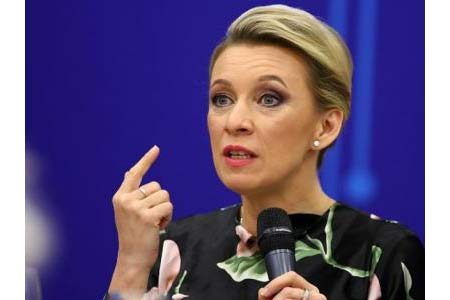 Zakharova: Russia ready to discuss with Armenia the prospects for expanding military cooperation as part of a review of bilateral ties
 Tevanyan: Armenia, like Ukraine and Moldova, is being drawn into the EU’s global war
 Yerevan City Hall is considering introducing a valet parking system in the city
 Expert: The circus surrounding the “Albanization” of Armenian culture in the presence of foreign ambassadors in occupied Artsakh is genocide
 Political scientist: If Russian-Armenian relations are destroyed, Turkey will take Russia`s place
 Political scientist: The Armenian public is simply obliged to significantly change the entire content of public discourse and struggle
 Cross tattoos are being removed from the skin of Christian prisoners in Azerbaijan by fire, according to a human rights activist.
 Zakharova: Armenia`s likely introduction of visas with Russia will be a step against Yerevan itself
 Putin: Armenia`s recognition of Karabakh as part of Azerbaijan in Prague has given Russia`s position on this issue an ambivalent character
 Putin: Armenia`s adoption of the law on EU accession means an announcement of its withdrawal from the Eurasian Economic Union
 Aram Vardevanyan: Public demands solutions, not apology scandals in Parliament