
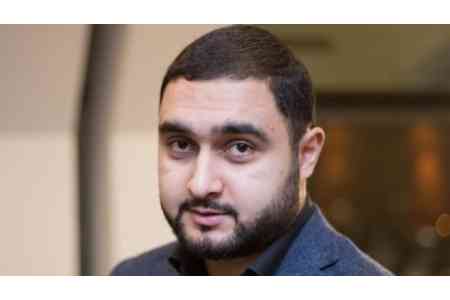
ArmInfo. According to analyst Tigran Dumikyan, if tensions in Armenian-Russian relations persist or deepen, the possibility of tightening customs controls, introducing additional trade restrictions, or revising energy pricing policies cannot be theoretically ruled out. Referring to the recent phone conversation between the leaders of Armenia and Russia, the analyst stated that developments in Armenian-Russian relations in recent weeks indicate the emergence of a qualitatively new situation in bilateral relations.
" Official Moscow now demands a more open and targeted clarification of its foreign policy stance from Armenia. Concurrently, the practical application of the benefits previously available to Armenia within the framework of the single EAEU market is being restricted," the expert believes.
According to him, the problem lies in the fact that in the emerging new geopolitical realities, the South Caucasus has become an important platform for global competition, where the strategic interests of Russia, the West, Turkey, Iran, and other players intersect.
"For Russia, the region continues to be a vital security zone, while Western countries are constantly striving to increase their political, economic, and military presence in the region. In this context, the 'Middle Corridor' initiative, in which the collective West is showing growing interest, is of particular importance. The project is viewed not only as an alternative logistics route connecting Europe and Asia, but also as a strategic instrument to reduce the transit influence of Russia and, to some extent, Iran. Western political circles have repeatedly stated that Russia's military-political presence in the region remains one of the main limiting factors for the full implementation of this initiative," Dumikyan recalled.
He noted that, as a rule, such political statements are accompanied by closed diplomatic negotiations and practical steps that are not fully disclosed in the public sphere but can have a significant impact on the regional balance of power. The analyst is confident that in such a situation, it is important to evaluate not only public statements but also the political decisions and negotiating processes that could form the basis of official Moscow's current harsh response.
Dumikyan believes that, regardless of the content of these processes, the high degree of economic vulnerability remains a key problem for Armenia. At the same time, the expert added, restrictions that have arisen in the export sector of Armenian products in recent months have already led to significant economic losses, negatively affecting both the operations of manufacturing and exporting companies and state budget tax revenues. The analyst noted that the sphere of strategic imports remains the most sensitive. He pointed out that, according to official data for 2025 alone, about 99% of wheat and approximately 85% of natural and liquefied gas are imported into Armenia from the Russian Federation. Thus, he continued, even a limited set of economic pressure instruments could have a substantial impact on Armenia's domestic market.
"Therefore, if tensions in Armenian-Russian relations persist or deepen, the possibility of tightening customs controls, introducing additional trade restrictions, or revising energy pricing policies cannot be theoretically ruled out. Although the implementation of such scenarios depends on numerous political and economic factors, their likelihood cannot be ignored from an economic security perspective. Under these circumstances, the Armenian authorities have virtually no room for maneuver, so it is necessary to make prompt and effective decisions to mitigate potential political and economic risks," Dumikyan believes.
Otherwise, the analyst is confident that the main socioeconomic consequences of the geopolitical standoff will fall on the shoulders of ordinary Armenian citizens in the form of a significant decline in living standards, increased food security risks, increased inflationary pressure, and rising utility costs.
Recall, on July 27, during a phone conversation with Russian President Vladimir Putin, Armenian Prime Minister Nikol Pashinyan emphasized that restrictions on the export of goods of Armenian origin to the Russian market contradict the Armenian-Russian legal framework and the provisions of the Eurasian Economic Union (EAEU). Pashinyan called for measures to address these issues. Regarding the referendum on Armenia's accession to the European Union, as stated in the joint statement of the leaders of the four EAEU member states adopted on May 29 of this year, Pashinyan emphasized that holding a referendum is only feasible after Armenia submits an official application for EU membership and makes this issue substantive. At the same time, Pashinyan emphasized the Armenian government's readiness to resolve the aforementioned issues through an open, partnership-based, and friendly dialogue.










 Expert: The arrest of opposition figures in Armenia for social media posts is a systematic attempt to intimidate the public and suppress dissent.
 Azerbaijani Studies Expert: While Azerbaijan Prepares Its Generation for War, Aliyev’s Aide Calls on Armenia to Prepare Armenian Society for “Peace”
 Turkologist: Azerbaijan will never, under any circumstances, stop pressuring the Armenian people
 Political scientist: We need to move away from the question of "when" and replace it with more important questions
 International Law Specialist: Azerbaijan intends to initiate legal proceedings against Armenia by sentencing Armenian prisoners
 Dmitry Medvedev predicted a Ukrainian-like fate for Armenia amid the country`s shift in foreign policy
 Russian Security Council: In Armenia, they want to force Russian asset owners to dispose of their assets
 Zakharova: Russia ready to discuss with Armenia the prospects for expanding military cooperation as part of a review of bilateral ties
 Tevanyan: Armenia, like Ukraine and Moldova, is being drawn into the EU’s global war
 Yerevan City Hall is considering introducing a valet parking system in the city
 Expert: The circus surrounding the “Albanization” of Armenian culture in the presence of foreign ambassadors in occupied Artsakh is genocide
 Political scientist: If Russian-Armenian relations are destroyed, Turkey will take Russia`s place
 Political scientist: The Armenian public is simply obliged to significantly change the entire content of public discourse and struggle
 Cross tattoos are being removed from the skin of Christian prisoners in Azerbaijan by fire, according to a human rights activist.
 Zakharova: Armenia`s likely introduction of visas with Russia will be a step against Yerevan itself
 Putin: Armenia`s recognition of Karabakh as part of Azerbaijan in Prague has given Russia`s position on this issue an ambivalent character
 Putin: Armenia`s adoption of the law on EU accession means an announcement of its withdrawal from the Eurasian Economic Union