
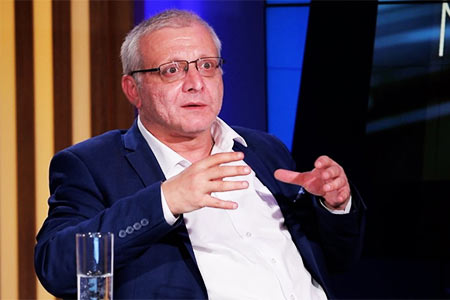
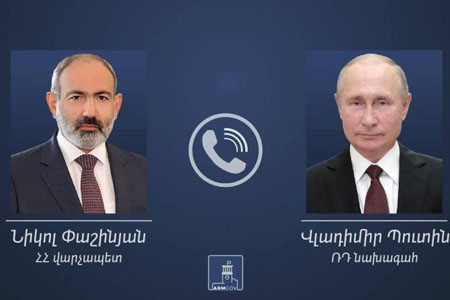
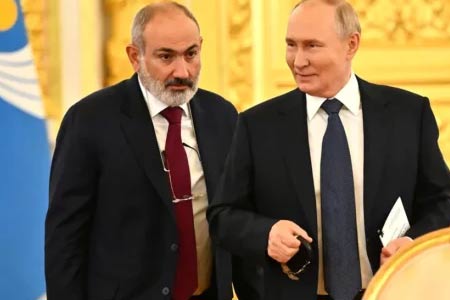
ArmInfo. The recent phone call between Armenian Prime Minister Nikol Pashinyan and Russian President Vladimir Putin did not signal a resolution to the ongoing crisis in Armenian-Russian relations, but rather confirmed that the strategic differences between the parties continue to deepen. That assessment was shared on Facebook by Suren Surenyants, a political scientist and leader of the Democratic Alternative party.
Surenyants noted that the conversation, initiated by Pashinyan on July 27, marked their first official contact since the June parliamentary elections. According to the analyst, the timing was politically significant, coming amid heightened bilateral tensions and economic pressures stemming from Russian restrictions on Armenian exports.
"It is noteworthy that the conversation with Putin was preceded by telephone calls between Pashinyan and German Chancellor Friedrich Merz (July 22) and French President Emmanuel Macron (July 25). Since contacts with European partners apparently failed to yield results that could mitigate restrictions on the Russian market, turning to Moscow became less of a political choice and more of an objective necessity," the politician believes.
Surenyants recalled that, according to official Yerevan, Pashinyan raised the issue of restrictions on the export of goods of Armenian origin, emphasizing that they contradict both the Armenian-Russian legal framework and the principles of the Eurasian Economic Union (EAEU), and asked for measures to resolve the issue. However, as the political scientist noted, the Kremlin's official statement reveals a completely different set of priorities. "The Russian side once again placed the issue of Armenia's European integration on the agenda. Putin reaffirmed the logic of the joint statement adopted on May 29 in Astana by the leaders of four EAEU member states (Belarus, Kazakhstan, Kyrgyzstan, and Russia) and emphasized the need to hold a national referendum in Armenia as soon as possible to determine the country's strategic course: the European Union (EU) or continued participation in the EAEU. In response, Pashinyan effectively acknowledged that the EU accession process is not yet in the practical stage, noting that holding a referendum will only be possible if Armenia officially applies for EU membership," Sureniants noted.
However, as the politician noted, even this cautious stance has not yielded any tangible results. According to him, no announcements regarding the lifting or easing of export restrictions have been made since the telephone conversation. "Furthermore, the Kremlin's statement didn't even mention economic issues, clearly demonstrating Moscow's priorities. Another noteworthy circumstance is that this is yet another instance of Putin not congratulating Pashinyan on his victory in the parliamentary elections. In interstate relations, such silence is rarely accidental and, as a rule, contains a political signal," the politician explained.
According to Surenyants, the content of the telephone conversation clearly followed the political logic of the April 1 meeting between Pashinyan and Putin, as well as the statement made in Astana. That is, as the political scientist clarified, Moscow no longer intends to tolerate Yerevan's policy of "sitting on two chairs." "Furthermore, the joint statement adopted in Astana stipulates that by December 2026, the EAEU Intergovernmental Council must submit a report on the possible consequences of suspending the application of the EAEU Treaty with respect to Armenia. This is no longer a warning, but a process with specific deadlines. Thus, the telephone conversation between Pashinyan and Putin did not mark the beginning of overcoming the crisis in Armenian-Russian relations. On the contrary, it confirmed that the strategic differences between the parties continue to deepen, and economic problems have already become one of the most noticeable manifestations of this crisis," Surenyants noted. That is, as the politician noted, Moscow is clearly not prepared to be guided by Yerevan's economic difficulties or its political clarifications. "Russia continues to expect from Armenia not assurances, but a clear and final strategic choice. 'Moscow does not believe in tears.' This phrase most accurately characterizes the political content of the Pashinyan-Putin phone call," Surenyants concluded.













 To overcome risks Armenia must reduce domestic escalation - expert
  Armenia and France discuss further development of strategic partnership and EU cooperation
  Zatulin: Pashinyan was eager to get back to Russia because he actually lost the elections
 Human rights activist Ruben Melikyan dismissed from YSU
 Pashinyan removed from INNOPROM guest list
 Zakharova: Armenia`s pro-EU pivot poses economic security risks to EAEU member states
 It`s time for South Caucasus countries to think of South Caucasus as single, unified region - RA premier
  Pashinyan: Armenia and Azerbaijan should leave each other alone
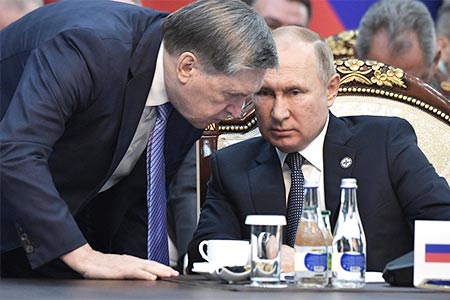 Moscow sees situation with Armenia as attempt to attack Russia-involving integration associations - Russian presidential aid
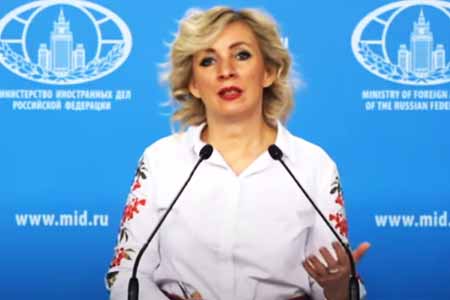 Zakharova: Armenia views relations with Russia as tool for financially securing reorientation toward EU
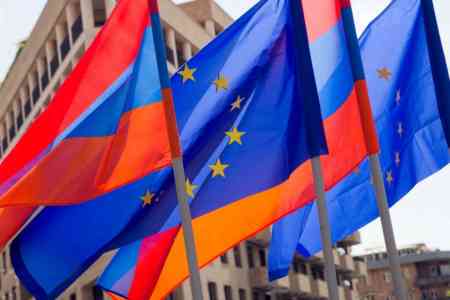 The Armenian Minister of Justice and the EU Ambassador discussed visa liberalization issues for Yerevan.
 Azerbaijan`s aggressive plans against Armenia became possible in wake of Pashinyan`s decisions on Artsakh - expert
 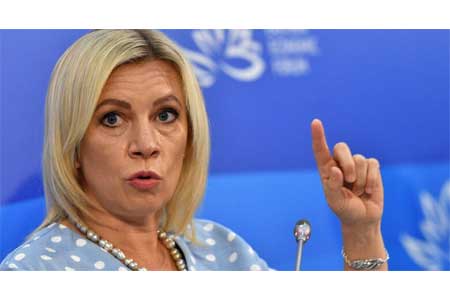 Zakharova: Russia sent a note of protest to Armenia over the act of vandalism at the "Mother Armenia" memorial in Gyumri
