

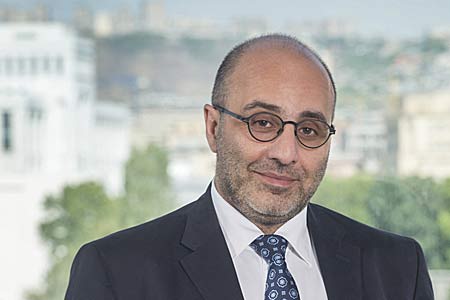
ArmInfo. In their prime working years (30-35), women perform 4-5 times more unpaid work than men. This was reported by Tigran Jrbashyan, Partner. Head of Management Advisory Service at America Advisory, while presenting the results of the "National Transfer Accounts of Armenia" study, conducted with the support of UNFPA (UK contribution).
According to Jrbashyan, women in this age bracket spend 47–49 hours per week on unpaid labor— including housework, childcare, and caring for elderly family members—compared to only 8–11 hours for men. On average, women dedicate 15.3 hours per week to household chores and another 6.8 hours to caring for children or elderly relatives. Figures for men are significantly lower: 3.6 hours per week on housework and 2.2 hours on caregiving.
Figures for men are significantly lower: 3.6 hours per week on housework and 2.2 hours on caregiving. "Children are the primary source of unpaid work, and as a rule, the main burden of caring for them falls on women," the expert emphasized. According to the study's estimates, when unpaid labor is expressed in monetary terms, women account for about 78% of its total value, compared to only 11% for men. "We are dealing with a massive sector of the economy. When we try to estimate its scale, we realize that no industry, service sector, or agriculture compares to it," Jrbashyan noted, adding that the share of unpaid labor in the economy can range from 16% to 30%. He pointed out that a significant volume of created value-added essentially remains invisible. In our view, the time has come to understand that the largest contribution to value creation is made precisely by unpaid work, which is mostly performed by women," he said. At the same time, Jrbashyan noted that women in Armenian society are more productive because they are better educated, particularly in professional fields.
He noted that the higher a country's level of development, the smaller the gap between men and women in the distribution of unpaid labor. He cited Scandinavian countries as an example, where, despite a more balanced division of responsibilities, women still perform the majority of such work. "Given Armenia's aging population, we are essentially indulging in the luxury of having such a situation," the expert warned.
Lusine Sargsyan, Head of the UN Population Fund (UNFPA) Office in Armenia, noted that the country's youth population has decreased by 25% over the past decade. According to Sargsyan, the current situation requires systemic rather than piecemeal solutions involving all stakeholders. First and foremost, she noted, this concerns employers, who must recognize their role in demographic processes.
"Employers must understand the importance of their role not only as consumers, but also as businesses, which may face labor shortages in the future due to the worsening demographic situation. At the same time, it is necessary to help employers become more family-oriented without harming their business. A balanced approach is needed on both sides. International experience shows that companies that take into account the family needs of their employees ultimately generate higher profits, as employees stay with such organizations longer, and employers do not have to constantly search for new personnel and incur additional training costs," Sargsyan emphasized.



























 Azerbaijani studies expert : Ruben Vardanyan’s wife threatened with arrest if she visits Baku
 Political scientist: The model of allied relations between Russia and Armenia has collapsed
 Expert: The defeated authorities` position on normalizing relations with the enemy should not affect the rights of Artsakh refugees
 Political scientist: If Russian-Armenian relations are destroyed, Turkey will take Russia`s place
 Political scientist: The Armenian public is simply obliged to significantly change the entire content of public discourse and struggle
 Cross tattoos are being removed from the skin of Christian prisoners in Azerbaijan by fire, according to a human rights activist.
 Zakharova: Armenia`s likely introduction of visas with Russia will be a step against Yerevan itself
 Putin: Armenia`s recognition of Karabakh as part of Azerbaijan in Prague has given Russia`s position on this issue an ambivalent character
 Putin: Armenia`s adoption of the law on EU accession means an announcement of its withdrawal from the Eurasian Economic Union
 Medvedev: Yerevan will never become an EU member, but it will permanently damage relations with the Eurasian Economic Union, including with Moscow.
 Aram Vardevanyan: Public demands solutions, not apology scandals in Parliament
 Arrested Armenian oligarch on economy and new jobs
  "In Baku, we gave a worthy rebuff to the false claims regarding the past and present of our people" – Former Artsakh Parliament Speaker from Baku captivity
  NA Vice Speaker candidate believes his wife`s salary as director of HayPost is the lowest in the company`s history
 RF Permanent Representative: There is no CSTO-Armenia conflict
 Moscow: NATO seeking to "Pull" Armenia away from CSTO Allies
  Political analyst: Russia intends to determine which "Camp" Armenia will choose through a referendum
 Narek Karapetyan will give up his parliamentary salary in favor of charitable contributions.