

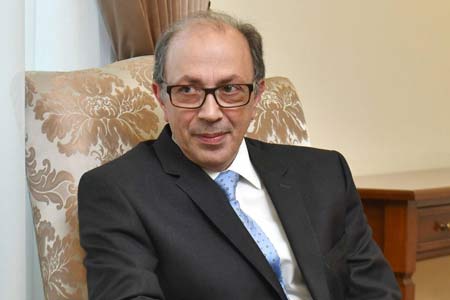
ArmInfo. Armenia's participation in the creation of the future security architecture is no longer a diplomatic choice, but a strategic necessity. This is stated in an article by former Armenian Foreign Minister and founding member of the Pan-Armenian Council of Diplomats, Ara Ayvazyan.
He noted that there are periods in the history of states when challenges do not arise in isolation, but form a unified crisis environment. In such moments, he argues, it is not enough to respond to individual threats; it is necessary to rethink the country's place in a changing world, define national interests, and develop a long-term development strategy. Ayvazyan believes that Armenia finds itself in precisely such a situation today. "Domestic political polarization, the changing regional balance of power, and the profound transformation of the international order are no longer independent processes. They mutually reinforce each other and determine the state's ability to maintain stability and agency," explained the former Armenian Foreign Minister.
According to him, the country currently faces three interrelated strategic crises: domestic stability, regional security, and global order. The domestic crisis in Armenia, as the founding member of the Pan-Armenian Council of Diplomats noted, has not yet escalated into open civil confrontation, but the level of political polarization poses serious risks to the state's stability. In this regard, he recalled that a democratic society presupposes competition between different points of view. According to him, the problem arises when minimal consensus on issues beyond the current political struggle-security, foreign policy priorities, the development of state institutions, and the future of the state-disappears. "The current stage is characterized not only by political confrontation. Following the fundamental changes in regional reality that have occurred in recent years, our society lacks a unified vision for the country's long-term development strategy. If political competition turns into a struggle to eliminate the opponent, the state gradually loses the ability to make strategic decisions. Amid a deteriorating socioeconomic situation, declining trust in state institutions, and growing public discontent, the internal crisis could deepen, posing a threat to social stability," Ayvazyan believes.
In this regard, he urged considering internal consolidation as a key component of national security. Thus, according to him, Armenia needs to restore a minimum national consensus on fundamental issues: preserving independence, ensuring security, strengthening state institutions, and creating conditions for long-term development. Because, as the former Foreign Minister noted, without internal stability, it is impossible to formulate an effective foreign strategy.
Speaking about the crisis of the regional order, the diplomat stated that the South Caucasus is not experiencing another stage of political change, but a transitional period for the formation of a new regional order. According to Ayvazyan, not only the balance of military and political forces is changing, but also the very principles of organizing regional security. "While until recently the focus was on resolving individual conflicts, today a new system of regional relations is emerging that will determine the fate of the South Caucasus for decades to come," the former minister believes.
Thus, according to him, Azerbaijan is seeking to consolidate the results of recent years, transforming its military advantage into long-term political influence and a new regional reality. That is, as the founding member of the Pan-Armenian Council of Diplomats explained, it is no longer so much a question of ending one conflict, but rather of forming a new regional hierarchy. "For Turkey, these processes are opening up exceptional opportunities to implement the centuries-old strategy of Great Turan by asserting its influence in the South Caucasus. At the same time, the ongoing changes are affecting the interests of other key players in the region. For Russia, the South Caucasus continues to be part of a strategic security space, where changing regional balances directly impact its position in the broader Eurasian context. For Iran, maintaining strategic stability along its northern borders and preventing the formation of a regional configuration that could upset the existing balance of interests is of fundamental importance," Ayvazyan noted. Thus, according to him, this is no longer just a bilateral Armenian-Azerbaijani standoff, but the formation of a new regional system in which the interests of all major participants are intertwined. This is precisely why, as the former minister noted, the stability of the future order cannot be ensured solely by the advantage of one side or the logic of military-political dominance.
"The main question for the future of the South Caucasus is not only which state will wield greater influence, but also the principles on which the new regional order will be built. Will it be based solely on competition for dominance or on institutional mechanisms that ensure predictability, mutual security, and consideration of the legitimate interests of all states in the region," Ayvazyan explained.
Armenia's task in this situation, he said, is not only to protect its own sovereignty and national interests, but also to become an active participant in the process of shaping the rules of future regional interaction, so as not to be dictated to.
"That's why Armenia's participation in the creation of the future security architecture is no longer a diplomatic choice, but a strategic necessity. At the same time, the logic of these processes cannot be understood by viewing the South Caucasus solely as an independent region. The order emerging here is part of a larger transformation of the international system, the center of which is increasingly shifting to Eurasia," explained the founding member of the Pan-Armenian Council of Diplomats.
Speaking about the global crisis, he noted that events in the South Caucasus should be viewed in a broader Eurasian context. Because, as Ayvazyan explained, the formation of a new world order is gradually turning the region into a key hub of rivalry between major centers of power. Thus, according to him, in the new situation, the South Caucasus ceases to be a periphery of global politics and becomes one of the main epicenters of the emerging geopolitical confrontation.
"The processes unfolding in the South Caucasus are becoming part of a broader global rivalry, where the interests of Russia, Turkey, Iran, the United States, the European Union, the United Kingdom, China, India, the Persian Gulf states, and Israel intersect. However, the transformation of the region into a platform for great power rivalry does not mean that the states located here will inevitably become passive observers and objects. The ability of small states to remain independent actors in international relations is determined not only by external circumstances but also by the quality of their own strategies," Ayvazyan believes.
The former minister believes that the response to the three strategic crises cannot be limited to isolated measures. As Ayvazyan noted, internal stability, regional security, and international agency are interconnected elements of a unified state strategy. The former minister believes that national consolidation should form the foundation of such a strategy. He believes that it is on this foundation that national interests can be clearly articulated, as in modern conditions, they are not limited to the formal preservation of state sovereignty. National interests, as Ayvazyan explained, include the state's ability to ensure the security of its citizens, protect national identity, develop human capital, maintain demographic stability, and maintain political agency, which must be expressed through strengthening strategic autonomy.
He identified the creation of a strategic planning system with permanent mechanisms for analyzing, forecasting, and assessing long-term development scenarios as the next link in this logic.
According to him, the history of international relations has repeatedly shown that periods of global order transition have become the most severe trials for medium and small states. However, it was precisely during such periods, Ayvazyan believes, that the quality of state institutions, strategic thinking, and society's capacity for consolidation determined whether they would retain their agency or become the objects of decisions made by others.

















 Expert: Economic pressure on Armenia may be virtually painless for other EAEU members, but not for Armenia itself
 Expert on protests in France: Civilizations fade when society loses a vision of the future
 Turkologist: Azerbaijan is not all-powerful—its vulnerabilities should become part of Armenia’s security strategy
 Opinion: The development of the Amulsar mine near the resort town of Jermuk is the beginning of an environmental disaster in Armenia
 Expert: The arrest of opposition figures in Armenia for social media posts is a systematic attempt to intimidate the public and suppress dissent.
 The Artsakh Public Council expressed outrage at the UN Secretary-General`s behavior
 Lukashenko called for Armenia to assume the CIS presidency in 2029
 Dmitry Medvedev predicted a Ukrainian-like fate for Armenia amid the country`s shift in foreign policy
 Russian Security Council: In Armenia, they want to force Russian asset owners to dispose of their assets
 Zakharova: Russia ready to discuss with Armenia the prospects for expanding military cooperation as part of a review of bilateral ties
 Tevanyan: Armenia, like Ukraine and Moldova, is being drawn into the EU’s global war
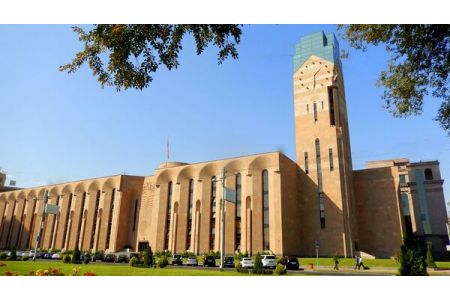 Yerevan City Hall is considering introducing a valet parking system in the city
 Expert: The circus surrounding the “Albanization” of Armenian culture in the presence of foreign ambassadors in occupied Artsakh is genocide
 Political scientist: If Russian-Armenian relations are destroyed, Turkey will take Russia`s place
 Political scientist: The Armenian public is simply obliged to significantly change the entire content of public discourse and struggle
 Cross tattoos are being removed from the skin of Christian prisoners in Azerbaijan by fire, according to a human rights activist.
 Zakharova: Armenia`s likely introduction of visas with Russia will be a step against Yerevan itself
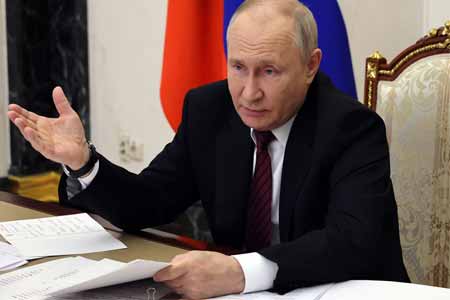 Putin: Armenia`s recognition of Karabakh as part of Azerbaijan in Prague has given Russia`s position on this issue an ambivalent character
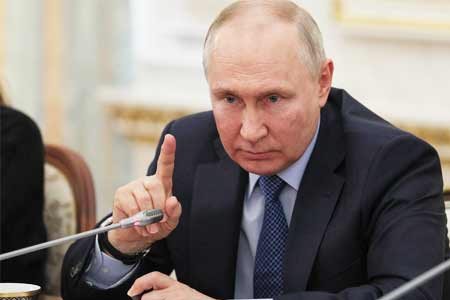 Putin: Armenia`s adoption of the law on EU accession means an announcement of its withdrawal from the Eurasian Economic Union