

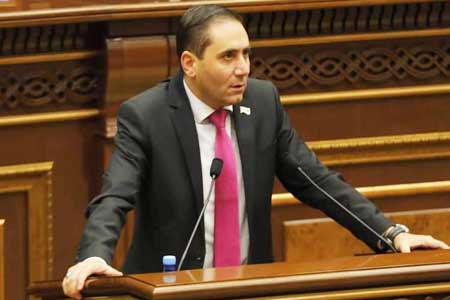
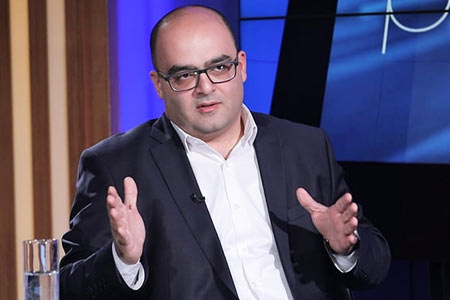
ArmInfo. Azerbaijan is not a state capable of dictating Israel's domestic political agenda. This is how former Armenian parliament member Arman Abovyan commented on reports that Israel suspended the process of recognizing the Armenian Genocide in the Ottoman Empire after pressure from Azerbaijan.
In his Telegram channel, the politician noted that reports in the media—alleging that a vote on recognizing the Armenian Genocide had been removed from the Knesset's agenda—had sparked a new wave of indignation within the Armenian information sphere. Addressing claims that this decision was made under Azerbaijani pressure, Abovyan dismissed such explanations as "extremely naive and foolish."
"Azerbaijan is not the kind of state that can dictate its domestic agenda to Israel," Abovyan wrote. "No matter how much 'Aliyev-junior' puffs out his chest, he has not grown to a level where he can exert pressure on Israel. Whether one likes it or not, Israel is a key military-political player in the Middle East, possessing its own strategic interests and making decisions based exclusively on them."
He added, "This, of course, does not justify Israel, which itself has committed genocide in Gaza and aggression against Iran—a brotherly nation to the Armenians," Abovyan believes. According to him, talk about Baku allegedly forcing Benjamin Netanyahu to change his position seems more like an attempt to simplify a complex political picture.
"It is far more logical to assume that we are witnessing a coordinated political game in which both Israel and Azerbaijan are pursuing their own objectives. For Benjamin Netanyahu's cabinet, the issue of recognizing the Armenian Genocide has become a tool for exerting pressure on Turkey and an element of internal political maneuvering, designed to boost popularity among the most radically anti-Turkish segments of Israeli society. Furthermore, these parliamentary maneuvers maintain space for diplomatic bargaining within the complex Israeli political landscape," the politician asserted.
According to Abovyan, the most surprising aspect of this situation is the reaction from a segment of Armenian society. He noted that instead of recognizing the diplomatic window of opportunity that has opened, an emotional "hysteria" has taken hold, which works against Armenia's own interests. Abovyan believes it is essential for the Armenian people to understand three fundamentally important points. First, he argues, it is less important that the vote in the Knesset was postponed or removed from the agenda. "What is fundamentally important is that, for the first time in history, the Israeli government itself has acknowledged the Armenian Genocide as a genocide and brought this issue to a parliamentary procedure. This is already a significant political precedent. Moreover, a substantial portion of the Israeli intellectual and public elite has publicly welcomed this step. This means that the issue has ceased to be merely an academic discussion and has entered Israel's active political agenda," Abovyan added.
Secondly, the politician is confident that there is no need to harbor illusions about the motives of the Israeli leadership. He reminded that Israel is guided solely by its own national interests and is indifferent to the moral aspect of the issue.
"If recognition of the Armenian Genocide proved to be a useful tool in the confrontation with Turkey and a way to strengthen the Netanyahu government's domestic political position, then it is precisely this tool that they used. And there is nothing surprising about this," Abovyan asserted.
Regarding his third point, Abovyan stated that Armenian diplomacy should be entirely indifferent to why Israel took this step. The politician reminded the public that in international politics, it is the result—not the motive—that matters.
"The result is that Armenia now possesses another serious diplomatic and political argument in the struggle against Turkey's policy of denying the Armenian Genocide. This argument must be used as effectively as possible, rather than being discarded due to emotions. Unfortunately, against this backdrop, the anti- Armenian stance of the Pashinyan authorities in Armenia looks especially stark. Their constant declarations regarding the inadmissibility of 'politicizing' the issue of Genocide recognition are, in fact, repeating word- for-word the long-standing line of official Turkey, which has always sought to remove this topic from the sphere of international politics and reduce it strictly to historical discussions," Abovyan added.
According to him, a perpetrator always seeks to avoid practical accountability for their crime, and Turkey is not unique in this regard. Meanwhile, the approach of the current Armenian authorities, he argues, fundamentally weakens Armenia's diplomatic standing and contributes to the erosion of the diplomatic toolkit that serves the interests of the Republic of Armenia.
"In international politics, the winner is not the one who screams and cries the loudest, but the one who knows how to exploit even the contradictions between other states to further their own national interests. Cold calculation is always stronger than hysteria. And if the political situation creates additional opportunities for the Armenian people to defend historical truth, they must be seized without hesitation or unnecessary emotion. After all, when the pro-Turkish Pasha chaos in the country ends, we must have the tools to defend our national interests in our arsenal," he concluded.
On July 13, it was reported that Israel had suspended a critically important vote in the Israeli parliament on recognizing the violence against Armenians by the Ottoman Empire during World War I as genocide. Media outlets today began circulating information that this was allegedly done after a call from the President of Azerbaijan to the Prime Minister of Israel.
On June 25, Foreign Minister Gideon Saar submitted a draft resolution for government approval on Israel's first official recognition of the Armenian Genocide. It was unanimously approved by the Israeli cabinet and sent to parliament for approval. This occurred amid rapidly deteriorating relations with Turkey due to Recep Tayyip Erdogan's statements against Israel.
Ten years ago, the Knesset Education Committee announced its recognition of the Armenian Genocide. In May 2018, amid worsening relations between Israel and Turkey, the Knesset plenum approved a debate and vote on a similar issue. However, the Israeli government has yet to officially recognize the Armenian Genocide.
Two years ago, Defense Minister Israel Katz wrote on social media that "Turkey committed the Holocaust of Armenians," and Prime Minister Benjamin Netanyahu announced last year that he would recognize the Armenian Genocide.

































 Azerbaijani studies expert : Ruben Vardanyan’s wife threatened with arrest if she visits Baku
 Political scientist: The model of allied relations between Russia and Armenia has collapsed
 Expert: The defeated authorities` position on normalizing relations with the enemy should not affect the rights of Artsakh refugees
 Political scientist: If Russian-Armenian relations are destroyed, Turkey will take Russia`s place
 Political scientist: The Armenian public is simply obliged to significantly change the entire content of public discourse and struggle
 Cross tattoos are being removed from the skin of Christian prisoners in Azerbaijan by fire, according to a human rights activist.
 Zakharova: Armenia`s likely introduction of visas with Russia will be a step against Yerevan itself
 Putin: Armenia`s recognition of Karabakh as part of Azerbaijan in Prague has given Russia`s position on this issue an ambivalent character
 Putin: Armenia`s adoption of the law on EU accession means an announcement of its withdrawal from the Eurasian Economic Union
 Medvedev: Yerevan will never become an EU member, but it will permanently damage relations with the Eurasian Economic Union, including with Moscow.
 Aram Vardevanyan: Public demands solutions, not apology scandals in Parliament
 Arrested Armenian oligarch on economy and new jobs
  "In Baku, we gave a worthy rebuff to the false claims regarding the past and present of our people" – Former Artsakh Parliament Speaker from Baku captivity
  NA Vice Speaker candidate believes his wife`s salary as director of HayPost is the lowest in the company`s history
 RF Permanent Representative: There is no CSTO-Armenia conflict
 Moscow: NATO seeking to "Pull" Armenia away from CSTO Allies
  Political analyst: Russia intends to determine which "Camp" Armenia will choose through a referendum
 Narek Karapetyan will give up his parliamentary salary in favor of charitable contributions.