
ArmInfo. When it comes to films with war/post-war themes, the stories of heroes are always familiar to a significant portion of Armenian viewers. After all, pride in one's history, origins, culture, and science are integral elements of national identity and mentality.
And whenever the author offers an unusual perspective on painful events or touches on topics that are usually perceived as almost sacred, the viewer is not always ready to accept such a perspective. Therefore, after the Yerevan premiere of Tamara Stepanyan's film "Arto's Land" (2025, Armenia, France), which took place during the opening of the 23rd Golden Apricot International Film Festival, audience opinions and impressions were divided.
Stepanyan's film tells the story of a French woman, Celine (Camille Cottin), who, after the death of her husband, Arto Saroyan (Hovnatan Avedikyan), comes to Armenia to obtain Armenian citizenship for their children, believing this is important for maintaining ties to their father's homeland and their national identity. To do this, she turns to the archives of Gyumri, where Arto was born, to find his birth certificate. However, after a lengthy search, it turns out that her husband was not at all the man he claimed to be.
To uncover the truth, Celine, following clues from people she meets, travels to Artsakh. Judging by the film's details, the events unfold in 2021-after the end of the 44-day war, but before the Azerbaijani blockade. It is there that she learns that her husband was a deserter during the First Artsakh War. This truth upends Celine's familiar world: she realizes she knew almost nothing about the past of the man she spent her life with. She is forced to rethink the memory of her loved one, say goodbye to the image of Arto she created, and accept the new, painful reality she must now live with.
One of the film's strengths is its rejection of the usual glorification of war, although that is not what the film is about. Contemporary Armenian cinema, when addressing this topic, often depicts heroism-and such films are undoubtedly necessary and very important, both for history and for future generations. Stepanyan, however, deliberately chooses a different perspective. She shows the side of war that provokes internal resistance. Stepanyan confronts the viewer with a different truth about war, one that is unpleasant and uncomfortable, yet still exists in our reality. Something many prefer to remain silent about.
In the public consciousness, a deserter is often perceived solely as a negative character. In Stepanyan's film, however, he is, first and foremost, a man who is frightened. Fear of death is a natural state for any person, and it certainly doesn't absolve them of responsibility for the consequences, which are almost always dire during war. However, this human weakness also becomes a subject of discussion for the director. War gives birth not only to heroes, but also to fear, despair, and flight. And art has the right to speak not only of heroism.
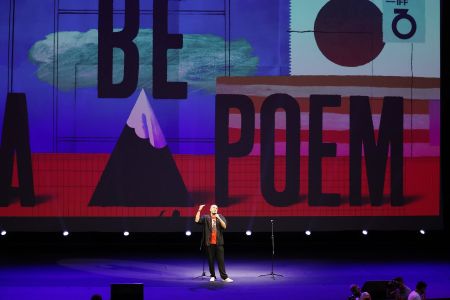
The finale of the premiere screening left a particularly strong impression. One scene in the film features a composition by Artsakh rapper Valeri Kazaryan (Lyoka), accompanying Celine's trip to Artsakh. The same song also plays during the end credits. However, at the premiere, the film's story unexpectedly took a further turn: during the credits, Lyoka took the stage and continued performing the composition live. A strange and symbolic moment - some audience members quietly left the auditorium, while others remained to listen.
This scene unexpectedly proved no less cinematic and eloquent than the film itself. It seemed to serve as a continuation of the film, clearly demonstrating how differently society today perceives Artsakh, its memory, and the conversation about war itself. Perhaps it was this moment that marked the most interesting conclusion of the evening at the opening ceremony of the 23rd Golden Apricot Film Festival.
Interestingly, Karen Avetisyan, artistic director and director of the Golden Apricot Film Festival, noted that this year's film festival slogan, "Be A Poem," is in some sense an allusion to Tamara Stepanyan's film. He explained that the idea for the slogan arose from a statement made in 1951-six years after the end of World War II-by the German philosopher, thinker, and sociologist Theodor Adorno, who asked, "To what extent is poetry possible after a disaster, or rather after Auschwitz? To what extent is it meaningful, in such a tragic, destroyed, fragmented world?"
"And after six years of our tragedy (the 44-day Artsakh War - ed.), we tried to rephrase what Adorno arrived at over time: that art is not only possible, but also necessary. Because at the point where the word, 'which was in the beginning,' ends, at the point where it becomes powerless, art comes to the rescue," Avetisyan said.
It's hard to disagree. Of course, art won't solve all problems, won't end wars, won't punish dictators, given the colossal cultural legacy associated with the horrors of war. But art will always help us move forward, continue to create, build on ruins, create within limitations, and bring light into the darkness.
In this sense, the Golden Apricot Film Festival has remained one of Armenia's most important cultural phenomena for over two decades. For 23 years, the festival has spoken to society through the language of art, opening a space for complex conversations that are often impossible in politics or public debate. And perhaps precisely because of this, Armenian cinema is increasingly seeing the emergence of filmmakers willing to address the most sensitive topics honestly and without regard for conventional audience expectations.
As a reminder, the Golden Apricot Film Festival is taking place this year from July 13th to 19th. The opening ceremony took place at the Karen Demirchyan Sports and Concert Complex. During the ceremony, which honored all film festival traditions, Austrian director Jessica Hausner was awarded the Master Prize, and French cinematographer Bruno Delbonelle received the Parajanov Thaler for his contribution to the global film industry.
Until July 19, the festival will feature competition and non-competition programs featuring films from around the world, as well as films screened at prestigious international film festivals. The festival will once again bring together renowned directors, industry representatives, and film enthusiasts in one venue. Film screenings will be held at the Nairi and Moskva cinemas, as well as the Cinema House. The founders of the Golden Aborikos are Harutyun Khachatryan, Mikael Stamboltsyan, and Susanna Harutyunyan. In March of this year, it was announced that the Yerevan International Film Festival had joined the International Federation of Film Producers Associations (FIAPF). It is worth noting that of the more than 5,000 film festivals held worldwide, only about 50 are recognized by this organization.






 Expert: Economic pressure on Armenia may be virtually painless for other EAEU members, but not for Armenia itself
 Expert on protests in France: Civilizations fade when society loses a vision of the future
 Turkologist: Azerbaijan is not all-powerful—its vulnerabilities should become part of Armenia’s security strategy
 Opinion: The development of the Amulsar mine near the resort town of Jermuk is the beginning of an environmental disaster in Armenia
 Expert: The arrest of opposition figures in Armenia for social media posts is a systematic attempt to intimidate the public and suppress dissent.
 The Armenian Foreign Minister commented on the country`s return to work within the CSTO.
 The Artsakh Public Council expressed outrage at the UN Secretary-General`s behavior
 Lukashenko called for Armenia to assume the CIS presidency in 2029
 Dmitry Medvedev predicted a Ukrainian-like fate for Armenia amid the country`s shift in foreign policy
 Russian Security Council: In Armenia, they want to force Russian asset owners to dispose of their assets
 Zakharova: Russia ready to discuss with Armenia the prospects for expanding military cooperation as part of a review of bilateral ties
 Tevanyan: Armenia, like Ukraine and Moldova, is being drawn into the EU’s global war
 Yerevan City Hall is considering introducing a valet parking system in the city
 Expert: The circus surrounding the “Albanization” of Armenian culture in the presence of foreign ambassadors in occupied Artsakh is genocide
 Political scientist: If Russian-Armenian relations are destroyed, Turkey will take Russia`s place
 Political scientist: The Armenian public is simply obliged to significantly change the entire content of public discourse and struggle
 Cross tattoos are being removed from the skin of Christian prisoners in Azerbaijan by fire, according to a human rights activist.
 Zakharova: Armenia`s likely introduction of visas with Russia will be a step against Yerevan itself
 Putin: Armenia`s recognition of Karabakh as part of Azerbaijan in Prague has given Russia`s position on this issue an ambivalent character
 Putin: Armenia`s adoption of the law on EU accession means an announcement of its withdrawal from the Eurasian Economic Union