


ArmInfo. Medication quality and safety controls will be strengthened in Armenia. At an extraordinary session on June 30, the RA National Assembly Committee on Healthcare approved the amendments to the Law "On Medicines" submitted by the RA government for the second reading.
Introducing the amendments, RA Deputy Minister of Health Astghik Grigoryan noted that no new proposals had been submitted by either MPs or the government for the second reading. The bill aims to clarify regulations governing drug circulation and improve access to medications. Furthermore, the proposed amendments are intended to eliminate discrepancies in current legislation, improve the effectiveness of control mechanisms, and harmonize Armenian regulations with those of the Eurasian Economic Union. Specifically, one of the key amendments concerns drug manufacturers and suppliers. It proposes clarifying the procedure for issuing certificates of compliance with good manufacturing and good distribution practices. The initial certificate will be issued based on general monitoring after a license is issued, followed by ongoing inspections at facilities and warehouses. The document also revises the grounds for suspending and terminating licenses. Specifically, a drug manufacturing license may be terminated if the drug is produced without a good manufacturing practice certificate. Similar measures are proposed for the wholesale distribution of drugs without a good distribution practice certificate. A separate set of amendments concerns the import of drugs. The draft proposes permitting the import of certain unregistered drugs included in the list of essential drugs, as well as immunomodulatory drugs used in oncology. The rationale notes that it is impossible to ensure that only registered drugs from the list of essential drugs are available on the market, as registration has a limited period, and some registered drugs are not imported for long periods and are effectively absent from the market. It is also proposed to clarify the grounds for refusing to issue an import certificate. Such grounds include violation of transportation or storage conditions, including temperature control, the presence of damaged packaging, recall of the drug for reasons of safety, efficacy or quality, and obstruction of the collection of samples for examination.
Furthermore, the draft clarifies regulations on parallel imports. Importers will be able to apply to the authorized body for preliminary parallel import permission before ordering and shipping a drug. However, such permission will not be a prerequisite for obtaining an import certificate. Significant changes are also proposed for customs warehouses. According to the draft, customs and other warehouses, as well as temporary storage areas where drugs, pharmaceutical substances, medicinal plant materials, or investigational pharmaceutical products are stored, will be required to comply with licensing and certification requirements for proper distribution activities. This provision will be deferred until six months after the official publication of the law. The draft also stipulates that after the adoption of post-registration changes unrelated to quality, efficacy, and safety, drugs in previously approved packaging may be sold if they were made before the adoption of the change or within 180 calendar days thereafter. Another change concerns drug advertising: the law is proposed to eliminate the requirement to include information about the state registration of the drug in advertisements, as this information is verified by the authorized body when issuing an advertising permit.


























 Expert: The arrest of opposition figures in Armenia for social media posts is a systematic attempt to intimidate the public and suppress dissent.
 Azerbaijani Studies Expert: While Azerbaijan Prepares Its Generation for War, Aliyev’s Aide Calls on Armenia to Prepare Armenian Society for “Peace”
 Turkologist: Azerbaijan will never, under any circumstances, stop pressuring the Armenian people
 Political scientist: We need to move away from the question of "when" and replace it with more important questions
 International Law Specialist: Azerbaijan intends to initiate legal proceedings against Armenia by sentencing Armenian prisoners
 Dmitry Medvedev predicted a Ukrainian-like fate for Armenia amid the country`s shift in foreign policy
 Russian Security Council: In Armenia, they want to force Russian asset owners to dispose of their assets
 Zakharova: Russia ready to discuss with Armenia the prospects for expanding military cooperation as part of a review of bilateral ties
 Tevanyan: Armenia, like Ukraine and Moldova, is being drawn into the EU’s global war
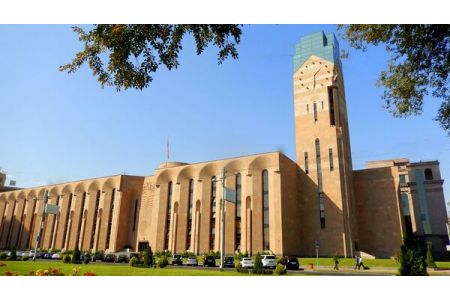 Yerevan City Hall is considering introducing a valet parking system in the city
 Expert: The circus surrounding the “Albanization” of Armenian culture in the presence of foreign ambassadors in occupied Artsakh is genocide
 Political scientist: If Russian-Armenian relations are destroyed, Turkey will take Russia`s place
 Political scientist: The Armenian public is simply obliged to significantly change the entire content of public discourse and struggle
 Cross tattoos are being removed from the skin of Christian prisoners in Azerbaijan by fire, according to a human rights activist.
 Zakharova: Armenia`s likely introduction of visas with Russia will be a step against Yerevan itself
 Putin: Armenia`s recognition of Karabakh as part of Azerbaijan in Prague has given Russia`s position on this issue an ambivalent character
 Putin: Armenia`s adoption of the law on EU accession means an announcement of its withdrawal from the Eurasian Economic Union