
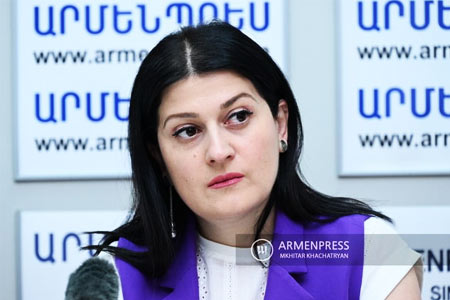
ArmInfo. Of the potential 20,000 Artsakh families, 6,911 families, or approximately 28,400 people, have received a housing certificate. Gayane Karagezyan, Advisor for Coordination of Individual Functions of Structural Units of the Ministry of Labor and Social Affairs of Armenia, announced this at a press conference in Yerevan, presenting the recent changes to the program.
According to her, the changes can be divided into two groups: the first concerns the beneficiaries themselves, and the second is related to improving the mechanisms of interaction between the state and financial institutions, in particular, the introduction of more effective financial resource management tools. One of the key changes, according to Karagezyan, concerns divorced parents. "A parent who does not have custody of a child after a divorce will be able to apply for a certificate. This means that the certificate can be issued for either oneself or for a new family, if one has been created. Another change concerns families whose applications were previously rejected due to the lack of information on children under six years of age in the database of the Migration and Citizenship Service of the Ministry of Internal Affairs of Armenia. Such cases were quite common, and the reasons could be varied, including technical errors and human error. In this regard, it was decided that if a child is under six years old as of September 19, 2023, and the parents' application is rejected solely due to the lack of information in the database, such applications will now be accepted," Karagyozyan said.
The next changes, as the Ministry of Social Labor representative continued, concern the use of the certificate's positive balance. She recalled that previously, families could not re-use a home renovation loan, as the program only provided for one such loan. However, as Karagyozyan noted, this restriction has been lifted after the changes.
Another important change, she said, was made to the certificate consolidation process. As Karagyozyan explained, the problem arose in families where one or more members encountered delays in obtaining Armenian citizenship. As a result, the coordination adviser noted, the remaining family members were unable to take advantage of the program in a timely manner. "Now, the family will be able to use the certificates of those members who already meet the program's conditions. After the remaining members resolve their citizenship issues and also receive certificates, they can be combined with those already used. The unused amount will be counted as a positive balance, which can be used for the purposes specified by the program—obtaining a loan for home renovation or reconstruction, purchasing furniture and appliances, and purchasing a plot of land," Karagyozyan noted.
The changes, she said, also affected the work of the Interdepartmental Commission. Previously, as the Ministry of Social Labor representative noted, when reviewing individual applications, the Commission often had to request additional information from the Ministry of Defense (if the applications concerned military personnel) or from the Ministry of Education, Science, Culture, and Sports (MESC) of Armenia. "To make the Commission's work more efficient and effective, a decision was made to include representatives from these ministries."
A separate set of changes, as Karagyozyan recalled, concerns the state's interaction with financial institutions. She stated that the program now requires a mandatory down payment of 20%, but this innovation, she assured, does not create an additional financial burden for beneficiaries. "It is important that the people of Artsakh do not have any misunderstandings. These 20% will be fully financed by the state. Banks' ability to finance the program has also been expanded." As the number of participants increases, banks' own resources may prove insufficient, so refinancing organizations, in particular the National Mortgage Company of Armenia, will be involved in the process," Karagyozyan clarified.
Speaking about the implementation of certificates by region, Karagyozyan reported that Kotayk Province remains the leader, with 790 families purchasing housing. Next comes Armavir Province with 543 families, Ararat Province with 368, Yerevan Province with 366, Lori Province with 315, Syunik Province with 184, Gegharkunik Province with 129, Shirak Province with 115, Aragatsotn Province with 101, Tavush Province with 73, and Vayots Dzor Province with 51 families. According to her, these statistics indicate that not all program participants choose to live in Yerevan.
In total, 6,911 families, or approximately 28,400 people, received certificates. Of these, 3,254 families (approximately 15,000 people) have already exercised their right under one of the program's designated areas. Thus, 2,994 families purchased finished housing, 41 purchased housing under construction, and another 219 families used the funds to pay off a mortgage taken out before the program's launch. Furthermore, of the 3,035 families who purchased housing or were under construction, 1,803 took advantage of the 100% state subsidy without investing their own funds. Some of them retained a positive certificate balance. 1,232 families used additional personal funds. Of these, 204 families subsequently received a refund of approximately 348 million drams, which they used to obtain an additional loan under the program," Karagyozyan reported.
A representative of the Ministry of Social Labor also noted that when the program was launched, approximately 20,000 families were considered potential participants. However, she clarified that it was initially anticipated that some participants might not meet the established criteria, while others might not want to take advantage of the program. "Considering that the program is designed for five years and is currently only in its second year of implementation, we consider these figures to be very good. While as of January 1, 2025, only 289 certificates were issued, of which only 4 were implemented, by January 1, 2026, the number had increased to 4,012, with 1,751 implemented. As of today, 6,911 certificates have been issued, of which 3,254 have been implemented. These figures clearly demonstrate the growth dynamics," the coordination adviser believes.
Karagyozyan also cited statistics on small families, noting that the common belief that the certificate amount is insufficient for families of two or three isn't always true. According to her, out of 291 two-person families, 180 purchased housing with 100% state subsidy. "And out of 390 three-person families, 129 were able to purchase housing without using their own funds. It's important to understand that even small families can receive full subsidy if they're considering housing outside of Yerevan," Karagyozyan concluded.









 Opinion: The development of the Amulsar mine near the resort town of Jermuk is the beginning of an environmental disaster in Armenia
 Expert: The arrest of opposition figures in Armenia for social media posts is a systematic attempt to intimidate the public and suppress dissent.
 Azerbaijani Studies Expert: While Azerbaijan Prepares Its Generation for War, Aliyev’s Aide Calls on Armenia to Prepare Armenian Society for “Peace”
 Turkologist: Azerbaijan will never, under any circumstances, stop pressuring the Armenian people
 Political scientist: We need to move away from the question of "when" and replace it with more important questions
 Lukashenko called for Armenia to assume the CIS presidency in 2029
 Dmitry Medvedev predicted a Ukrainian-like fate for Armenia amid the country`s shift in foreign policy
 Russian Security Council: In Armenia, they want to force Russian asset owners to dispose of their assets
 Zakharova: Russia ready to discuss with Armenia the prospects for expanding military cooperation as part of a review of bilateral ties
 Tevanyan: Armenia, like Ukraine and Moldova, is being drawn into the EU’s global war
 Yerevan City Hall is considering introducing a valet parking system in the city
 Expert: The circus surrounding the “Albanization” of Armenian culture in the presence of foreign ambassadors in occupied Artsakh is genocide
 Political scientist: If Russian-Armenian relations are destroyed, Turkey will take Russia`s place
 Political scientist: The Armenian public is simply obliged to significantly change the entire content of public discourse and struggle
 Cross tattoos are being removed from the skin of Christian prisoners in Azerbaijan by fire, according to a human rights activist.
 Zakharova: Armenia`s likely introduction of visas with Russia will be a step against Yerevan itself
 Putin: Armenia`s recognition of Karabakh as part of Azerbaijan in Prague has given Russia`s position on this issue an ambivalent character
 Putin: Armenia`s adoption of the law on EU accession means an announcement of its withdrawal from the Eurasian Economic Union
 Aram Vardevanyan: Public demands solutions, not apology scandals in Parliament