
ArmInfo.The latest parliamentary elections in Armenia, held on June 7, best demonstrated the paradox of how claims of "foreign interference" can be used as a political weapon.
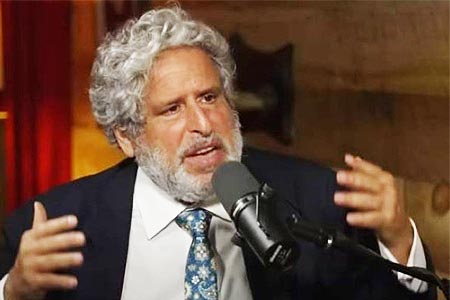
This was written by Robert Amsterdam, founder and managing partner of Amsterdam & Partners LLP and attorney for the leader of the "Strong Armenia" bloc, Samvel Karapetyan, in his new article "An Enemy Factory: The False Claims of "Russian Interference" as a Tool of Political Persecution" for the Washington Examiner.
In it, the attorney noted that democracy collapses not only from threats emanating from external enemies, but also when fear of these enemies becomes a pretext for suppressing domestic opponents. "When a government aims to destroy its opponent without paying the democratic price of defeating them at the ballot box or in open debate, it doesn't fight them. It simply redefines them. Then, an individual or group ceases to be a legitimate competitor and becomes a threat or agent to be expelled. This is precisely what my clients have encountered in Russia, Venezuela, Thailand, Uganda, and other countries," the lawyer writes.
As Amsterdam explained, in this case, the specific accusation isn't as important as its function-to remove the opponent from the political arena and portray them as a traitor. He noted that today, this accusation is increasingly being couched in the form of alleged "Russian interference." "It's important to be crystal clear here, as clarity is the first thing that's sacrificed in such discussions. Let's be clear: Russian interference does exist. Moscow has conducted disinformation campaigns around the world, exerted pressure, and pursued strategies lacking transparency of funding. Denying this would be irresponsible, just as it would be irresponsible to ignore similar interventions conducted by Western powers. However, in reality, there's a vast gap between accepting this reality and viewing any domestic dissent as a manifestation of it. In this gap, a new type of political criminal is emerging today-the 'pro-Russian' oppositionist, just as there were 'Soviet' opponents during the McCarthy era," the international lawyer noted.
Thus, according to Amsterdam, under this mechanism, the existence of a so-called hybrid threat is first declared, then it is assumed that the dissidents themselves pose this threat simply because they challenge the dominant political or geopolitical consensus. Ultimately, as the lawyer noted, the burden of proof falls on the opposing side. "Now, it is not the accusing party that must prove the existence of this connection, but the accused themselves who must refute it and demonstrate that they are not a puppet of a foreign state. As a result, a presumption of guilt is created that is virtually impossible to evade. This dynamic has been further exacerbated by the application of sanctions outside the legal framework, when a person's reputation can be razed to the ground without any real opportunity to defend themselves," the international lawyer noted.
Amsterdam believes that the most dangerous aspect of all this is systemic complicity. In this regard, he noted that the European Union (EU) is becoming increasingly tolerant of the use of the label "Russian interference" as a justification for limiting the law. Thus, as the lawyer noted, under the pretext of defending democracy, one of its fundamental characteristics-the right of the opposition to exist and compete-is undermined. "When an opponent is devalued and equated with the status of a foreign agent, virtually anything becomes permissible. They are no longer a rival to be confronted, but an existential threat. As a result, democracy is undermined under the guise of its defense. Accusations of interference become an alibi for those who want to govern without a real opposition. The recent parliamentary elections in Armenia best illustrate this paradox. The election campaign took place in an atmosphere of constant accusations of foreign interference, with rival political forces claiming that external forces were attempting to predetermine the election results. But one thing has become clear: the extent to which claims of interference have become a political weapon in themselves," the lawyer emphasized.
In this regard, Amsterdam noted, the political lines adopted by Yerevan and Kyiv are far more similar than many would like to admit. He pointed out that Prime Minister Nikol Pashinyan's attacks on the legitimate political opposition mirror the events unfolding in Ukraine under President Volodymyr Zelenskyy. In conclusion, the lawyer stated that democracy is measured not by how it treats its allies, but by the legal guarantees and protections it provides to its most undesirable adversaries. "When these guarantees are suspended in the name of combating 'interference,' the damage caused becomes irreversible," Amsterdam concluded.
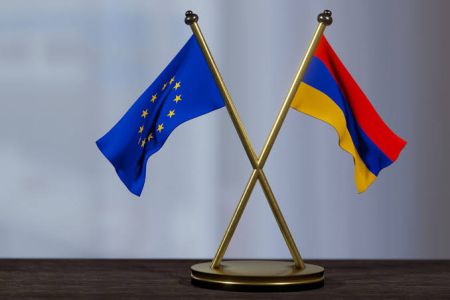
As a reminder, prior to the parliamentary elections in Armenia, on December 15, 2025, the EU High Representative for Foreign Affairs and Security Policy and Vice-President of the European Commission, Kaja Kallas, told reporters that Armenia had asked the European Union for financial assistance to "prevent external interference ahead of the next parliamentary elections" scheduled for June 2026. Kallas later also stated that Russia had allegedly intensified its disinformation campaign in the lead-up to the elections, and that the EU would provide Armenia with ?15 million to counter external threats. On April 26, 2026, the EU also approved the deployment of a mission to assist Armenia in combating hybrid attacks for an initial two- year period.










 Expert: The arrest of opposition figures in Armenia for social media posts is a systematic attempt to intimidate the public and suppress dissent.
 Azerbaijani Studies Expert: While Azerbaijan Prepares Its Generation for War, Aliyev’s Aide Calls on Armenia to Prepare Armenian Society for “Peace”
 Turkologist: Azerbaijan will never, under any circumstances, stop pressuring the Armenian people
 Political scientist: We need to move away from the question of "when" and replace it with more important questions
 International Law Specialist: Azerbaijan intends to initiate legal proceedings against Armenia by sentencing Armenian prisoners
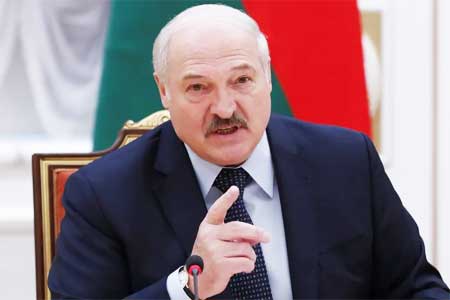 Lukashenko called for Armenia to assume the CIS presidency in 2029
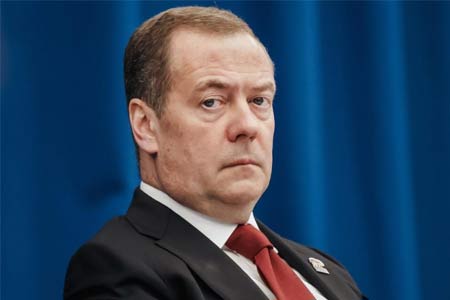 Dmitry Medvedev predicted a Ukrainian-like fate for Armenia amid the country`s shift in foreign policy
 Russian Security Council: In Armenia, they want to force Russian asset owners to dispose of their assets
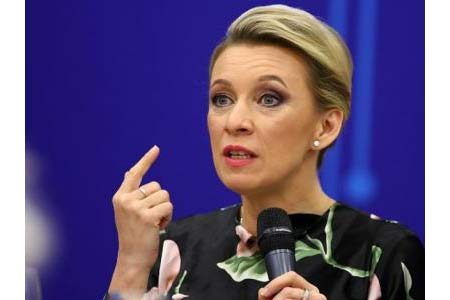 Zakharova: Russia ready to discuss with Armenia the prospects for expanding military cooperation as part of a review of bilateral ties
 Tevanyan: Armenia, like Ukraine and Moldova, is being drawn into the EU’s global war
 Yerevan City Hall is considering introducing a valet parking system in the city
 Expert: The circus surrounding the “Albanization” of Armenian culture in the presence of foreign ambassadors in occupied Artsakh is genocide
 Political scientist: If Russian-Armenian relations are destroyed, Turkey will take Russia`s place
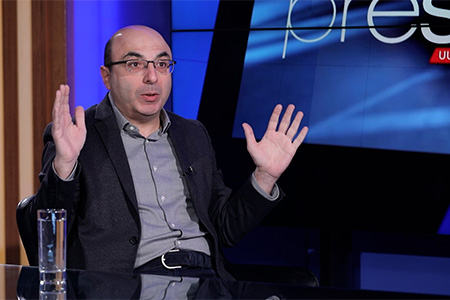 Political scientist: The Armenian public is simply obliged to significantly change the entire content of public discourse and struggle
 Cross tattoos are being removed from the skin of Christian prisoners in Azerbaijan by fire, according to a human rights activist.
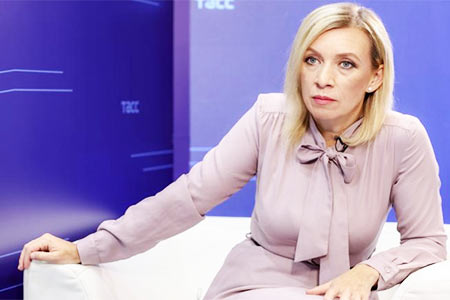 Zakharova: Armenia`s likely introduction of visas with Russia will be a step against Yerevan itself
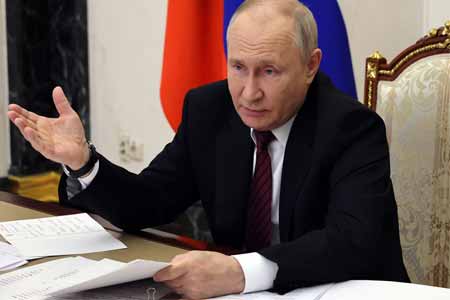 Putin: Armenia`s recognition of Karabakh as part of Azerbaijan in Prague has given Russia`s position on this issue an ambivalent character
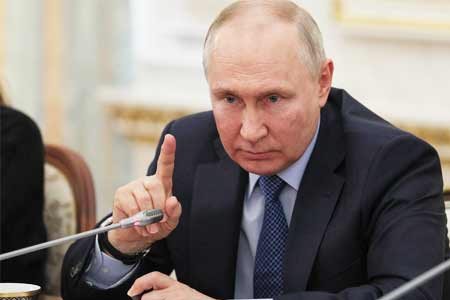 Putin: Armenia`s adoption of the law on EU accession means an announcement of its withdrawal from the Eurasian Economic Union