


ArmInfo. Armenia is entering not an era of peace, but an era of competing logistics regimes. This was stated by political scientist Vahe Davtyan.
"When several mutually exclusive routes simultaneously want to pass through your territory, it's not about peace, but about a struggle for control over space. 'Peace' here is a peculiar form of conflict," the expert noted.
Davtyan is confident that the US-Iran deal will directly impact the security architecture of the South Caucasus.
"Lifting the naval blockade, suspending sanctions on Iranian oil, unfreezing at least half of Iran's financial assets, and a number of other factors will inevitably impact the logic of the American presence in the Greater Middle East, including the Caucasus," he continued. The political scientist is confident that, given the current reality, Tehran may rethink the TRIPP (Trump Route for International Peace and Prosperity) project or at least stop labeling it a "red line." "In its new configuration, TRIPP becomes an important route for hydrocarbon supplies to Turkey, which addresses not only economic but also military-strategic objectives. NATO's current agenda includes the creation of an autonomous fuel system to supply the alliance's military infrastructure. This also includes a new fuel pipeline from Turkey to Eastern Europe (the Turkey-Romania oil pipeline), which I have previously written about in detail. My prediction: in the foreseeable future, the US will push for the Trans-Caspian Gas Pipeline project, without which the entire outlined strategy is a colossus with feet of clay. Thus, the South Caucasus could become a structural element of NATO's emerging logistics system," Davtyan believes.
At the same time, he adds, Iranian hydrocarbon supplies to Turkey could be increased for the same purposes. This is especially true for natural gas.
He recalled that the contract between Iran and Turkey for the supply of Iranian natural gas to Turkey is in effect until the end of July 2026. The volume is 10 billion cubic meters per year. Actual deliveries in 2025 amounted to 7.7 billion cubic meters. Turkey has already expressed a desire to extend the contract. "This, in turn, increases competition with Azerbaijan in the Turkish gas market and potentially weakens Baku's negotiating position in the energy dialogue with Ankara. The figures speak for themselves: pipeline gas imports to Turkey in 2025 amounted to 57.9 billion cubic meters, of which 21.1 billion cubic meters came from Russia, 11.9 billion cubic meters from Azerbaijan, and 7.7 billion cubic meters from Iran," Davtyan stated.
The expert is confident that the above indicates the growing importance of the Caucasus as a convergence zone between Middle Eastern and Eurasian policies. "If Iran partially emerges from its isolation, the struggle will no longer be about containing it, but rather about control over the routes of Iranian energy resources and goods. This automatically increases the strategic value of the South Caucasus for all external players. In other words, the Caucasus is gradually becoming not a periphery of global processes, but a key space in the struggle for control over new logistical and energy flows," the political scientist concluded.
















 Opinion: The development of the Amulsar mine near the resort town of Jermuk is the beginning of an environmental disaster in Armenia
 Expert: The arrest of opposition figures in Armenia for social media posts is a systematic attempt to intimidate the public and suppress dissent.
 Azerbaijani Studies Expert: While Azerbaijan Prepares Its Generation for War, Aliyev’s Aide Calls on Armenia to Prepare Armenian Society for “Peace”
 Turkologist: Azerbaijan will never, under any circumstances, stop pressuring the Armenian people
 Political scientist: We need to move away from the question of "when" and replace it with more important questions
 Lukashenko called for Armenia to assume the CIS presidency in 2029
 Dmitry Medvedev predicted a Ukrainian-like fate for Armenia amid the country`s shift in foreign policy
 Russian Security Council: In Armenia, they want to force Russian asset owners to dispose of their assets
 Zakharova: Russia ready to discuss with Armenia the prospects for expanding military cooperation as part of a review of bilateral ties
 Tevanyan: Armenia, like Ukraine and Moldova, is being drawn into the EU’s global war
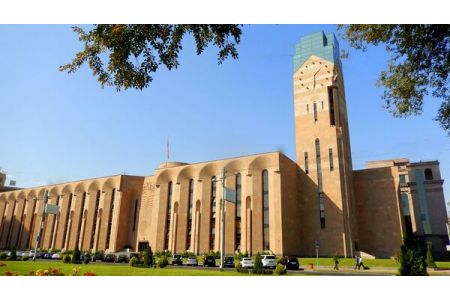 Yerevan City Hall is considering introducing a valet parking system in the city
 Expert: The circus surrounding the “Albanization” of Armenian culture in the presence of foreign ambassadors in occupied Artsakh is genocide
 Political scientist: If Russian-Armenian relations are destroyed, Turkey will take Russia`s place
 Political scientist: The Armenian public is simply obliged to significantly change the entire content of public discourse and struggle
 Cross tattoos are being removed from the skin of Christian prisoners in Azerbaijan by fire, according to a human rights activist.
 Zakharova: Armenia`s likely introduction of visas with Russia will be a step against Yerevan itself
 Putin: Armenia`s recognition of Karabakh as part of Azerbaijan in Prague has given Russia`s position on this issue an ambivalent character
 Putin: Armenia`s adoption of the law on EU accession means an announcement of its withdrawal from the Eurasian Economic Union
 Aram Vardevanyan: Public demands solutions, not apology scandals in Parliament