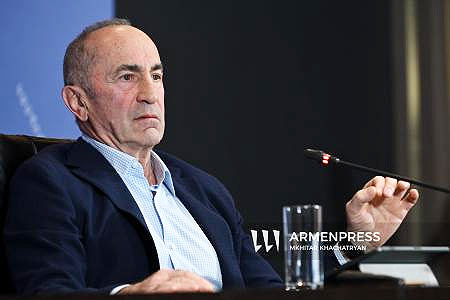
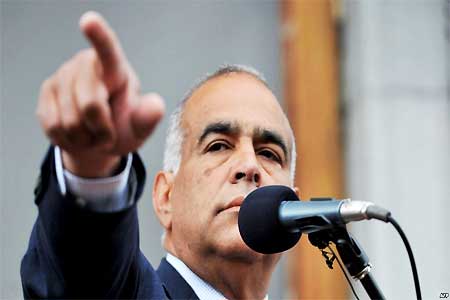
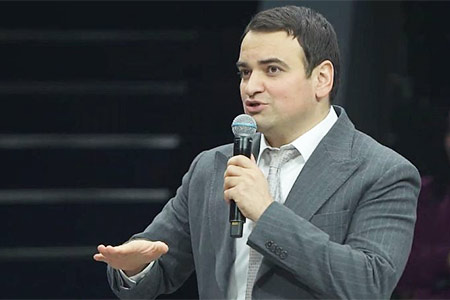
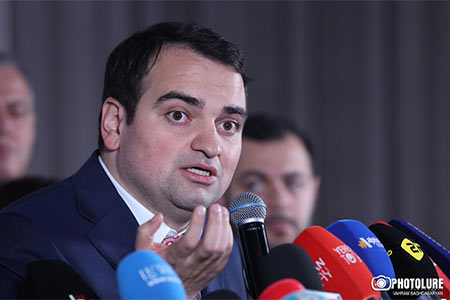
ArmInfo.The Armenian authorities have done everything to find themselves at the center of a clash of interests between Russia and the European Union. This was stated by Robert Kocharyan, Armenia's second president and the prime ministerial candidate from the Armenia bloc, in an interview with Armenia TV.
"If the heads of four states make such a statement, it means that four countries at least see a problem here. It's strange that Armenia doesn't see this problem. They passed a meaningless law on EU accession, and then, with concrete steps, provoked all of this, bringing it to this point," the second president of Armenia said, referring to the tensions between the Armenian authorities and the EAEU, as well as the demand for a referendum on membership in the EU or EAEU.
Speaking about how the current situation can be resolved, Kocharyan expressed his belief that the country's leadership must develop horizontal, long-term planning in the interests of the country, not just to maintain their own grip on power three months before the elections.
He disagreed with the notion that this pressure from Russia, Armenia's northern neighbor, is being exerted ahead of the elections. He recalled the circumstances that preceded it. The politician noted that the Armenian authorities recently traveled to Brussels and asked for protection from possible hybrid attacks.
"If we try to assess the cause and effect relationship, rather than reasoning as a biased outside observer, the picture emerges differently. The Armenian authorities have done everything to find themselves at the center of a clash of interests between Russia and the European Union. Does Russia have interests here? Of course they do. And Russia's interests here are incompatible with the EU's," the politician stated.
He expressed his belief that Armenia has artificially inserted itself into the center of this clash of interests, creating a number of problems for itself, instead of pursuing a complementary policy as it had in previous years. In particular, without damaging relations with Russia, it is necessary to develop dynamic relations with the EU.
At the same time, touching on the Russian restrictions on imports of Armenian products and the actions of the Armenian authorities, Kocharyan stated that official Yerevan continues to deepen its confrontation with Russia in the absence of other markets. "Armenia has no alternative market. Simply none. They have exported practically nothing in agricultural products to the EU over the past eight years," he said.
The politician is convinced that this is more of an election ploy, saying, "elect us, and we will solve your problems." However, according to Kocharyan, the problem won't be resolved after the elections because it is too deep.
He is also confident that the state will not be able to compensate for the damage inflicted on Armenian producers as a result of Russian sanctions. "People simply don't understand the scale and depth of the problem. They can't compensate for this volume," the former Armenian leader said.
As a reminder, on January 9, 2025, the Armenian government approved a draft law on the start of the EU accession process, proposed by the "Eurakve" civic initiative. The draft was sent to the Armenian parliament for approval. On March 26, the parliament passed it in its final reading and sent it to the president for signature. The document was signed on April 4 of that year. Moscow stated that Russia had conveyed to Armenia that simultaneous membership in the Eurasian Economic Union and the European Union was impossible. On May 9, 2026, Russian President Vladimir Putin, speaking to journalists, suggested that Armenia decide on its membership in the EU and the EAEU as soon as possible, expressing its readiness to "begin a civilized divorce" if necessary. Yerevan responded by stating that it would leave the EAEU whenever it deemed it necessary.
It should be noted that, according to the RA Statistics Committee, foreign trade turnover between Armenia and the EAEU countries decreased by 36.9% in 2025, amounting to just over $8 billion. Export volumes fell by 5% to $3.2 billion, while imports declined by 48.5% to $4.8 billion.
Trade with Russia during the reporting period declined by 38.3%, amounting to $7.6 billion. Trade with Belarus increased by 22.9% to $251.4 million in 2025. Trade with Kazakhstan increased by 6.3% to $115.9 million. Trade with Kyrgyzstan declined by 23.2% to $11.3 million. The EAEU countries accounted for 37.5%.
In the first quarter of 2026, trade turnover between Armenia and the EAEU countries decreased by 15.6% to $1.4 billion. At the same time, exports demonstrated a decrease in volume of 6.5%, amounting to $685.9 million, against the backdrop of a decline in imports by 22.6% to $722.7 million.











 Opinion: Following Berlin talks, Baku gains expanded influence within EU and strengthens cooperation ties with main European powerhouse
 Armenian expert: Could modern Azerbaijan even exist without Russian and Soviet modernization?
 Zatulin: Pashinyan was eager to get back to Russia because he actually lost the elections
 Human rights activist Ruben Melikyan dismissed from YSU
 Pashinyan removed from INNOPROM guest list
 Zakharova: Armenia`s pro-EU pivot poses economic security risks to EAEU member states
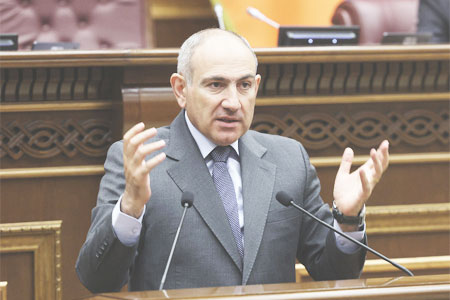 It`s time for South Caucasus countries to think of South Caucasus as single, unified region - RA premier
 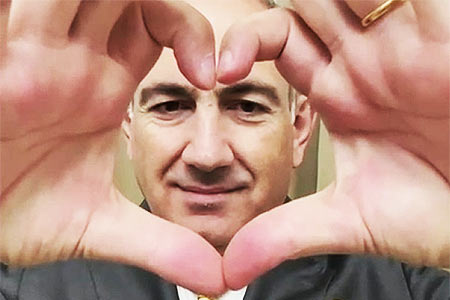 Pashinyan: Armenia and Azerbaijan should leave each other alone
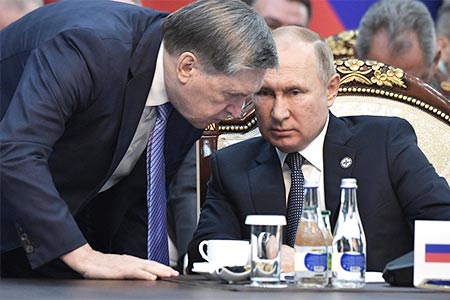 Moscow sees situation with Armenia as attempt to attack Russia-involving integration associations - Russian presidential aid
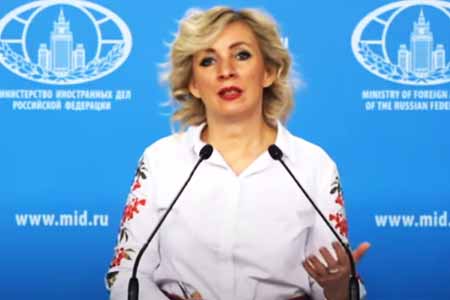 Zakharova: Armenia views relations with Russia as tool for financially securing reorientation toward EU
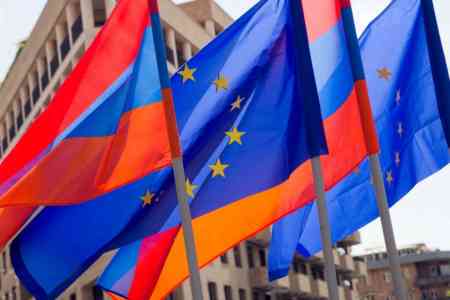 The Armenian Minister of Justice and the EU Ambassador discussed visa liberalization issues for Yerevan.
 Azerbaijan`s aggressive plans against Armenia became possible in wake of Pashinyan`s decisions on Artsakh - expert
  Zakharova: Russia sent a note of protest to Armenia over the act of vandalism at the "Mother Armenia" memorial in Gyumri
 Samvel Karapetyan proposes creating a post-election opposition coalition