
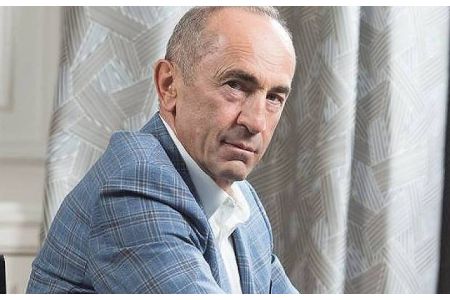
ArmInfo. "One of our core platform objectives is the right of Artsakh Armenians to return to Artsakh,". stated Robert Kocharyan, the second president of Armenia and the prime ministerial candidate from the "Armenia" bloc, at a meeting with journalists in Meghri.
At the same time, he noted that this issue is not conflict-inducing, much like consistent efforts regarding the international recognition of the 1915 Armenian Genocide. "Ultimately, there is a ruling by the International Court of Justice, and statements have been voiced by the European Court. On the contrary, within the negotiation process, this will strengthen Armenia's positions," Kocharyan said.
According to the ex-president, the return of the people of Artsakh to their homeland is realistic, but not at the present moment. "We are talking about a safe and guaranteed return. And it is difficult to fight against this. For instance, it will be difficult for Azerbaijan—they will have to explain 'why not?'" the politician noted. Simultaneously, Kocharyan described the current authorities' policy regarding the "return" of 300,000 Azerbaijanis to Armenia as unacceptable and contrary to Armenia's national interests.
First, according to all demographic and statistical data, around 160,000 Azerbaijanis lived in Armenia, not 300,000. Second, Aliyev's narrative—echoed by Nikol Pashinyan—proposing that the right of Artsakh citizens to return to their homeland should be linked to the return of Azerbaijanis to Armenia is fundamentally flawed. This is because the majority of Azerbaijanis left Armenia under state-level exchange programs, and today in Azerbaijan, there are many villages that were populated as part of these exchange initiatives. Pashinyan fails to grasp this, placing the two issues on the same level and speaking in the terminology of the Azerbaijani authorities. Consequently, if Pashinyan remains in power, the Azerbaijanis—for whom the issue of the so-called "return of 300,000 people" is pushed at the state level— will ultimately achieve their goal.
In this context, Kocharyan pointed out the Armenian authorities' lack of understanding of protecting the country's territorial integrity. This applies to the transfer of the "Goris-Kapan" road based on incomprehensible GPS data, and now there's talk of transferring Tigranakert based on the same incomprehensible principle, without any serious documentary justification. "These people don't have the same attitude toward land that a country's leaders should have. The constitutions of all nations speak of territorial integrity—that is, the territory where the people live. And the authorities are obligated to defend this principle. But they don't understand this. Without a doubt, we will approach this with a completely opposite standpoint," Kocharyan emphasized.











 Azerbaijani Studies Expert: While Azerbaijan Prepares Its Generation for War, Aliyev’s Aide Calls on Armenia to Prepare Armenian Society for “Peace”
 Turkologist: Azerbaijan will never, under any circumstances, stop pressuring the Armenian people
 Political scientist: We need to move away from the question of "when" and replace it with more important questions
 International Law Specialist: Azerbaijan intends to initiate legal proceedings against Armenia by sentencing Armenian prisoners
 Dmitry Medvedev predicted a Ukrainian-like fate for Armenia amid the country`s shift in foreign policy
 Russian Security Council: In Armenia, they want to force Russian asset owners to dispose of their assets
 Zakharova: Russia ready to discuss with Armenia the prospects for expanding military cooperation as part of a review of bilateral ties
 Tevanyan: Armenia, like Ukraine and Moldova, is being drawn into the EU’s global war
 Yerevan City Hall is considering introducing a valet parking system in the city
 Expert: The circus surrounding the “Albanization” of Armenian culture in the presence of foreign ambassadors in occupied Artsakh is genocide
 Political scientist: If Russian-Armenian relations are destroyed, Turkey will take Russia`s place
 Political scientist: The Armenian public is simply obliged to significantly change the entire content of public discourse and struggle
 Cross tattoos are being removed from the skin of Christian prisoners in Azerbaijan by fire, according to a human rights activist.
 Zakharova: Armenia`s likely introduction of visas with Russia will be a step against Yerevan itself
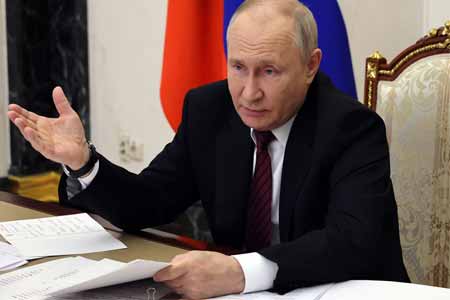 Putin: Armenia`s recognition of Karabakh as part of Azerbaijan in Prague has given Russia`s position on this issue an ambivalent character
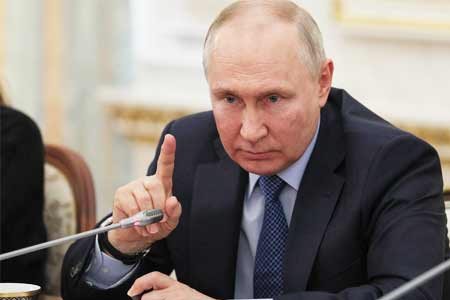 Putin: Armenia`s adoption of the law on EU accession means an announcement of its withdrawal from the Eurasian Economic Union
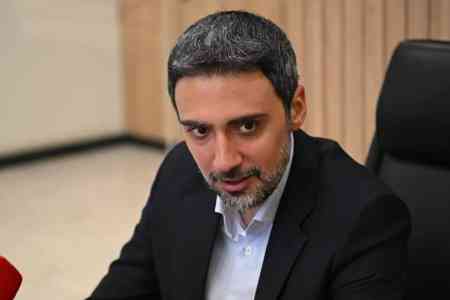 Aram Vardevanyan: Public demands solutions, not apology scandals in Parliament
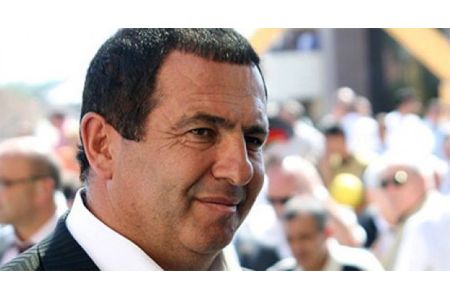 Arrested Armenian oligarch on economy and new jobs