

ArmInfo. The government of Armenia has proposed new regulations for the penitentiary service system. The corresponding amendments to the law "On Penitentiary Service" were approved at a sesion of the RA NA Committee on State and Legal Affairs.
Presenting the amendments, the RA Deputy Minister of Justice, Gevorg Kocharyan, noted that the adoption of the bill is driven by the need to resolve several issues that have arisen during the application of current legal norms. It also aims to clarify regulatory gaps that are incomplete and lead to misinterpretation.
Specifically, the bill proposes to expand recruitment opportunities for the service by eliminating the current age limit of 30 years. This adjustment will help attract experienced and qualified specialists to the system, while optimizing the order and structure of the penitentiary service.
The reform also plans to merge two separate departments that perform distinct functions but pursue the same objective: the escorting and security units of the service's central body will be consolidated into a single department. Furthermore, the scope of authority will be refined by revoking the service's right to grant parole and to supervise cases of conditional sentencing, given that these functions are now executed by the Probation Service. Flexible promotion mechanisms are also planned for introduction.
A penitentiary service employee who receives a positive evaluation following an official attestation process will be eligible for promotion to a higher position without undergoing a competitive selection process. The planned changes will clarify and simplify the conditions for appointments to basic and leadership positions.
Additionally, penitentiary employees will have the opportunity—on their own initiative and without a competition—to transfer to a lower position or a different service location. This ensures they can serve in an institution closer to their place of residence, or in another unit of the same institution if an equivalent position is unavailable.
The powers of the Minister of Justice regarding decision-making and review processes will also be clarified. Finally, the adopted amendments expand the grounds for dismissing an employee, introducing a provision for termination if an employee refuses an available vacant position. If there are no vacancies, the employee is dismissed from their current position and placed in the personnel reserve.





















 Armenian Historian: People Like Magdalena Grono Should Be Kept Away from the Thresholds of Armenian Shrines
 Azerbaijani studies expert: Armenia’s Foreign Ministry could use the ICC against Aliyev’s Armenophobic statements
 An Armenian political analyst exposed Hajiyev’s lies and attempts to mislead diplomats accredited in Azerbaijan in occupied Artsakh
 Expert: The circus surrounding the “Albanization” of Armenian culture in the presence of foreign ambassadors in occupied Artsakh is genocide
 Zakharova: Russia ready to discuss with Armenia the prospects for expanding military cooperation as part of a review of bilateral ties
 Tevanyan: Armenia, like Ukraine and Moldova, is being drawn into the EU’s global war
 Yerevan City Hall is considering introducing a valet parking system in the city
 Political scientist: If Russian-Armenian relations are destroyed, Turkey will take Russia`s place
 Political scientist: The Armenian public is simply obliged to significantly change the entire content of public discourse and struggle
 Cross tattoos are being removed from the skin of Christian prisoners in Azerbaijan by fire, according to a human rights activist.
 Zakharova: Armenia`s likely introduction of visas with Russia will be a step against Yerevan itself
 Putin: Armenia`s recognition of Karabakh as part of Azerbaijan in Prague has given Russia`s position on this issue an ambivalent character
 Putin: Armenia`s adoption of the law on EU accession means an announcement of its withdrawal from the Eurasian Economic Union
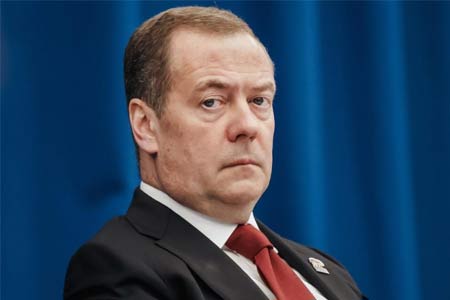 Medvedev: Yerevan will never become an EU member, but it will permanently damage relations with the Eurasian Economic Union, including with Moscow.
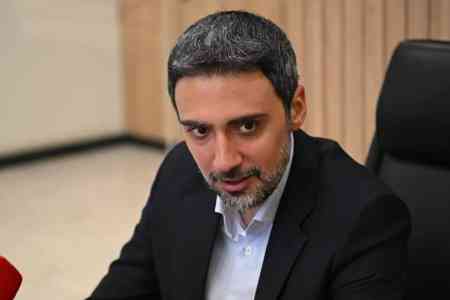 Aram Vardevanyan: Public demands solutions, not apology scandals in Parliament
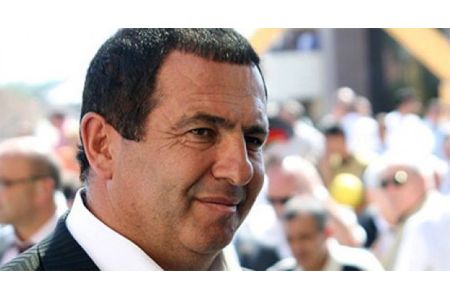 Arrested Armenian oligarch on economy and new jobs
 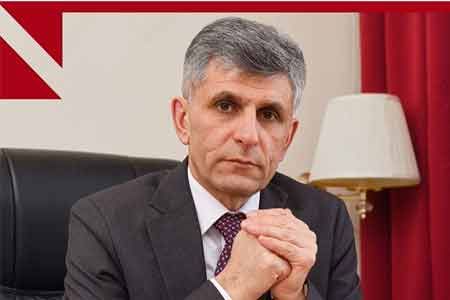 "In Baku, we gave a worthy rebuff to the false claims regarding the past and present of our people" – Former Artsakh Parliament Speaker from Baku captivity