
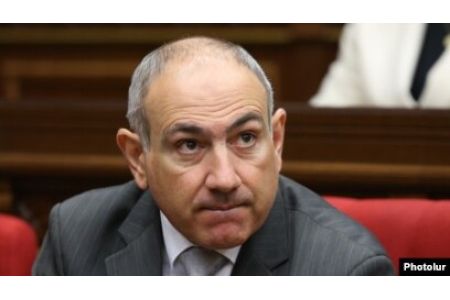
ArmInfo. RA Prime Minister Nikol Pashinyan expressed condolences over the death of People's Artist of Armenia Nikolay Tsaturyan.
"It was with deep sorrow that I learned of the passing of People's Artist of the Republic of Armenia Nikolay Tsaturyan. Nikolay Tsaturyan's creative career is one of the finest manifestations of the combination of life and work: for many years, he served Armenian theatrical art with exceptional dedication. His role and contribution to the cultural life of Armenia, to the education and formation of a new generation of Armenian theater, are invaluable. He was not only a master director, but also a dedicated teacher, who passed on his rich experience and knowledge to generations, shaping a unique taste characteristic of theater and cinema. His theatrical productions-"The Apricot Tree," "The Hours of Your Life," and "And Three Chairs Fell from the Sky"-truly enriched our theatrical culture.
At the same time, I would like to emphasize Nikolay Tsaturyan's role as an intellectual who spoke sharply and truthfully, constantly raising issues and problems relevant to the people.
On behalf of the Government of the Republic of Armenia and myself, I express "Our deepest condolences to Nikolay Tsaturyan's family, his relatives, colleagues, and all fans of Armenian theater," reads the condolence message distributed by the RA government press service.
It should be noted that People's Artist of the Republic of Armenia Nikolay Tsaturyan died at the age of 80. According to the press service of the Ministry of Education, Science, Culture, and Sports of Armenia, a government commission will be established to organize his funeral.
Nikolay Tsaturyan was born on January 8, 1945, in Yerevan. He graduated from the directing department of the Yerevan Art and Theater Institute, where he studied under Vardan Adjemyan. He later attended master classes in Moscow, where he studied with Andrei Tarkovsky, Semyon Tumanov, and Georgiy Daneliya. At the Armenfilm studio, he worked with Genrikh Malyan, Frunze Dovlatyan, and Vardan Adjemyan. He was second unit director on the films "We and Our Mountains," "The Saroyan Brothers," and "The Rock." He also worked as an intern at the Mosfilm studio on a film by Yuli Raizman. For nearly 20 years, Tsaturyan was the director of the Gabriel Sundukyan National Academic Theater in Yerevan, where he staged approximately 25 productions, including "The Apricot Tree" by Vahagn Davtyan, "The Hours of Your Life" by William Saroyan, "Mad Money" by Alexander Ostrovsky, "The Marriage of Figaro" by Pierre Beaumarchais, "Blue Horses on Red Grass" by Mikhail Shatrov, and "Save Our Souls" by Alexander Agasaryan. For many years, he taught at the Sundukyan Theater's acting studio. From 1992 to 2004, Nikolay Tsaturyan directed the Yerevan Metro Theater. During this time, he staged the plays "Willie, Titi, Jig, and a Girl" by Alexander Agasaryan, "Behind Closed Doors" by Jean-Paul Sartre, "Topaz" by Marcel Pagnol, and "And Three Chairs Fell from the Sky" by Hovhannes Margaryan. Since 1973, he taught at the Yerevan State Institute of Theater and Cinema. He has also staged productions in Moscow, Kyiv, Georgia, Beirut, and New York. For nearly 20 years, he collaborated with the "Petros Adamyan" theater troupe in Aleppo, where he staged 22 plays. He also starred in the films "Incident" and "Comrade Panjuni" directed by Armen Manaryan. In 2004, he was appointed artistic director of the Vardan Adjemyan State Drama Theater in Gyumri, and since 2014, he has served as the theater's artistic consultant. Nikolay Tsaturyan has worked with such outstanding actors as Metaxia Simonyan, Sos Sargsyan, Frunzik Mkrtchyan, and Karen Janibekyan. Among his most famous productions are Richard Kalinoski's "The Monster on the Moon," Friedrich Durrenmatt's "The Unrealized Labor of Hercules," Alexander Kalantaryan's "Boomerang," Karine Khodikyan's "How a Woman Left Home," Gabriel Sundukyan's "And Three Chairs Fell from the Sky" and "The Power of Money," Valentin Krasnogorov's "Casting of Love," William Gibson's "Flight" and "The Miracle Worker," and Alexander Agasaryan's "The Girl with Three Names."












 Armenian Historian: People Like Magdalena Grono Should Be Kept Away from the Thresholds of Armenian Shrines
 Azerbaijani studies expert: Armenia’s Foreign Ministry could use the ICC against Aliyev’s Armenophobic statements
 An Armenian political analyst exposed Hajiyev’s lies and attempts to mislead diplomats accredited in Azerbaijan in occupied Artsakh
 Expert: The circus surrounding the “Albanization” of Armenian culture in the presence of foreign ambassadors in occupied Artsakh is genocide
 Zakharova: Russia ready to discuss with Armenia the prospects for expanding military cooperation as part of a review of bilateral ties
 Tevanyan: Armenia, like Ukraine and Moldova, is being drawn into the EU’s global war
 Yerevan City Hall is considering introducing a valet parking system in the city
 Political scientist: If Russian-Armenian relations are destroyed, Turkey will take Russia`s place
 Political scientist: The Armenian public is simply obliged to significantly change the entire content of public discourse and struggle
 Cross tattoos are being removed from the skin of Christian prisoners in Azerbaijan by fire, according to a human rights activist.
 Zakharova: Armenia`s likely introduction of visas with Russia will be a step against Yerevan itself
 Putin: Armenia`s recognition of Karabakh as part of Azerbaijan in Prague has given Russia`s position on this issue an ambivalent character
 Putin: Armenia`s adoption of the law on EU accession means an announcement of its withdrawal from the Eurasian Economic Union
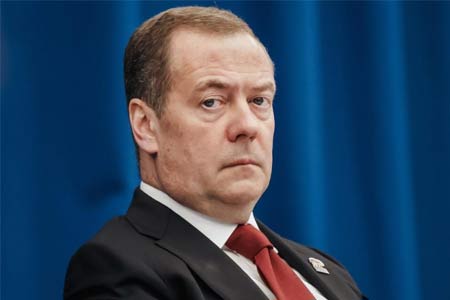 Medvedev: Yerevan will never become an EU member, but it will permanently damage relations with the Eurasian Economic Union, including with Moscow.
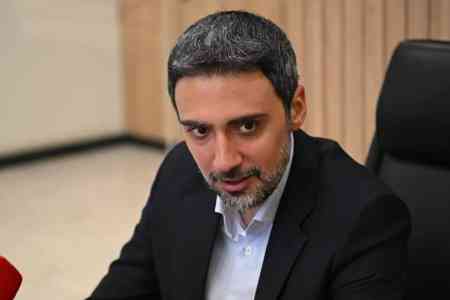 Aram Vardevanyan: Public demands solutions, not apology scandals in Parliament
 Arrested Armenian oligarch on economy and new jobs
 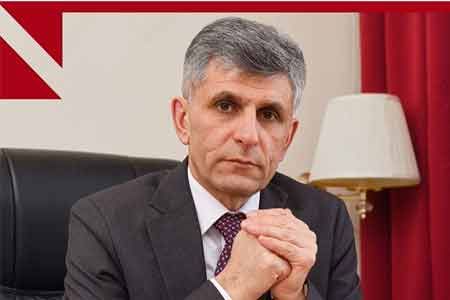 "In Baku, we gave a worthy rebuff to the false claims regarding the past and present of our people" – Former Artsakh Parliament Speaker from Baku captivity