
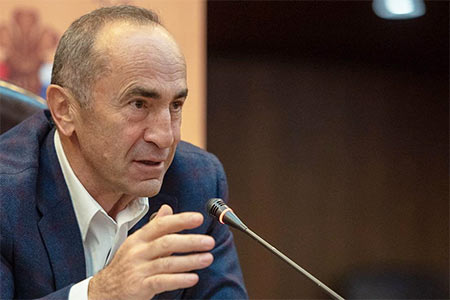
ArmInfo.Small countries must avoid getting entangled in the contradictions between major geopolitical players, as stated by former Armenian President Robert Kocharyan during an interview with RTVI. He pointed out that the Kremlin's concern regarding Yerevan's current policy is well-founded.
He criticized the Armenian leadership for pursuing a "geopolitical pivot" toward the European Union despite the total lack of clear prospects for actual membership.
The Europeans, as the former president noted, encourage Armenia in any steps that could irritate Russia, and Armenia is essentially following this path. "The experience of Georgia, the experience of Saakashvili, teaches nothing to the Armenian Prime Minister. Our approach is this: you can't get involved in the contradictions of major geopolitical players, especially small countries, because then disaster is sure to follow. We must interact with geopolitical centers in areas where interests converge, and not interfere where they diverge. Look at Pashinyan's formula. We are going to the European Union, we froze membership in the CSTO, and with the Eurasian Economic Community, everything is fine as long as it benefits us. I think for a great country, this is even insulting. I don't think any small country can formulate its foreign policy objectives and priorities in this way with the Americans, with Brussels for example. And this cannot but cause irritation. But the Russian leadership is patient, and I have the feeling that they tolerated this for a long, long time, until it reached a certain point, and they decided to speak out. But the tension - it's always been the case, as it seems to me and as far as I understand this situation, it was all held back in the hope that people would eventually learn, that people would begin to better understand how to build foreign policy guidelines," Robert Kocharyan emphasized.
He also pointed out Armenia's enormous economic dependence on Russia, and it must be strange for Moscow if the Armenian leadership pursues foreign policy in isolation from the country's economic interests. "These are movements in completely different directions: on the one hand, there's a sort of political statement about rapprochement with the European Union, on the other, the EU's share in foreign trade is decreasing, while Russia's is increasing. This divergence suggests that people simply don't understand what they're doing," the former president noted.
He also recalled that it was during his presidency that Yerevan spoke of a complementary policy, which had practical implications. "By the way, during my tenure, trade with the European Union was approximately the same as trade with Russia, but we never said that politically we were moving toward the European Union. Firstly, that's unrealistic, and secondly, we live in a region where the European Union has no intention of joining," Robert Kocharyan added. The former president expressed confidence that the European Union would freeze its enlargement policy. "There's a very serious crisis there; they need to figure out their own identity, what they want, and where they're heading. But the security system we were in is tied to Russia. You can't be in one security system and somehow move somewhere else politically; that's strange behavior. I think this is the behavior of people who don't understand the fundamental principles of international relations and security," the former president noted. Answering the question of whether he personally sees Armenia within the orbit of Russia or the European Union, the former president noted that the word "orbit" doesn't quite capture what's happening.
"Today, even according to official statistics, more than 40% of trade turnover is with Russia. Almost everything is tied to Russia—more than 60% of trade turnover, including parallel imports, exports, all of these flows. And in this situation, talking about any other benchmarks is simply pointless. The most pragmatic task for Armenia is to develop these relations, to integrate into a huge market—the Russian market, the EurAsEC market. There is simply no other market that can replace this one. I know how difficult it is to enter the European market for every product group. It's enormously challenging. They defend their market zealously, very persistently, and have found very interesting mechanisms for protecting this market through phytosanitary controls. Every government must think about the security and well-being of its state and its people," the former president emphasized.





 Opinion: The development of the Amulsar mine near the resort town of Jermuk is the beginning of an environmental disaster in Armenia
 Expert: The arrest of opposition figures in Armenia for social media posts is a systematic attempt to intimidate the public and suppress dissent.
 Azerbaijani Studies Expert: While Azerbaijan Prepares Its Generation for War, Aliyev’s Aide Calls on Armenia to Prepare Armenian Society for “Peace”
 Turkologist: Azerbaijan will never, under any circumstances, stop pressuring the Armenian people
 Political scientist: We need to move away from the question of "when" and replace it with more important questions
 Lukashenko called for Armenia to assume the CIS presidency in 2029
 Dmitry Medvedev predicted a Ukrainian-like fate for Armenia amid the country`s shift in foreign policy
 Russian Security Council: In Armenia, they want to force Russian asset owners to dispose of their assets
 Zakharova: Russia ready to discuss with Armenia the prospects for expanding military cooperation as part of a review of bilateral ties
 Tevanyan: Armenia, like Ukraine and Moldova, is being drawn into the EU’s global war
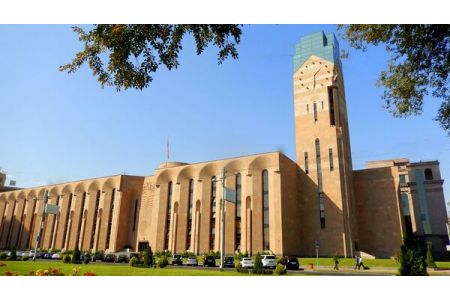 Yerevan City Hall is considering introducing a valet parking system in the city
 Expert: The circus surrounding the “Albanization” of Armenian culture in the presence of foreign ambassadors in occupied Artsakh is genocide
 Political scientist: If Russian-Armenian relations are destroyed, Turkey will take Russia`s place
 Political scientist: The Armenian public is simply obliged to significantly change the entire content of public discourse and struggle
 Cross tattoos are being removed from the skin of Christian prisoners in Azerbaijan by fire, according to a human rights activist.
 Zakharova: Armenia`s likely introduction of visas with Russia will be a step against Yerevan itself
 Putin: Armenia`s recognition of Karabakh as part of Azerbaijan in Prague has given Russia`s position on this issue an ambivalent character
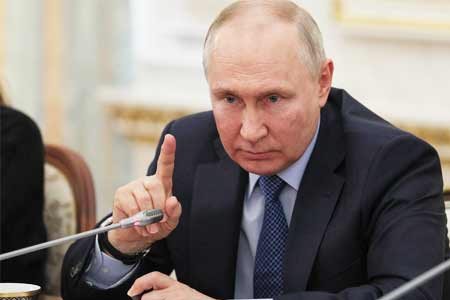 Putin: Armenia`s adoption of the law on EU accession means an announcement of its withdrawal from the Eurasian Economic Union
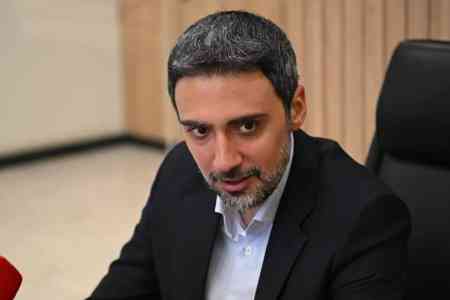 Aram Vardevanyan: Public demands solutions, not apology scandals in Parliament