

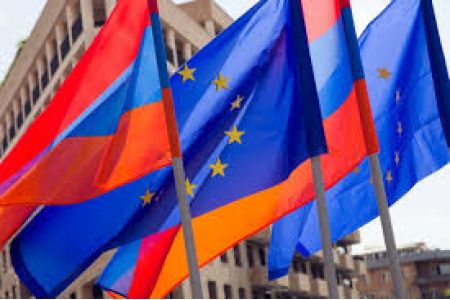
ArmInfo. Today, EU ambassadors approved a decision to send a new civilian mission to Armenia in Brussels, as reported by the RFE/RL's Armenian service, emphasizing that this decision paves the way for final approval, which is expected to take place at a meeting of EU foreign ministers next week.
The source writes that it has at its disposal a proposal from the EU High Commissioner for Foreign Affairs and Security Policy regarding the mandate, structure, and duration of this new mission. According to the document, the mission will strengthen Armenia's resilience to hybrid threats by providing strategic and practical advice and support to the country's ministries and security agencies. "These consultations will focus on policy development, detection, and response to external information manipulation, cyberattacks, as well as illicit financial flows. The mission will also assess what is needed to develop Armenia's security capabilities so that it can better identify and respond to hybrid threats in line with EU methodologies and standards," the publication continues.
Earlier, in a document justifying the need for the mission, the EU Foreign Office stated that the upcoming parliamentary elections in Armenia in June, subsequent local elections, and a possible constitutional referendum will be a decisive test not only for domestic stability but also for regional peace. "Several years ago, Baku criticized the decision to deploy unarmed European observers on its border with Armenia and ultimately achieved its goal, clearly stipulating in the peace treaty with Armenia that no third-party forces would be deployed on the common border. Now, by sending a new mission to Armenia, Brussels emphasizes that its goal is to 'reduce and neutralize Russia's destabilizing actions,'" the source writes.
Recall, Radio Liberty previously reported that it had a letter from Armenian Foreign Minister Ararat Mirzoyan to Brussels at its disposal, in which he "requested the deployment of a rapid response team to Yerevan to counter Kremlin disinformation and Russian interference in the Armenian parliamentary elections, and then, possibly, a more permanent civilian mission." In this regard, it was recalled that the EU sent a similar team of approximately 20 people to Chisinau during last year's parliamentary elections "to help Moldovan authorities identify and counter disinformation emanating from Russia on social media." It should be added that the EU's top diplomat, Kaja Kallas, previously announced the allocation of 15 million euros to Armenia to "counter Russian propaganda."







 Expert on protests in France: Civilizations fade when society loses a vision of the future
 Turkologist: Azerbaijan is not all-powerful—its vulnerabilities should become part of Armenia’s security strategy
 Opinion: The development of the Amulsar mine near the resort town of Jermuk is the beginning of an environmental disaster in Armenia
 Expert: The arrest of opposition figures in Armenia for social media posts is a systematic attempt to intimidate the public and suppress dissent.
 The Artsakh Public Council expressed outrage at the UN Secretary-General`s behavior
 Lukashenko called for Armenia to assume the CIS presidency in 2029
 Dmitry Medvedev predicted a Ukrainian-like fate for Armenia amid the country`s shift in foreign policy
 Russian Security Council: In Armenia, they want to force Russian asset owners to dispose of their assets
 Zakharova: Russia ready to discuss with Armenia the prospects for expanding military cooperation as part of a review of bilateral ties
 Tevanyan: Armenia, like Ukraine and Moldova, is being drawn into the EU’s global war
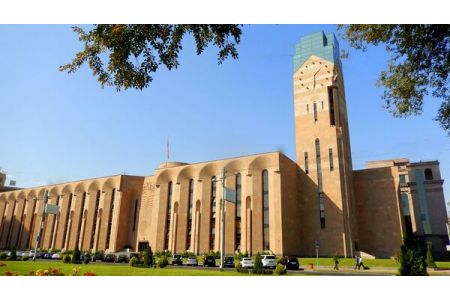 Yerevan City Hall is considering introducing a valet parking system in the city
 Expert: The circus surrounding the “Albanization” of Armenian culture in the presence of foreign ambassadors in occupied Artsakh is genocide
 Political scientist: If Russian-Armenian relations are destroyed, Turkey will take Russia`s place
 Political scientist: The Armenian public is simply obliged to significantly change the entire content of public discourse and struggle
 Cross tattoos are being removed from the skin of Christian prisoners in Azerbaijan by fire, according to a human rights activist.
 Zakharova: Armenia`s likely introduction of visas with Russia will be a step against Yerevan itself
 Putin: Armenia`s recognition of Karabakh as part of Azerbaijan in Prague has given Russia`s position on this issue an ambivalent character
 Putin: Armenia`s adoption of the law on EU accession means an announcement of its withdrawal from the Eurasian Economic Union
