
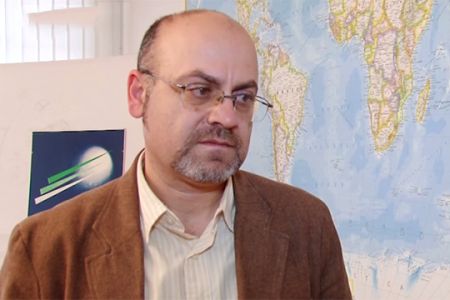
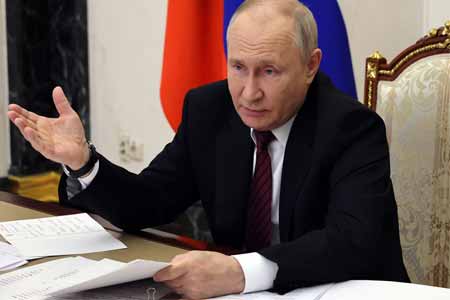
ArmInfo. The statements made by Russian President Vladimir Putin in Moscow during his meeting with Armenian Prime Minister Nikol Pashinyan were addressed to Armenian voters and aimed at influencing pre-election sentiments in the country. This is stated in a commentary received by ArmInfo by Aghasi Tadevosyan, a senior researcher at the Institute of Archaeology and Ethnography of the National Academy of Sciences of the Republic of Armenia and a cultural anthropologist, on the April meeting of the Armenian and Russian leaders in Moscow.
According to him, the Russian president essentially used a carrot and stick tactic. "On the one hand, he voiced threats and similar statements, but on the other, it was very interesting that he spoke about the centuries-old friendship between the Armenian and Russian peoples and the traditions that underpin this friendship. At the same time, he emphasized fostering a positive attitude toward the Russian businessman, a pro-Russian politician, as he called him (Samvel Karapetyan - ed.)," Tadevosyan noted.
According to the cultural anthropologist, if one were to try to formulate the Russian president's message in one sentence, it would be as follows: "Dear Armenian voter, I propose a Russian businessman or pro-Russian politician in this election. Otherwise, the friendship between Armenia and Russia will suffer, which means the threats I mentioned will be realized." "This speech was addressed to Armenian voters and aimed at influencing pre-election sentiment. It is also noteworthy that throughout his speech, the Russian president avoided using the terms 'Armenia' and 'citizen of Armenia,' instead relying on 'Armenian people,' 'Armenianity,' 'Armenian community,' and similar expressions," Tadevosyan noted.
According to him, this demonstrates a "value-based approach that prioritizes not Armenia's sovereignty and statehood, but the Armenian nation living under Russian jurisdiction." Summing up, the expert stated that the Russian president's rhetoric fits perfectly with the logic of the hybrid attacks recently launched against Armenia. "And, by the way, such talk is being heard at the level of the country's top official. What consequences could this have, if any? It can be assumed that it does, and this could be because this talk and these approaches are being generated by various, so to speak, pro- Russian circles to influence the mood of Armenian voters during the pre-election period. What can be done? We need to approach all of this consciously and not succumb to manipulation," Tadevosyan concluded.
As a reminder, Putin and Pashinyan held talks in Moscow on April 1. The meeting took place in a rather tense atmosphere, with the parties exchanging mutual accusations. The Russian leader emphasized Moscow's position on Yerevan's claims against the CSTO, the Nagorno-Karabakh issue, Yerevan's integration into the EU, and further cooperation with the Eurasian Economic Union. The Russian leader also conveyed Moscow's position on the construction of the nuclear power plant and the persecution of Russian businessman Samvel Karapetyan in Armenia. Pashinyan, for his part, assured of the friendly nature of bilateral relations, recalled the claims against the CSTO, attempted to shift responsibility for the surrender of Artsakh to Russia, and declared that Russian citizens would not be able to participate in political processes in Armenia.





 Expert: Economic pressure on Armenia may be virtually painless for other EAEU members, but not for Armenia itself
 Expert on protests in France: Civilizations fade when society loses a vision of the future
 Turkologist: Azerbaijan is not all-powerful—its vulnerabilities should become part of Armenia’s security strategy
 Opinion: The development of the Amulsar mine near the resort town of Jermuk is the beginning of an environmental disaster in Armenia
 Expert: The arrest of opposition figures in Armenia for social media posts is a systematic attempt to intimidate the public and suppress dissent.
 The Armenian Foreign Minister commented on the country`s return to work within the CSTO.
 The Artsakh Public Council expressed outrage at the UN Secretary-General`s behavior
 Lukashenko called for Armenia to assume the CIS presidency in 2029
 Dmitry Medvedev predicted a Ukrainian-like fate for Armenia amid the country`s shift in foreign policy
 Russian Security Council: In Armenia, they want to force Russian asset owners to dispose of their assets
 Zakharova: Russia ready to discuss with Armenia the prospects for expanding military cooperation as part of a review of bilateral ties
 Tevanyan: Armenia, like Ukraine and Moldova, is being drawn into the EU’s global war
 Yerevan City Hall is considering introducing a valet parking system in the city
 Expert: The circus surrounding the “Albanization” of Armenian culture in the presence of foreign ambassadors in occupied Artsakh is genocide
 Political scientist: If Russian-Armenian relations are destroyed, Turkey will take Russia`s place
 Political scientist: The Armenian public is simply obliged to significantly change the entire content of public discourse and struggle
 Cross tattoos are being removed from the skin of Christian prisoners in Azerbaijan by fire, according to a human rights activist.
 Zakharova: Armenia`s likely introduction of visas with Russia will be a step against Yerevan itself
 Putin: Armenia`s recognition of Karabakh as part of Azerbaijan in Prague has given Russia`s position on this issue an ambivalent character
 Putin: Armenia`s adoption of the law on EU accession means an announcement of its withdrawal from the Eurasian Economic Union