
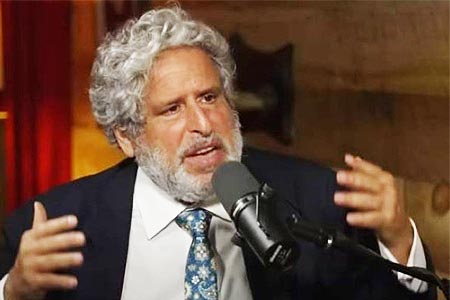
ArmInfo. Robert Amsterdam, founder and managing partner of Amsterdam & Partners LLP and attorney for Strong Armenia party leader Samvel Karapetyan, has urged the European Union suspend the deployment and activities of the Hybrid Rapid Response Team (HRRT) to Armenia, as stated in a formal legal complaint he has sent to EU leadership, including European Commission President Ursula von der Leyen.
In its letter to von der Leyen, Amsterdam recalled that he represents the interests of businessman Samvel Karapetyan. "As you read this letter, my client remains subject to political persecution, which the European Commission has not only failed to condemn but is actively funding.
I will be blunt: what the European Union is doing in Armenia is not democratic asisistance. It is electoral interference. The deployment of a Hybrid Rapid Response Team (HRRT) operating exclusively with the government, the channeling of millions of euros of European public funds without the slightest guarantee of neutrality, and an unprincipled reform of the Electoral Code designated specifically to exclude the use of personal names in blocs of electoral alliances, are a pattern we have seen before," the lawyer noted.
He added that the hastily adopted amendments to the Electoral Code by the ruling party in Armenia marked a turning point and once again demonstrates the application of double standards. Amsterdam added that when he wrote to the President of the European Parliament warning of the criminal prosecution of his client, the arrests of his lawyers, and the imprisonment of clergy, the response from the EU Delegation to Armenia was that "these are matters within the competence of the Armenian authorities."
"Not a single word of condemnation. Not a single sign of concern. We were told these were 'internal matters.' However, when it comes to deploying a rapid response team to shape the electoral agenda, allocating 27 million EUR to 'fight disinformation' (which coincidentally aligns with the opposition's rhetoric), and exporting the 'Moldovan model' three months before the elections, then yes, Armenia ceases to be an internal matter and becomes a European affair. The criminalization of the opposition is Armenia's problem, while interference in elections in favor of a government that criminalizes the opposition is a European project. These are the Commission's double standards, and this letter officially points this out," Amsterdam stated. He reiterated that days earlier, the Armenian authorities amended the Electoral Code immediately before the elections, banning the use of personal names in electoral blocs. According to the lawyer, this is not a procedural reform: it is a legislative trap specifically designed to target Samvel Karapetyan and the "Strong Armenia" bloc. "When a government, fearing genuine competition, resorts to legislatively excluding its opponents' identities from the election campaign itself, the international community must recognize this for what it is: political sabotage and the ultimate destruction of free and fair elections," the legal expert added.
In this vein, he added that the deployment of the Hybrid Rapid Response Team to Armenia, funded through the NDICI-Global Europe instrument with a budget of 27 million euros, supposedly aimed at combating "hybrid threats," is in reality a mechanism for direct interference in Armenia's domestic political arena, creating a clear and structural imbalance between the ruling government and the opposition. "The mechanism operates by securitizing opposition discourse. When the Commission dispatches a team tasked with monitoring 'public narratives' during the pre-election period, it introduces a conceptual framework to Armenia-the concept of a 'hybrid threat'-that allows it to view the political opposition as an extension of Russian interference. This framework requires no proof that the opposition is a tool of Moscow; it suffices to use security-focused terminology to reclassify legitimate political opinions as a threat to national security. As a result, the debate about the opposition's legitimacy is transferred from the democratic sphere to the security sphere, where the standards of evidence are lower and the powers that be have greater leeway," Amsterdam asserts.
He emphasized that Pashinyan's government is already using the Russian interference argument to justify the criminal prosecution of the opposition and the clergy. By providing this government with a European team specializing in "countering disinformation," the Commission is not combating external threats, but rather lending supranational legitimacy to the ruling government's repressive narratives. "Ultimately, there is no mechanism that would prevent the Armenian government from using the European team to discredit, as 'Russian propaganda,' the discourse of an opposition that simply disagrees with government policy. The asymmetry is structural and unjustified: the government receives European funding, which it can use to strengthen its electoral position, while the opposition not only lacks such funding but is also an indirect target of the actions this funding supports. The opposition was not consulted when developing this action. An independent oversight mechanism was not established. Objective and publicly accessible criteria for classifying content as 'disinformation' were not published," the lawyer continued.
At the same time, he expressed conviction that the Commission's silence regarding the recent amendments to Armenia's Electoral Code is also unacceptable, and the ban on the use of personal names in electoral blocs, introduced immediately before the elections, is a legislative trap designed to neutralize Samvel Karapetyan and the "Strong Armenia" bloc. "The rules of the game are being changed mid-game to force specific individuals out of politics. This isn't democracy. This is legal terror, and the fact that the Commission doesn't condemn it, while simultaneously deepening cooperation with the responsible government, makes the Commission complicit in the destruction of Armenian democracy. We will not allow legislation to become a punitive instrument. "We will challenge this illegality on every possible platform," Amsterdam stated.
In light of all of the above, the lawyer demanded that the European Commission immediately suspend the deployment and activities of the Hybrid Rapid Response Team in Armenia until independent and transparent oversight mechanisms, including the participation of opposition representatives, are established. Furthermore, the Commission must publish a detailed operational mandate for the team, the criteria used to classify content as "disinformation," and the appeal mechanisms available to those affected by its decisions; conduct an independent assessment of the impact of the 27 million EUR allocation on the balance of political competition in Armenia and suspend payments until this assessment is completed; publicly condemn amendments to Armenia's Electoral Code prohibiting the use of individuals' names in electoral blocs as interference in free and fair elections; and, ultimately, apply to Armenia the same standards of conditionality for respect for the rule of law that the EU applies to its member states and condition continued cooperation on the release of politically motivated detainees and an end to the persecution of opposition figures, clergy, and lawyers.
"Should the Commission fail to take appropriate and timely action in response to the above demands, we hereby formally notify that we will take the following legal action: filing an annulment action under Article 263 of the Treaty on the Functioning of the European Union (TFEU) in the General Court of the European Union challenging the financial execution acts allocating funds from NDICI-Global Europe to the operation in Armenia, as well as an injunction action seeking the immediate suspension of the deployment and disbursement of funds on the grounds that damages have not been claimed but have already materialized in similar circumstances in Moldova and Romania," Amsterdam said.
He added that they are prepared to engage in any other proceedings that may be necessary in international fora, including, but not limited to, the European Court of Human Rights, to protect the rights of the Armenian opposition and hold the European Union accountable for its role in undermining democracy in Armenia. "The European Union does not act as a neutral guarantor of democracy in Armenia. It is an active participant in creating a favorable electoral environment for the ruling government. Justice is not for sale, and democracy cannot be a one-way street. We will challenge this illegality on every possible platform and hold the Commission accountable for its complicity in the destruction of Armenian democracy," he concluded.
Earlier, the EU announced it would allocate 15 million EUR to Armenia to combat hybrid threats in response to a request for assistance from the Armenian authorities.















 Russian political scientist: Moscow`s reaction to the TRIPP project will largely depend on the trend in Russian-American relations
 Armenian Political Scientist: The approaches, methods, rmphases and content of today’s struggle in Armenia Cannot Remain the Same
 Political scientist: Armenians will live peacefully in their homeland only when they can once again set national goals for themselves, such as Artsakh
 Russian Security Council: In Armenia, they want to force Russian asset owners to dispose of their assets
 Zakharova: Russia ready to discuss with Armenia the prospects for expanding military cooperation as part of a review of bilateral ties
 Tevanyan: Armenia, like Ukraine and Moldova, is being drawn into the EU’s global war
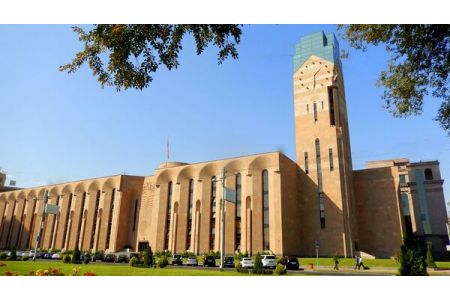 Yerevan City Hall is considering introducing a valet parking system in the city
 Expert: The circus surrounding the “Albanization” of Armenian culture in the presence of foreign ambassadors in occupied Artsakh is genocide
 Political scientist: If Russian-Armenian relations are destroyed, Turkey will take Russia`s place
 Political scientist: The Armenian public is simply obliged to significantly change the entire content of public discourse and struggle
 Cross tattoos are being removed from the skin of Christian prisoners in Azerbaijan by fire, according to a human rights activist.
 Zakharova: Armenia`s likely introduction of visas with Russia will be a step against Yerevan itself
 Putin: Armenia`s recognition of Karabakh as part of Azerbaijan in Prague has given Russia`s position on this issue an ambivalent character
 Putin: Armenia`s adoption of the law on EU accession means an announcement of its withdrawal from the Eurasian Economic Union
 Medvedev: Yerevan will never become an EU member, but it will permanently damage relations with the Eurasian Economic Union, including with Moscow.
 Aram Vardevanyan: Public demands solutions, not apology scandals in Parliament
 Arrested Armenian oligarch on economy and new jobs
  "In Baku, we gave a worthy rebuff to the false claims regarding the past and present of our people" – Former Artsakh Parliament Speaker from Baku captivity