

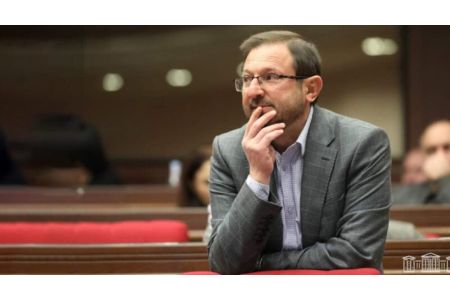
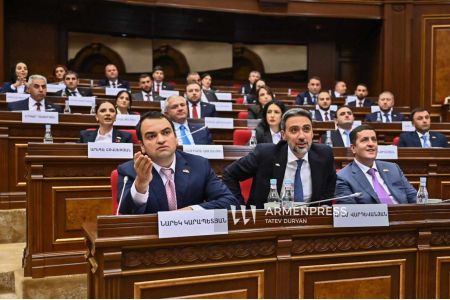
ArmInfo. Instead of properly ensuring information and psychological security in the army, Armenian Defense Minister Suren Papikyan and the ministry he leads are caught in the middle of the ruling Civil Contract party's pre-election turmoil. This was stated by Gegham Manukyan, a member of the Armenian parliament from the opposition Armenia faction, in a video message on his Facebook page.
He stated that the Armenian army is currently facing unprecedented information threats, which remain ignored by the armed forces' leadership. "While the Defense Minister is busy campaigning, the threats are mounting: the country's information and psychological security is under attack, every day is a worrying time for families with military personnel, and the chaos in Armenia's security sector seems endless," the MP emphasized.
Manukyan recalled that the ruling Civil Contract party had previously published its election platform, which, among other things, addressed the country's security and the Armenian Armed Forces. However, as the MP noted, this topic is addressed more from a populist perspective than from a substantive one. In this regard, the MP called for attention to be paid to a new, dangerous phenomenon in the Armenian Armed Forces. "Recently, we've been seeing articles with headlines about accidents in some unit, stabbings during a 25-day training exercise between conscripts, explosions in a military unit, injuries to contract soldiers, accidents involving military vehicles, and so on. Such news appears and spreads like lightning throughout the Armenian media landscape. Meanwhile, the Armenian Ministry of Defense remains silent, as the Ministry, headed by Papikyan, is currently focused solely on the election campaign and attacks on the Armenian Apostolic Church, instead of discussing the country's security issues. These are all issues that the Armenian Ministry of Defense is responsible for addressing," the opposition figure noted.
Manukyan noted that previously, no media outlet would publish news about military accidents until the first, last, and patronymic names of the wounded, deceased, or killed service member were known. Because, as the MP explained, everyone understood the danger of such actions at the time, including thanks to joint work with the Armenian Ministry of Defense. The media understood that news of each such incident, without additional information about who it happened to, would cause anxiety for all parents whose children were serving.
"However, chaos reigns in the Armenian army now; there are no names or surnames. The Ministry spends hours not confirming the news or commenting. Meanwhile, this is, in fact, a very important security buffer, affecting both the reputation of the Armenian Armed Forces, information security, and, ultimately, public peace. Families closely connected to the army through their children serving there find themselves in a vulnerable position amidst information chaos," Manukyan concluded.
As a reminder, on April 4, the ruling Civil Contract party presented its election platform, the ideological foundation of which is the idea of "Real Armenia" and the doctrine of the country's economic and institutional transformation. One of the provisions of this platform addresses the ruling party's vision for ensuring the country's security. Thus, according to the "Civil Contract" program, the army is a reserve instrument for ensuring external security in case diplomatic measures fail.














 International Law Specialist: Azerbaijan intends to initiate legal proceedings against Armenia by sentencing Armenian prisoners
 An Armenian Turkologist spoke out against attempts to deny the value of Artsakh and the liberation of Armenia.
 Russian political scientist: Moscow`s reaction to the TRIPP project will largely depend on the trend in Russian-American relations
 Armenian Political Scientist: The approaches, methods, rmphases and content of today’s struggle in Armenia Cannot Remain the Same
 Russian Security Council: In Armenia, they want to force Russian asset owners to dispose of their assets
 Zakharova: Russia ready to discuss with Armenia the prospects for expanding military cooperation as part of a review of bilateral ties
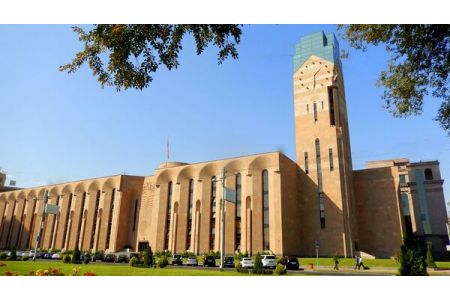 Yerevan City Hall is considering introducing a valet parking system in the city
 Expert: The circus surrounding the “Albanization” of Armenian culture in the presence of foreign ambassadors in occupied Artsakh is genocide
 Political scientist: If Russian-Armenian relations are destroyed, Turkey will take Russia`s place
 Political scientist: The Armenian public is simply obliged to significantly change the entire content of public discourse and struggle
 Cross tattoos are being removed from the skin of Christian prisoners in Azerbaijan by fire, according to a human rights activist.
 Zakharova: Armenia`s likely introduction of visas with Russia will be a step against Yerevan itself
 Putin: Armenia`s recognition of Karabakh as part of Azerbaijan in Prague has given Russia`s position on this issue an ambivalent character
 Putin: Armenia`s adoption of the law on EU accession means an announcement of its withdrawal from the Eurasian Economic Union
 Medvedev: Yerevan will never become an EU member, but it will permanently damage relations with the Eurasian Economic Union, including with Moscow.
 Arrested Armenian oligarch on economy and new jobs
  "In Baku, we gave a worthy rebuff to the false claims regarding the past and present of our people" – Former Artsakh Parliament Speaker from Baku captivity