
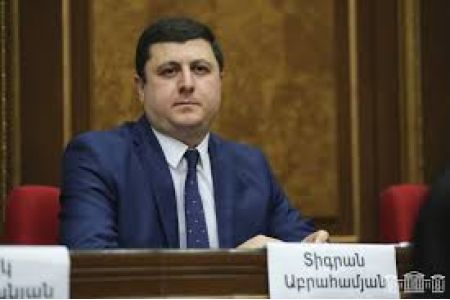
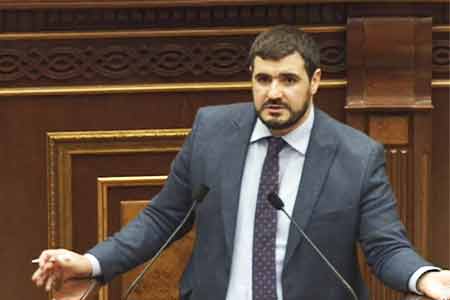
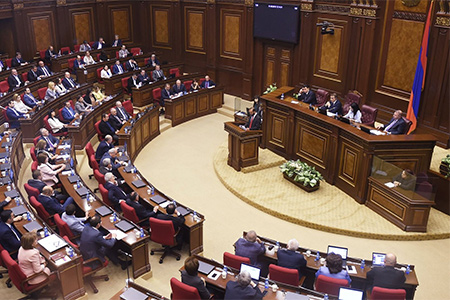
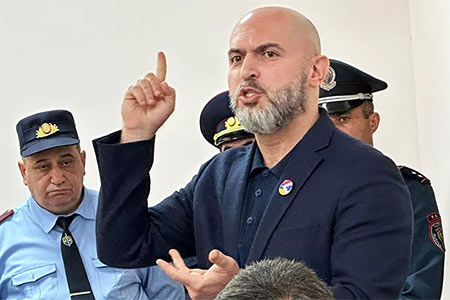
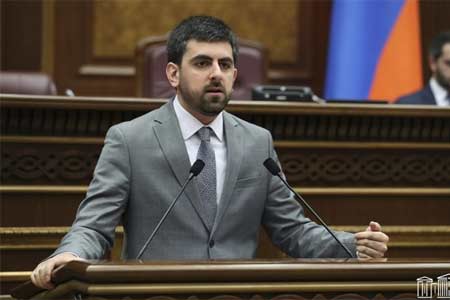
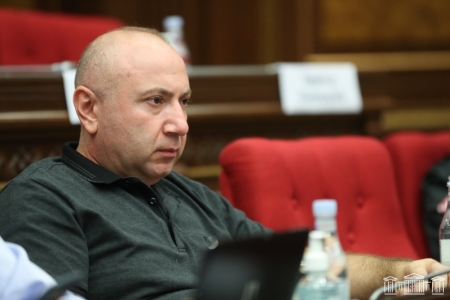
ArmInfo. National Assembly Member Tigran Abrahamyan, from the opposition "With Honor" faction, presented a draft statement "on the situation in relations between the state and the Armenian Apostolic Church (AAC)" during parliamentary hearings.
The parliamentary hearings began with a moment of silence to mark the 10th anniversary of the four-day April War in Artsakh. The hearings were convened to discuss the current situation in the country, particularly in light of the Armenian authorities' attacks on the AAC. The opposition figure emphasized that the crisis in relations between the Armenian authorities and the Armenian Church is not only dangerous but also requires a broader analysis. "This isn't just about the anti-national actions of the Armenian authorities and their touching on sensitive issues, but also about where the government's authority ends. This raises questions about whether the law in our country functions as a certain feature or as a tool. Ultimately, this concerns the security of Armenian citizens, regardless of whether they are followers of the Armenian Apostolic Church or not," Abrahamyan noted.
According to the opposition leader, the government's interference in the internal affairs of the Armenian Church, the arrest of clergy for defending the homeland or for expressing their position, demonstrates the lack of a deterrent mechanism that would prevent the crossing of red lines that bring the country closer to the point of no return. "Recently, numerous situations have arisen that raise questions about the boundaries in the relationship between the Armenian Apostolic Church and the authorities. We are seeing statements and decisions that allow state bodies, including courts and law enforcement agencies, to interfere in the internal affairs of the Church. This is no longer a technical or procedural issue, but a matter of the principle of the rule of law," the MP noted. As Abrahamyan noted, the crux of the problem lies in the fact that the Armenian Church, like any religious structure, has its own internal canons and decision-making rules. In this context, he said, the government has the right to monitor compliance with laws in the country, but it has no right to change the decision-making mechanisms within the Church or dictate who should perform church services and how church bodies should operate, as reflected in the draft statement submitted by their faction.
The opposition member also pointed out to another sensitive issue: interference in church rites. The statement, as the MP noted, raises the question of whether a civil servant or the state system can influence the conduct of church rites, including which names should be mentioned in liturgies. "Our stance on this issue is clear: the state cannot interfere in church affairs, as this violates the constitutional principle of neutrality, and thus the authorities are essentially encroaching on territory that is not under their control," Abrahamyan noted. At the same time, as the deputy noted, the draft statement is not limited to simply recording concerns about current events but also proposes a number of practical solutions.
First and foremost, he stated, is the need to ensure legal transparency, which implies the existence of clear, publicly accessible standards for investigative and law enforcement agencies regarding religious freedom. "Secondly, there is a need for international legal advice. The program proposes contacting the Venice Commission for a professional opinion on the limits of government intervention in matters of the Church's internal governance and on the criteria that courts and other authorities should follow in such situations," the deputy continued.
The third proposal, Abrahamyan noted, concerns the depolarization of the justice system. The MP clarified that this means that in highly publicized cases, the criteria of judicial independence and extrajudicial investigation must be even more strictly adhered to. He stated that society must be confident that no case will be used as a means of pressure or an impetus to change the internal affairs of any institution.
Finally, the fourth and final point, as the opposition member noted, addresses the role of the Human Rights Defender of Armenia in these matters. Abrahamyan stated that when it comes to religious freedom, it is necessary not only to document the problem but also to assess the risks and propose steps to prevent further interference. "Today, all of this is important for Armenia's future. Because if we accept that the government can overstep its authority, then tomorrow, by the same logic, the same thing could happen to another structure, group, or even individual, which is no longer uncommon these days. The rule of law is essential precisely in such cases-not only when everything is calm, but also when tensions arise and the temptation arises to resolve issues not through law, but through force. The state is obligated to respect the self- governance of religious organizations. We are not alone in speaking about the exceptional role of the Armenian Apostolic Church; this is also enshrined in the Constitution of Armenia. And if we can convey a message to Armenian society, it would be this: in the Republic of Armenia, no one can stand above the Constitution; no state structure has the right to overstep the boundaries established by it. Freedom to all clergy who are currently imprisoned!" Abrahamyan concluded.
It should be noted that, according to the Constitution of Armenia, the Armenian Apostolic Church is separate from the state and has a special mission. However, since May of this year, the country's authorities have been pursuing an active anti-church policy and seeking the resignation of Catholicos of All Armenians Karekin II, who was elected to this position posthumously. This campaign has targeted both clergy and citizens who support the Church. To date, four high-ranking clergy have been imprisoned on trumped-up charges as part of this anti-church campaign.














 Who and why is sacrificing RA National Security Service`s reputation? - expert
  Tehran creating security environment in which sustainable shipping in Strait of Hormuz difficult to imagine without its direct participation - expert
  Arrested Armenian oligarch on economy and new jobs
  NA Vice Speaker candidate believes his wife`s salary as director of HayPost is the lowest in the company`s history
 RF Permanent Representative: There is no CSTO-Armenia conflict
 Moscow: NATO seeking to "Pull" Armenia away from CSTO Allies
  Political analyst: Russia intends to determine which "Camp" Armenia will choose through a referendum
 Narek Karapetyan will give up his parliamentary salary in favor of charitable contributions.
 Armenian analyst: Developing relations with Europe and the U.S. must not jeopardize relations with regional powers
 Armenia and France discuss further development of strategic partnership and EU cooperation
  To overcome risks Armenia must reduce domestic escalation - expert
  Zatulin: Pashinyan was eager to get back to Russia because he actually lost the elections
 Human rights activist Ruben Melikyan dismissed from YSU
 Pashinyan removed from INNOPROM guest list
 Zakharova: Armenia`s pro-EU pivot poses economic security risks to EAEU member states
 It`s time for South Caucasus countries to think of South Caucasus as single, unified region - RA premier
  Pashinyan: Armenia and Azerbaijan should leave each other alone