


ArmInfo. Armenia retained its 54th position in the "Freedom in the World 2026" report prepared by the international human rights organization Freedom House.
Thus, according to the report, Armenia remains among countries considered partly free. "Following mass anti-government protests and the 2018 elections, which led to the ouster of the entrenched political elite, Armenia has undergone significant changes. Since then, the government has been working to address long- standing problems, including systemic corruption, political opacity, a flawed electoral system, and weak rule of law," the report states regarding Armenia, without providing further details.
However, it is emphasized that in 2025, the level of freedom in the world declined for the 20th consecutive year. A total of 54 countries saw a deterioration in their political rights and civil liberties scores over the year, while only 35 saw improvements. The largest declines over the year were recorded in Guinea-Bissau, Tanzania, Burkina Faso, Madagascar, and El Salvador, while the largest improvements were recorded in Syria, Sri Lanka, Bolivia, and Gabon. Three countries-Bolivia, Fiji, and Malawi-improved their status from "Partly Free" to "Free" thanks to competitive elections, growing judicial independence, and strengthening the rule of law.
Among countries rated "Free," the largest declines over the year were recorded in the United States, Bulgaria, and Italy. In the United States, the negative change in scores was due to the escalation of both legislative ineffectiveness and executive dominance, growing pressure on citizens' ability to express themselves freely, and the new administration's actions to undermine anti-corruption safeguards. The US lost 3 points on the 100-point scale, bringing its net decline since 2005 to 12 points, more than any other country rated "Free" over the same period except Nauru and Bulgaria.
While many rights and freedoms have been curtailed over the past two decades, media freedom, freedom of expression, and due process have suffered the most. Coups d'etat, armed conflicts, attacks on democratic institutions by elected leaders, and increased repression by authoritarian regimes have been the primary drivers of this deterioration over this 20-year period.
For twenty years, the decline in global freedom has been a boon for the world's autocracies, whose numbers have increased and their repression has intensified. In 2005, 45 countries were rated Not Free; today, that number stands at 59. Within their borders, this growing group of authoritarian rulers has sought to eradicate ethnic and religious minorities; eliminate political opponents, democracy activists, and independent media; and foster corruption. They have also increasingly threatened and disregarded the sovereignty of other countries. Through collaboration and influence, autocrats have sought to reshape the US-led international order created after World War II to ensure peace, rights, and accountability. They have attacked or undermined civil society groups, journalists, international and regional organizations, and independent election observers, viewing these actors and institutions as obstacles to kleptocracy and the unbridled exercise of power.











 Expert: The arrest of opposition figures in Armenia for social media posts is a systematic attempt to intimidate the public and suppress dissent.
 Azerbaijani Studies Expert: While Azerbaijan Prepares Its Generation for War, Aliyev’s Aide Calls on Armenia to Prepare Armenian Society for “Peace”
 Turkologist: Azerbaijan will never, under any circumstances, stop pressuring the Armenian people
 Political scientist: We need to move away from the question of "when" and replace it with more important questions
 Lukashenko called for Armenia to assume the CIS presidency in 2029
 Dmitry Medvedev predicted a Ukrainian-like fate for Armenia amid the country`s shift in foreign policy
 Russian Security Council: In Armenia, they want to force Russian asset owners to dispose of their assets
 Zakharova: Russia ready to discuss with Armenia the prospects for expanding military cooperation as part of a review of bilateral ties
 Tevanyan: Armenia, like Ukraine and Moldova, is being drawn into the EU’s global war
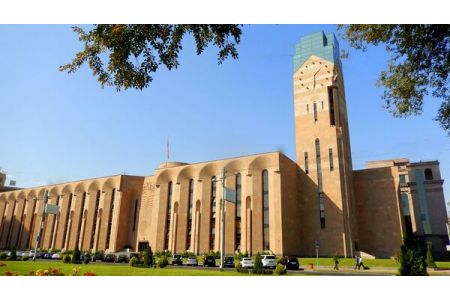 Yerevan City Hall is considering introducing a valet parking system in the city
 Expert: The circus surrounding the “Albanization” of Armenian culture in the presence of foreign ambassadors in occupied Artsakh is genocide
 Political scientist: If Russian-Armenian relations are destroyed, Turkey will take Russia`s place
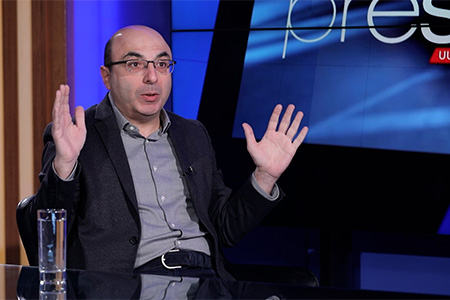 Political scientist: The Armenian public is simply obliged to significantly change the entire content of public discourse and struggle
 Cross tattoos are being removed from the skin of Christian prisoners in Azerbaijan by fire, according to a human rights activist.
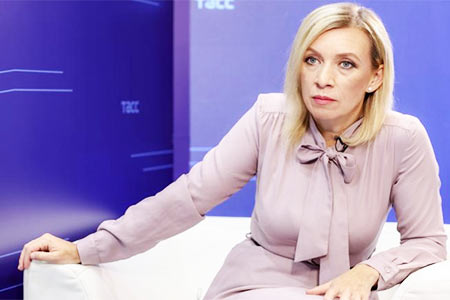 Zakharova: Armenia`s likely introduction of visas with Russia will be a step against Yerevan itself
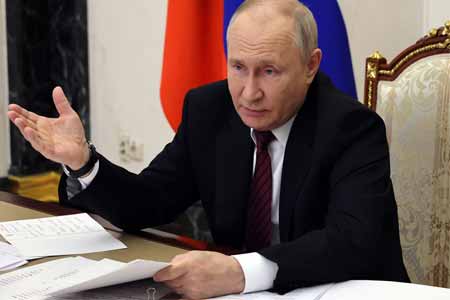 Putin: Armenia`s recognition of Karabakh as part of Azerbaijan in Prague has given Russia`s position on this issue an ambivalent character
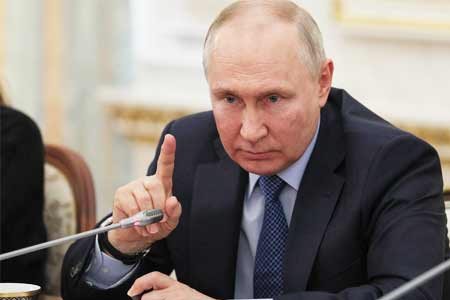 Putin: Armenia`s adoption of the law on EU accession means an announcement of its withdrawal from the Eurasian Economic Union
