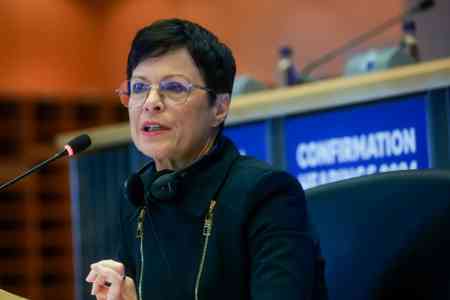
ArmInfo.European Commissioner for Enlargement and European Neighborhood Policy Marta Kos stated that she was pleased to return to Armenia after six months and see the country's transformation with her own eyes.
"Since my last visit, the world has become more unstable, and this once again demonstrates the importance of our partnership in the South Caucasus. This once again demonstrates the importance of having reliable partners and friends. This is how Europs sees Armenia," as stated by the European Commissioner at a joint briefing with Armenian Deputy Prime Minister Mher Grigoryan.
Kos expressed gratitude to official Yerevan for its assistance in evacuating Europeans from Iran through Armenian territory. She also emphasized that 2026 is a truly important year for Armenia, as it will host the European Political Community Summit on May 4, followed by the first Armenia-EU Summit. "This demonstrates how important this region has become for the European Union and how much our partnership has deepened. Amid wars in the north and south, trade routes passing through the South Caucasus are becoming more important than ever," she noted.
She reported that she had discussed with Armenian Deputy Prime Minister Mher Grigoryan issues related to improving the infrastructure linking Europe to Asia to reduce costs and delivery times. She added that, since 2022, cargo volume in this direction has quadrupled. She stated that this volume could increase even further this year, which is in the interests of both Armenia and the EU. Kos then touched on the peace process between Armenia and Azerbaijan, emphasizing that the two countries have taken important steps toward establishing peace, which is welcomed by the European Union. She also emphasized the EU's readiness to promote investments to strengthen regional connectivity. According to the European official, the construction of checkpoints, bridges, and roads promotes stronger people-to-people contacts and reduces the risk of conflict, something the EU knows firsthand. She further stated that since the launch of the Armenia Resilience Program, the EU has supported more than 7,000 businesses, helped build schools, and helped resettle refugees from Nagorno-Karabakh, and intends to continue participating in such projects.
"Today, we signed a funding agreement that will provide an additional 140 million euros in assistance for Armenia. These funds will, among other things, support reforms necessary for visa liberalization. Armenia is the only country in the world that is actively engaged in a visa liberalization dialogue with the EU, and this reflects the depth of their ties," Kos continued. In conclusion, she emphasized that this is an important year for democracy in Armenia, as the country will hold parliamentary elections in June. She noted that Europe is constantly monitoring the abuse of various types of disinformation and hybrid threats in various parts of the world. "We will support Armenia in combating hybrid threats and disinformation so that Armenians and citizens of Armenia can vote freely and fairly and independently decide the future of their country," Kos concluded.
Earlier, Radio Liberty reported that they had a letter from Armenian Foreign Minister Ararat Mirzoyan to Brussels at their disposal, in which he "requested the dispatch of a rapid response team to Yerevan to counter Kremlin disinformation and Russian interference in the parliamentary elections in Armenia." In this regard, it was recalled that the EU sent a similar team of approximately 20 people to Chisinau during last year's parliamentary elections "to help Moldovan authorities identify and counter disinformation emanating from Russia on social media." It should be added that the EU's top diplomat, Kaja Kallas, previously announced the allocation of 15 million euros to Armenia to "counter Russian propaganda."






 Analyst: The primary issue with Armenia`s new Parliament Speaker`s speech lies is its one-sided interpretation of the causes of the political crisis
 Expert: Gagik Tsarukyan embodies post-Soviet model of big business-state relations; this model is used in many other post-Soviet countries
 Expert: Azerbaijan promoting aggressive plans against Armenia at state level
 Iranologist: Baku`s propaganda of might masks the country`s inability to provide water to its own population
 NA Vice Speaker candidate believes his wife`s salary as director of HayPost is the lowest in the company`s history
 RF Permanent Representative: There is no CSTO-Armenia conflict
 Moscow: NATO seeking to "Pull" Armenia away from CSTO Allies
  Political analyst: Russia intends to determine which "Camp" Armenia will choose through a referendum
 Narek Karapetyan will give up his parliamentary salary in favor of charitable contributions.
 Armenia and France discuss further development of strategic partnership and EU cooperation
  To overcome risks Armenia must reduce domestic escalation - expert
  Zatulin: Pashinyan was eager to get back to Russia because he actually lost the elections
 Human rights activist Ruben Melikyan dismissed from YSU
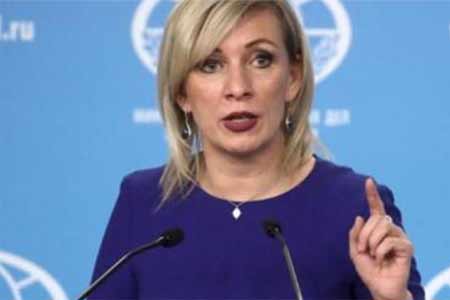 Zakharova: Armenia`s pro-EU pivot poses economic security risks to EAEU member states
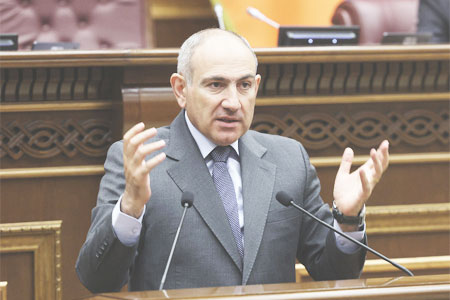 It`s time for South Caucasus countries to think of South Caucasus as single, unified region - RA premier
  Pashinyan: Armenia and Azerbaijan should leave each other alone
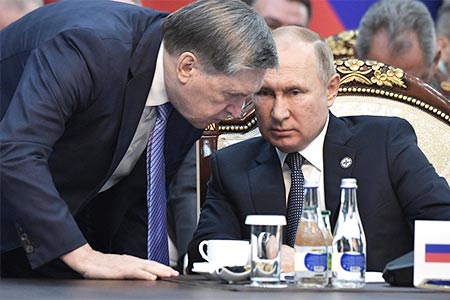 Moscow sees situation with Armenia as attempt to attack Russia-involving integration associations - Russian presidential aid