
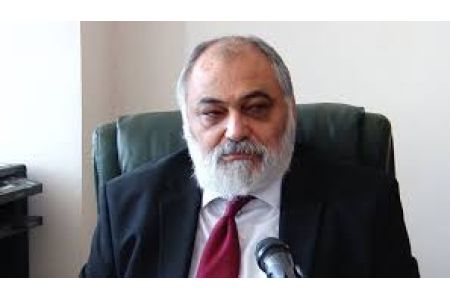
ArmInfo. Orientalist Ruben Safrastyan published the US Intelligence Community's "Annual Threat Assessment" for 2026, which focuses on Armenia and notes the existence of obstacles to a final reconciliation between Yerevan and Baku.
As the Armenian expert wrote on his Facebook page, the report was declassified several hours ago by the US Office of the Director of National Intelligence.
Safrastyan then cited excerpts from the report regarding Armenia, noting that the US-hosted peace summit between Armenia and Azerbaijan on August 8, 2025, provided both countries with an opportunity to establish lasting peace and contributed to increased regional stability. It states that the peace summit's outcomes included a preliminary agreement on the terms of a peace treaty and plans to establish the US-led "Trump Route for International Peace and Prosperity" (TRIPP), which would connect Azerbaijan with its Nakhchivan exclave via southern Armenia, opening trade flows for both countries and the entire region.
"These events represent a significant shift in the direction of Armenian-Azerbaijani relations. In 2020 and 2023, Azerbaijan militarily regained control of its Nagorno-Karabakh region, previously under the control of an ethnic Armenian population backed by Yerevan. Since August 8, both sides appear poised to maintain the positive momentum established after the Peace Summit," the report continues. In this vein, it notes that ceasefire violations on the Armenian-Azerbaijani border have sharply decreased and are now virtually nonexistent. It adds that in October 2025, Azerbaijani President Ilham Aliyev announced that Azerbaijan would lift restrictions on cargo transportation through Azerbaijani territory to Armenia, and Armenian Prime Minister Nikol Pashinyan reciprocated within days. Since then, Azerbaijan has supplied Armenia with gasoline and permitted the transit of wheat.
"The road to a final peace agreement remains hampered. For example, President Aliyev continues to insist that Armenia amend its constitution to remove what he calls language that makes Nagorno-Karabakh part of Armenia. This step would require a constitutional referendum in Armenia, the outcome of which is not guaranteed," the US intelligence community report states.






























 Political analyst: Russia intends to determine which "Camp" Armenia will choose through a referendum
 Political analyst: Pashinyan- Putin phone call confirms deepening strategic rift between Yerevan and Moscow
 Narek Karapetyan will give up his parliamentary salary in favor of charitable contributions.
 Armenia and France discuss further development of strategic partnership and EU cooperation
  To overcome risks Armenia must reduce domestic escalation - expert
  Zatulin: Pashinyan was eager to get back to Russia because he actually lost the elections
 Pashinyan removed from INNOPROM guest list
 Zakharova: Armenia`s pro-EU pivot poses economic security risks to EAEU member states
 It`s time for South Caucasus countries to think of South Caucasus as single, unified region - RA premier
  Pashinyan: Armenia and Azerbaijan should leave each other alone
 Moscow sees situation with Armenia as attempt to attack Russia-involving integration associations - Russian presidential aid
 Zakharova: Armenia views relations with Russia as tool for financially securing reorientation toward EU
 The Armenian Minister of Justice and the EU Ambassador discussed visa liberalization issues for Yerevan.
 Azerbaijan`s aggressive plans against Armenia became possible in wake of Pashinyan`s decisions on Artsakh - expert
  Zakharova: Russia sent a note of protest to Armenia over the act of vandalism at the "Mother Armenia" memorial in Gyumri