
ArmInfo. The lack of clear rules for interaction between doctors and pharmaceutical companies creates corruption risks in the healthcare system, as noted in a statement issued by the AntiCor initiative and received by ArmInfo.
The initiative emphasized that the main issue lies not so much in the cooperation itself, but in its form and the influence of hidden incentives on physician behavior. The initiative noted that pharmaceutical companies competing in the market often use "soft influence" tools: funding conferences and trainings, consulting contracts, grants, trips, gifts, or bonuses. "Formally, this may be presented as support for professional development, but in practice, in many cases, an informal mutual expectation develops: doctors must favor drugs from one company or another. This is where the risk of corruption arises: the object of exchange is no longer knowledge, but the direction of prescription," noted AntiCor.
The initiative noted that this phenomenon has several systemic consequences, one of which is related to the distortion of clinical decisions. As AntiCor explained, doctors, consciously or not, begin to choose drugs in which they have a financial or other interest, resulting in evidence-based medicine gradually giving way to market influence. "Secondly, the risk of overprescribing increases. With an incentive to prescribe more medications, the use of unnecessary drugs or additional treatments increases. This is especially dangerous in pediatrics, endocrinology, and the treatment of chronic diseases, where therapy is long-term. It also leads to the artificial promotion of expensive drugs, as pharmaceutical companies increasingly push highly profitable drugs, which in turn leads to increased healthcare costs for both the patient and the insurance system. Thus, the incentive for corruption also becomes a source of financial burden," the statement explains.
Furthermore, according to the source, this leads to a distortion of competition, resulting in market advantage not being given to the most effective or safe drugs, but to companies with greater resources to influence doctors, which in the long term distorts the structure of the entire pharmaceutical market. AntiCor also noted the risk of a systemic crisis of trust. "A patient who doubts the impartiality of prescriptions loses trust in the doctor and the healthcare system as a whole. This is not only an ethical issue, but also a public health problem, since it reduces patient adherence to treatment. These risks are especially pressing in an environment of low physician salaries, weak mechanisms for declaring conflicts of interest, and insufficient oversight. Under such conditions, 'rewards' offered by pharmaceutical companies become not an exception, but part of systemic behavior," the initiative noted.
AntiCor also noted that the introduction of universal health insurance could only exacerbate these risks if it isn't accompanied by clear monitoring. As the initiative noted, when every prescribed drug is reimbursed, it creates a financial flow that can be exploited for profit through targeted drug prescriptions. "In this case, the insurance system effectively begins to finance suboptimal and sometimes unnecessary treatment. The conclusion is clear: the problem isn't individual, but systemic. If clear rules for interaction between doctors and pharmaceutical companies aren't established, conflicts of interest aren't disclosed, and opaque incentive mechanisms aren't curbed, corruption risks will continue to grow, impacting both the quality of treatment and the sustainability of the healthcare system," AntiKor concluded.



































 Armenian Analyst: One of the Key Tasks of the United Opposition is to Form Effective Mechanisms to Contain the Armenian Authorities
 Armenian expert: Could modern Azerbaijan even exist without Russian and Soviet modernization?
 South Caucasus is entering a new phase of turbulence - ex-official
  Zatulin: Pashinyan was eager to get back to Russia because he actually lost the elections
 Human rights activist Ruben Melikyan dismissed from YSU
 Pashinyan removed from INNOPROM guest list
 Zakharova: Armenia`s pro-EU pivot poses economic security risks to EAEU member states
 It`s time for South Caucasus countries to think of South Caucasus as single, unified region - RA premier
  Pashinyan: Armenia and Azerbaijan should leave each other alone
 Moscow sees situation with Armenia as attempt to attack Russia-involving integration associations - Russian presidential aid
 Zakharova: Armenia views relations with Russia as tool for financially securing reorientation toward EU
 The Armenian Minister of Justice and the EU Ambassador discussed visa liberalization issues for Yerevan.
 Azerbaijan`s aggressive plans against Armenia became possible in wake of Pashinyan`s decisions on Artsakh - expert
 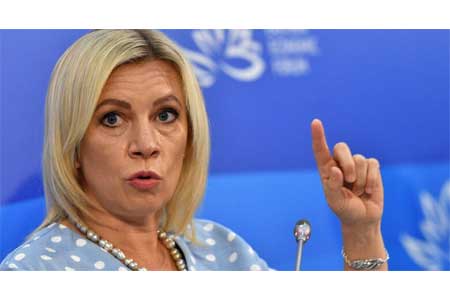 Zakharova: Russia sent a note of protest to Armenia over the act of vandalism at the "Mother Armenia" memorial in Gyumri
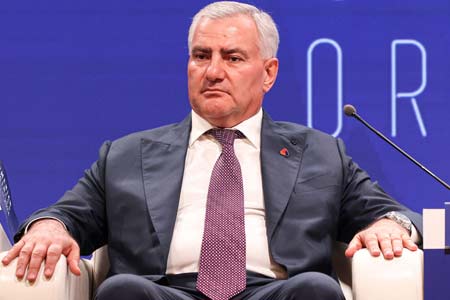 Samvel Karapetyan proposes creating a post-election opposition coalition
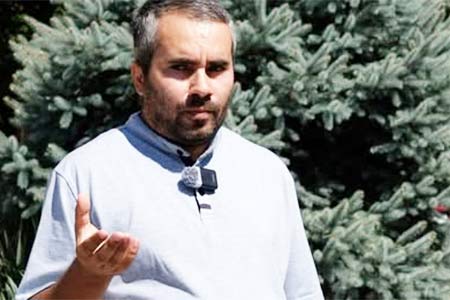 Artsakh`s Cultural Heritage Ombudsman called on Moscow to respond to destruction of WWII monuments by Azerbaijan in occupied NKR