

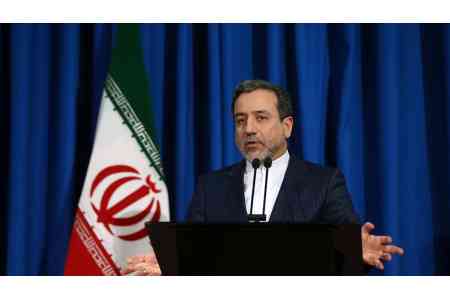
ArmInfo. Iran's stance against developing nuclear weapons will not change significantly, Iranian Foreign Minister Abbas Araghchi said in an interview with Qatar's Al Jazeera.
The new Supreme Leader of the Islamic Republic, Mojtaba Khamenei, has not yet expressed his views on the issue, Araghchi said.
Ayatollah Ali Khamenei, who was assassinated at the start of the US-Israeli war against Iran, issued a fatwa (religious edict) against weapons of mass destruction more than twenty years ago. Western countries, including the US and Israel, have accused Tehran of seeking to develop nuclear weapons for years, while the Islamic Republic's authorities maintain that the program is purely for peaceful purposes.
Araghchi said fatwas depend on the Islamic legal context in which they are issued, adding that he cannot judge the legal or political views of the new Supreme Leader, Mojtaba Khamenei.
An Iranian diplomat believes that after the war, the Persian Gulf countries should develop a new protocol for the Strait of Hormuz to ensure safe navigation and reflect the interests of Iran and the region.
Tehran closed the Strait of Hormuz, through which approximately 20% of international oil and liquefied natural gas passes, and vowed not to allow "a single liter" of these commodities to reach the United States, Israel, or their partners. Iranian Parliament Speaker Mohammad Bagher Ghalibaf wrote yesterday on the social media platform Ex that the war had irreversibly changed the situation in the Strait.
The United States attempted to create a naval coalition to escort tankers in the Persian Gulf, but most NATO countries declared they did not want to participate in military operations against Iran. France announced that it would consider participating in such an international coalition only after a ceasefire and preliminary negotiations with Tehran.
According to Araghchi, the war can only end with a cessation of hostilities throughout the region and with Iran receiving compensation for the damage it has suffered.
Araghchi was also asked why Iranian strikes in the Persian Gulf are targeting not only US military bases but also residential and commercial areas. He replied that some US forces are deployed in urban areas. "American troops will be attacked wherever they gather, no matter what facilities they control. Some of these locations may be close to urban areas," Araghchi said. He acknowledged that regional countries were "unhappy and their people suffered" from the Iranian strikes, but added that the blame for this lies entirely with the United States, which started the war.
The Foreign Minister also commented on the assassination of the head of Iran's Supreme National Security Council, Ali Larijani, and other senior officials, emphasizing that this will not stop Tehran's operations. Araghchi noted that new people are quickly appointed to replace the killed senior officials. According to him, the United States and Israel do not understand that the Islamic Republic has a stable political system independent of individuals.
The death of senior officials does not cause disruptions in governance, and the state continues to function, Araghchi emphasized.
Earlier today, Iranian state television reported that Tehran fired cluster munition missiles at Tel Aviv. warheads in response to the killing of Larijani.












 Opinion: The development of the Amulsar mine near the resort town of Jermuk is the beginning of an environmental disaster in Armenia
 Expert: The arrest of opposition figures in Armenia for social media posts is a systematic attempt to intimidate the public and suppress dissent.
 Azerbaijani Studies Expert: While Azerbaijan Prepares Its Generation for War, Aliyev’s Aide Calls on Armenia to Prepare Armenian Society for “Peace”
 Turkologist: Azerbaijan will never, under any circumstances, stop pressuring the Armenian people
 Political scientist: We need to move away from the question of "when" and replace it with more important questions
 Lukashenko called for Armenia to assume the CIS presidency in 2029
 Dmitry Medvedev predicted a Ukrainian-like fate for Armenia amid the country`s shift in foreign policy
 Russian Security Council: In Armenia, they want to force Russian asset owners to dispose of their assets
 Zakharova: Russia ready to discuss with Armenia the prospects for expanding military cooperation as part of a review of bilateral ties
 Tevanyan: Armenia, like Ukraine and Moldova, is being drawn into the EU’s global war
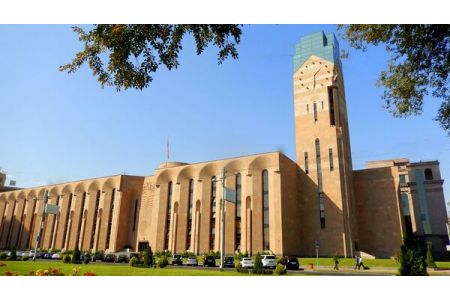 Yerevan City Hall is considering introducing a valet parking system in the city
 Expert: The circus surrounding the “Albanization” of Armenian culture in the presence of foreign ambassadors in occupied Artsakh is genocide
 Political scientist: If Russian-Armenian relations are destroyed, Turkey will take Russia`s place
 Political scientist: The Armenian public is simply obliged to significantly change the entire content of public discourse and struggle
 Cross tattoos are being removed from the skin of Christian prisoners in Azerbaijan by fire, according to a human rights activist.
 Zakharova: Armenia`s likely introduction of visas with Russia will be a step against Yerevan itself
 Putin: Armenia`s recognition of Karabakh as part of Azerbaijan in Prague has given Russia`s position on this issue an ambivalent character
 Putin: Armenia`s adoption of the law on EU accession means an announcement of its withdrawal from the Eurasian Economic Union
 Aram Vardevanyan: Public demands solutions, not apology scandals in Parliament