


ArmInfo.The US is losing its leading economic position on the international stage, and the Trump administration is attempting to regain its dominant position on the global economic map through aggression in the Middle East.
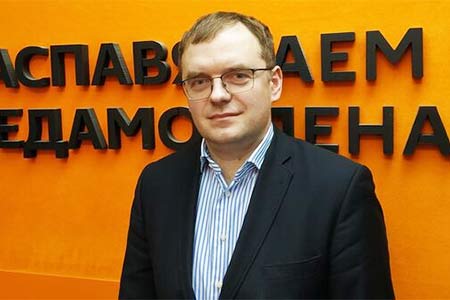
Alexander Kozlov, analyst and PhD in Economics, made this statement during a Minsk-Yerevan video conference "Will Trump Succeed in Drawing Turkey into a Conflict with Iran?" when discussing the economic situation that has developed amid the Middle East conflict.
He noted that it is unclear how much longer the US can maintain its status as a leading economic power, especially given that China is "nipping at its heels." In this context, he noted that many countries have recently begun conducting transactions in national currencies, gradually abandoning dollar transactions. This has meant that America is no longer perceived as the world's "policeman."
"In this context, US President Donald Trump's rhetoric demonstrates that they don't intend to stand on ceremony with anyone. And to restore their leadership, they need to stir up the markets, which is exactly what they're doing. The dollar was the world's primary trading currency. How can they regain its status? Through oil, since it accounts for 10% of global transactions. If settlements are in dollars, this will provide powerful support for this currency and ensure US economic hegemony," the analyst explained.
Kozlov noted that, having gained access to Venezuela's largest oil reserves-305 billion barrels-the US is pursuing its goal of dominating the oil market. "Ultimately, they want to widen the gap between the US and Chinese economies. Although China has already overtaken the US in purchasing power parity, in absolute terms, the United States still holds first place. In the next two to three years, we will see the economic development gap between the US and China widen in favor of the US. This is the US's main goal today. And what's happening in the Middle East is just the beginning," Kozlov asserts.
Speaking about the impact of the current situation on the economies of other countries, the analyst noted that European economic indicators remain below the global average. He emphasized that even if things develop normally, Europe will lag behind the economies of China and the United States. "Even if Europe has any chances today, it will still have to completely rethink its partnerships and rid itself of a dependency that is not serving it. Today, Europe resembles the 'swan, the crayfish, and the pike': it wants to live as before, but is doing nothing to achieve it. This is impossible. Europe needs to bring order to its economy and its thinking, otherwise, nothing will work," the analyst believes.
According to Kozlov, in the current situation, the European economy is not benefiting from this situation and is in a state of technical survival.
Regarding Russia's role, he noted that many perceive high gas and oil prices as "manna from heaven" for Moscow and other exporters. However, according to Kozlov, this is a profound misconception, as price transmission mechanisms can directly or indirectly influence inflation. "For our countries, rising energy prices are less attractive than stable prices. Looking at the EAEU's consumer price index, we're approaching 9-10%, which is problematic. Higher oil prices will only exacerbate inflation," the analyst explained.
He also pointed to the dual impact of high oil prices on the Russian economy: on one hand, they support the Russian budget, but on the other, they lead to higher prices for goods and services. "It's not yet clear which direction we'll take. Russia has sufficient reserves to maintain the ruble within the planned ranges. We must remember that the economy is a multifactorial model. It's possible that the ruble will weaken against the dollar to last year's levels-90-95 rubles per dollar. This could be influenced by many factors, including the situation in the Persian Gulf," the expert noted. In conclusion, Kozlov noted that the world will take the US government's rhetoric more seriously, and Americans will be able to manipulate their currency more freely. "It's convenient to hand out cheap dollars and collect expensive ones. The time is not far off when Americans will start collecting debts in dollars," the expert concluded.
Recall that on March 5, 2026, International Monetary Fund (IMF) Managing Director Kristalina Georgieva stated that the global economy is once again being tested by a new conflict in the Middle East. According to her, if it proves more protracted, it has the obvious potential to impact global energy prices, market sentiment, growth, and inflation, placing new demands on policymakers. Moreover, according to her, new shocks of varying forms and scales will continue.
























 Politician: The Moldovan scenario in Armenia will lead to revolution
 American agenda in South Caucasus has two priorities: TRIPP project and increasing pressure on Iran - expert
 Armenian political scientist outlines two likely goals for tomorrow`s visit by U.S. Secretary of State to Yerevan
  Domestic escalation to lead to external escalation soon - expert
  Opinion: Situation within Armenia and on its borders will largely depend on developments surrounding Iran
 CSTO Secretary General: Dual Membership in EU and EAEU "highly difficult"
 Armenia a passenger who wants to get from point A to point G - Maria Zakharova
 EU prepares support for Armenia amid economic restrictions imposed by Russia - media
 Catholicos: We must make every possible effort to ensure justice prevails for the people of Artsakh
 Opposition leader names newly built schools in Vayots Dzor to be handed over to Azerbaijanis
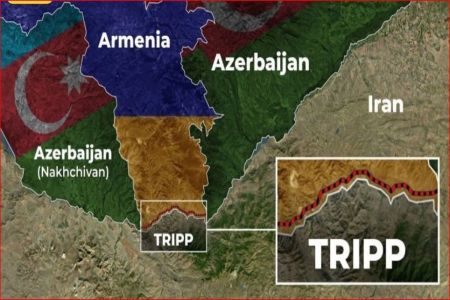 Expert: Armenia and Azerbaijan are participating in the US geopolitical game to encircle Iran
 Medvedev likens Pashinyan`s stance on EAEU/ EU referendum to Trotsky`s formula
 Breavis accuses EuroNews of spreading false information regarding Armenian elections
 Choice between EU and EAEU is choice between unrealizable dream and certainty