



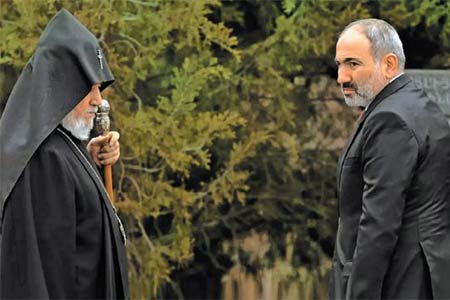
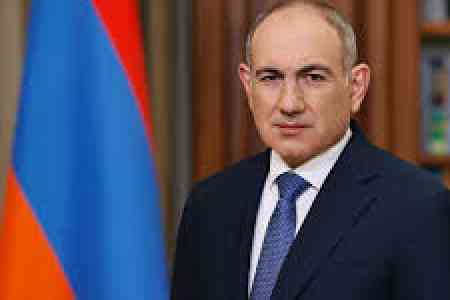
ArmInfo. In Armenia, Prime Minister Nikol Pashinyan's statements about the Armenian Apostolic Church (AAC) raised concerns about potential government interference in the AAC's religious autonomy, reads the 2026 Annual Report by the United States Commission on International Religious Freedom (USCIRF).
"Throughout 2025, Prime Minister Pashinyan proposed establishing and personally appointing a council to elect a new AAC leader, and elevated clergy who aligned with his agenda to oust the current catholicos. Pashinyan's attacks on Catholicos Karekin II coincided with the arrest of AAC clerics and other lay members who had criticized or expressed political opposition to Pashinyan's government. Whether these arrests are justified or religiously motivated is a topic of ongoing debate."
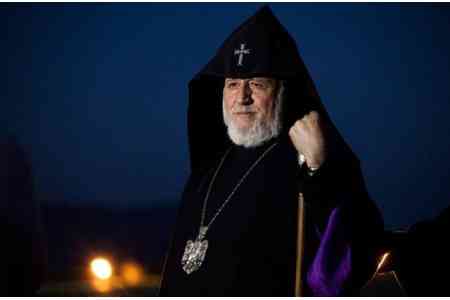
As a reminder, since May 2025, the Armenian authorities have been actively pursuing an anti-church policy and are seeking the resignation of Catholicos of All Armenians Garegin II, who is elected to this position for life. This campaign has targeted both clergy and citizens who support the Church. Currently, four high-ranking clergy are imprisoned on trumped-up charges as part of this anti-church campaign. Furthermore, the Armenian prime minister and 10 schismatic bishops signed a framework document on the so-called renewal of the Armenian Church.
According to the Constitution, Armenia is a secular state, where church and state are separate. However, the "exclusive mission" of the Armenian Apostolic Church (AAC) in preserving national identity is recognized.



















 Political analyst: Pashinyan- Putin phone call confirms deepening strategic rift between Yerevan and Moscow
 Opinion: Resolving conflict between Yerevan and Baku allows Washington to deprive Russia of key levers of influence in South Caucasus
 Narek Karapetyan will give up his parliamentary salary in favor of charitable contributions.
 Armenia and France discuss further development of strategic partnership and EU cooperation
  To overcome risks Armenia must reduce domestic escalation - expert
  Zatulin: Pashinyan was eager to get back to Russia because he actually lost the elections
 Pashinyan removed from INNOPROM guest list
 Zakharova: Armenia`s pro-EU pivot poses economic security risks to EAEU member states
 It`s time for South Caucasus countries to think of South Caucasus as single, unified region - RA premier
  Pashinyan: Armenia and Azerbaijan should leave each other alone
 Moscow sees situation with Armenia as attempt to attack Russia-involving integration associations - Russian presidential aid
 Zakharova: Armenia views relations with Russia as tool for financially securing reorientation toward EU
 The Armenian Minister of Justice and the EU Ambassador discussed visa liberalization issues for Yerevan.
 Azerbaijan`s aggressive plans against Armenia became possible in wake of Pashinyan`s decisions on Artsakh - expert
  Zakharova: Russia sent a note of protest to Armenia over the act of vandalism at the "Mother Armenia" memorial in Gyumri