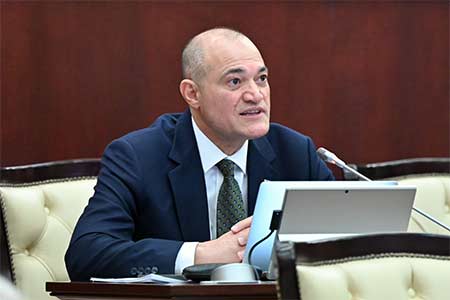
ArmInfo. The Azerbaijani authorities continue to maintain occupied Artsakh as a closed zone, where the activities and freedom of movement of so-called "Azerbaijani displaced persons" are restricted. This was stated in a statement by the press service of the Geghard scientific and analytical foundation in response to Azerbaijani media reports about "the dispatch of another group of Azerbaijanis" to Nagorno-Karabakh.
Geghard noted that similar materials with photographs are published in Azerbaijani media almost weekly. However, the foundation is confident that the photographs depicting "happy faces of Azerbaijanis and applause for their return" are far from reality. In support of this, Geghard noted that several days ago, at a regular session of the Azerbaijani parliament, MP Razi Nurullayev made a noteworthy statement, speaking out against the state building houses for "those returning to Nagorno-Karabakh" and instead proposing to create favorable living conditions.
"According to the MP, people should build their own homes to become more attached to the land. However, Nurullayev's speech demonstrates that, in reality, many of those 'returning' subsequently return to Baku. He believes that for the 'reconstruction' of Artsakh, it is not enough to implement only state-funded projects; the private sector should also be allowed to operate outside the special economic zones. Responding to Nurullayev, some MPs attempted to justify the government's investments and policies in the occupied territories. Even the Speaker of the Azerbaijani Parliament, Sahiba Gafarova, intervened, noting that no one was forced to return; everything is happening voluntarily," the foundation's statement noted.
"Geghard" further noted that, according to official Azerbaijani data, approximately 75,000 people have "relocated" to Artsakh. "The photographs being circulated show that a significant portion of the so-called displaced persons are elderly. This means that even the provision of free housing or an apartment and work in a garment factory is not very attractive to people, especially young families who have permanently resided in Baku and other cities of Azerbaijan. Furthermore, people are often resettled to places where they have never lived. For example, Haterk, Karmir Shuka, and other settlements in Artsakh, which were exclusively Armenian during the Soviet years," Geghard explained.
















 Analyst: The primary issue with Armenia`s new Parliament Speaker`s speech lies is its one-sided interpretation of the causes of the political crisis
 Expert: Gagik Tsarukyan embodies post-Soviet model of big business-state relations; this model is used in many other post-Soviet countries
 Expert: Azerbaijan promoting aggressive plans against Armenia at state level
 Iranologist: Baku`s propaganda of might masks the country`s inability to provide water to its own population
 NA Vice Speaker candidate believes his wife`s salary as director of HayPost is the lowest in the company`s history
 RF Permanent Representative: There is no CSTO-Armenia conflict
 Moscow: NATO seeking to "Pull" Armenia away from CSTO Allies
  Political analyst: Russia intends to determine which "Camp" Armenia will choose through a referendum
 Narek Karapetyan will give up his parliamentary salary in favor of charitable contributions.
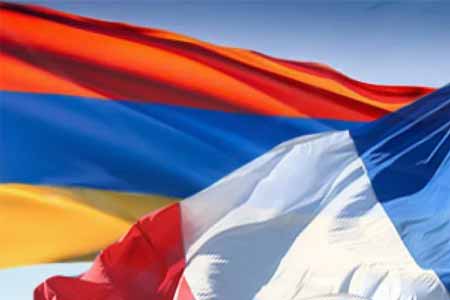 Armenia and France discuss further development of strategic partnership and EU cooperation
  To overcome risks Armenia must reduce domestic escalation - expert
  Zatulin: Pashinyan was eager to get back to Russia because he actually lost the elections
 Human rights activist Ruben Melikyan dismissed from YSU
 Zakharova: Armenia`s pro-EU pivot poses economic security risks to EAEU member states
 It`s time for South Caucasus countries to think of South Caucasus as single, unified region - RA premier
  Pashinyan: Armenia and Azerbaijan should leave each other alone
 Moscow sees situation with Armenia as attempt to attack Russia-involving integration associations - Russian presidential aid