
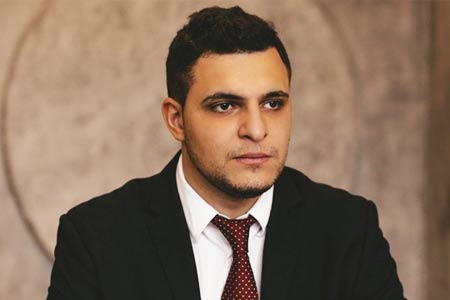
ArmInfo.The APRI Armenia research center is analyzing possible scenarios for Armenia in the context of events unfolding around the Islamic Republic of Iran (IRI). Currently, the most negative scenario for the country would be instability in Iran. Political scientist and APRI Armenia research fellow Sergey Melkonyan stated this in an interview with Civilnet.
He explained that regardless of the regime in Iran, instability in the country could lead to a humanitarian crisis, disruption of supply chains, and energy problems. "It's clear that, no matter how the situation develops, if even a center of power in the form of the Islamic Republic remains in Iran, attitudes toward American activity in the region will become more hostile and aggressive. This applies both to the Trump Route for International Peace and Prosperity (TRIPP) and to cooperation on other critical infrastructure. Armenia's task in this situation is to respond to these concerns not with words, but with actions. Even the slightest increase in the likelihood of risk to Iran could provoke a harsh reaction, for which we are not prepared. Unlike us, Iran has a much longer memory," Melkonyan emphasized.
Regarding the possible involvement of other countries in the conflict against Iran, the political scientist ruled out Azerbaijan's active participation in a conflict with Iran at this stage, even through the provision of airspace. In his opinion, Azerbaijan is not prepared to suffer the same losses as Kuwait, the UAE, Bahrain, or Oman.
"Nevertheless, they could take steps such as closing humanitarian air corridors or increasing their military presence on the border. Recently, reports emerged that Azerbaijan is amassing forces near the border. Therefore, these are the only possible countermeasures," the political scientist believes. As for the US, Melkonyan said, they are seeking to save face, and to do so, they need to ensure regime change in Iran, as well as destroy its nuclear infrastructure and ballistic missile arsenal. Meanwhile, Israel, the expert noted, has an entirely different goal: the complete destruction of the Islamic Republic of Iran, a repeat of the Syrian scenario. "For Israel, the Iranian regime is only an interim objective, while the ultimate goal is much broader," Melkonyan emphasized.
Speaking about Russia's possible actions in this situation, the expert noted that Russia has no obligation to provide military assistance to Iran under the strategic partnership agreement. Furthermore, Melkonyan noted, Russia is limited by its resources and can only offer the air defense systems it needs.
"Furthermore, Russia can provide upgraded Shahed (kamikaze drones - ed.) and reconnaissance assets. In all other respects, its capabilities are limited. The final component in this context could be maintaining the population's vitality while the conflict ends or decelerates. To control the situation, it is necessary to monitor not only the provinces with security resources but also the streets to prevent protests. Not only Russia but also China could provide support in this," the political scientist concluded.
As a reminder, on the morning of February 28, the US and Israel attacked Iran. In response, Iran launched strikes against US bases in the Middle East. As a result of US-Israeli aggression, Iran's Supreme Leader Ali Khamenei and several high-ranking Iranian military officials were killed. The US has so far confirmed the deaths of six of its soldiers. An Israeli strike on a girls' school in a southern Iranian province killed, according to the latest figures, 170 students and their teachers, and wounded dozens more.
According to HRANA, the total number of civilian deaths since the conflict began on February 28 has reached 1,097, including 181 children under the age of ten. Another 880 fatality reports are currently being verified and classified. The number of civilian casualties since February 28 has reached 5,402, including 100 children.




















 Iranologist: Baku`s propaganda of might masks the country`s inability to provide water to its own population
 Analyst: Continued tensions between Yerevan and Moscow could entail new restrictive measures from Russia
 Political analyst: Russia intends to determine which "Camp" Armenia will choose through a referendum
 Armenia and France discuss further development of strategic partnership and EU cooperation
  To overcome risks Armenia must reduce domestic escalation - expert
  Zatulin: Pashinyan was eager to get back to Russia because he actually lost the elections
 Human rights activist Ruben Melikyan dismissed from YSU
 Pashinyan removed from INNOPROM guest list
 Zakharova: Armenia`s pro-EU pivot poses economic security risks to EAEU member states
 It`s time for South Caucasus countries to think of South Caucasus as single, unified region - RA premier
  Pashinyan: Armenia and Azerbaijan should leave each other alone
 Moscow sees situation with Armenia as attempt to attack Russia-involving integration associations - Russian presidential aid
 Zakharova: Armenia views relations with Russia as tool for financially securing reorientation toward EU
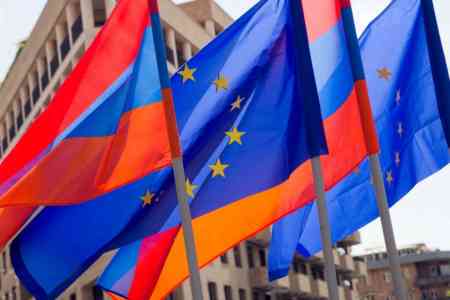 The Armenian Minister of Justice and the EU Ambassador discussed visa liberalization issues for Yerevan.
 Azerbaijan`s aggressive plans against Armenia became possible in wake of Pashinyan`s decisions on Artsakh - expert
  Zakharova: Russia sent a note of protest to Armenia over the act of vandalism at the "Mother Armenia" memorial in Gyumri