


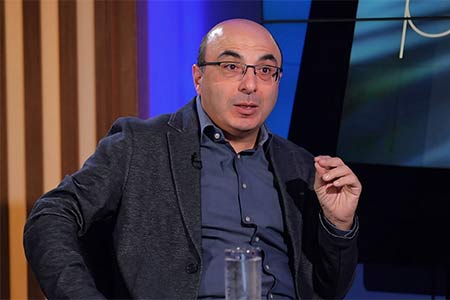
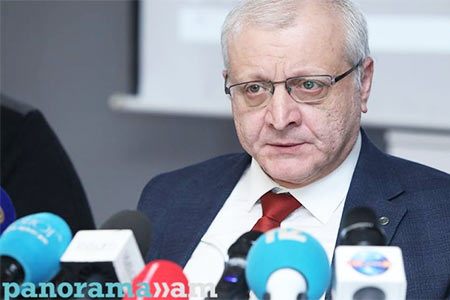
ArmInfo. The Armenian authorities have dramatically changed their tactics ahead of the parliamentary elections scheduled for June 7, 2026, according to political scientist and member of the Alternative Projects group Vahe Hovhannisyan, responding to statements by Armenian Parliament Speaker Alen Simonyan that only two opposition forces would be able to overcome the electoral threshold in the upcoming parliamentary elections.
Hovhannisyan, in a Facebook post, stated that until recently, the Armenian authorities had been repeating that they would not allow a repeat of the Gyumri scenario (50+1 votes - ed.). According to him, this was an obvious mistake, as it was these statements that determined the formula for the upcoming electoral process. "And the more often government officials repeated this formula, the faster it spread throughout society and became an idea that tacitly united the opposition systems. They've taken note of this, and the emphasis of their previous statements suggests they've dramatically changed their tactics," the political scientist noted.
He recalled that "Gyumri-2" assumed that the opposition forces would gain at least 50%+1% of the vote, with the ruling Civil Contract party constituting a minority. However, as Hovhannisyan noted, the new statements portray everything as if "the opposition is fighting for only 20% of the vote, while their power will be maintained by 50% or more." "In the near future, they will promote precisely this tactic, convincing everyone that they have won, that no one is fighting against them, and will launch false sociological campaigns to achieve this. But this tactic will also soon change. It is outdated and is quickly losing its relevance in the face of public sentiment in the technological age," the expert is confident.
Hovhannisyan believes that previous statements by the Armenian authorities also reveal another goal of their chosen tactic: to stir up tension within the opposition. As the expert noted, this is being accomplished through "shadowy" methods of influence. However, he expressed conviction that this is a poorly calculated approach, as the opposition today is represented by serious people who will not allow this primitive "trick" to work.
"There is another important objective factor: major opposition forces don't steal votes from each other. A process has developed where they pool and consolidate their own votes, rather than luring the established opposition electorate to their side. And finally, another derivative of this tactic is attacks on opposition forces and their figures," the expert noted.
Hovhannisyan, however, believes that regardless of its tone, changing tactics, and efforts to inspire pro- government ranks, the country's ruling force is acutely aware of the objective situation, which prevents it from reproducing itself. In this regard, the political scientist outlined what to expect from the authorities in the near future under the current circumstances. First and foremost, according to the expert, the authorities will attempt to form an alliance. Moreover, as Hovhannisyan noted, the Civil Contract will act in conjunction with law enforcement agencies, since, in the expert's opinion, no popular political force will cooperate with the authorities.
"The government will also increase pressure on opposition figures. It will make little attempt to reach an agreement, understanding that these are all agreements 'written on ice' and will not be observed. Furthermore, it will try to mitigate the acute conflicts within society it has provoked, which arose, for example, after Prime Minister Nikol Pashinyan's anti-church campaign. It will continue to distribute social bribes (health insurance, pension increases), although experience shows that they do not yield political dividends," the political scientist noted.
Moreover, the expert believes, it will attempt to find real solutions to implement Armenia's "Moldovan scenario." However, he called this a risky move, since, firstly, it will be difficult to predict the tension this will cause on the streets, and secondly, it could simply lead to a sharp, not equivalent, but shocking increase in the votes of other opposition forces.
"In these circumstances, opposition systems must stop responding solely to the narratives of the Armenian authorities. They must be flexible in their short-term tactics and become dominant in the public consciousness, presenting their approaches and proposals. They must be prepared for significant changes in the situation to avoid missing a win-win opportunity. Ultimately, the opposition must find the strength to stop fruitless and destructive attacks on each other and the pursuit of commercial interests," Hovhannisyan concluded.
On March 3, in a conversation with journalists, Armenian Parliament Speaker Alen Simonyan stated that he believes Armenia's second president, Robert Kocharyan, will not clear the threshold to win the parliamentary elections. Simonyan stated that only two opposition parties could clear this threshold in the elections: Samvel Karapetyan's Strong Armenia Party and Gagik Tsarukyan's Prosperous Armenia Party, which, he said, would compete for the top spot among the opposition (40%). However, he asserted that the ruling Civil Contract Party will undoubtedly win the elections, assuring that it will receive more votes than in 2021.











 Political analyst: Relatively high turnout indicates that Armenian citizens are actively and consciously shaping the country`s future
 Stanford University professor calls current Armenian parliamentary elections the dirtiest in the country`s history
 Politician: The Moldovan scenario in Armenia will lead to revolution
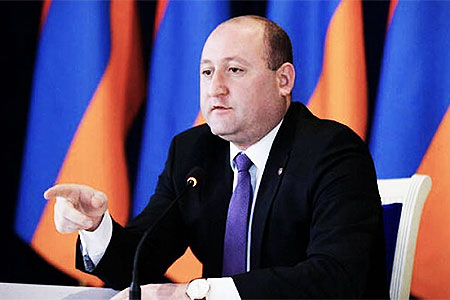 American agenda in South Caucasus has two priorities: TRIPP project and increasing pressure on Iran - expert
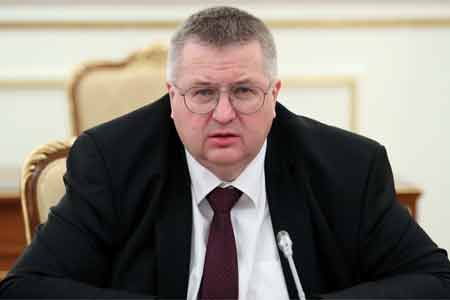 Russia trying to convey to Armenia that the EU has effectively transformed into a military-political union – Overchuk
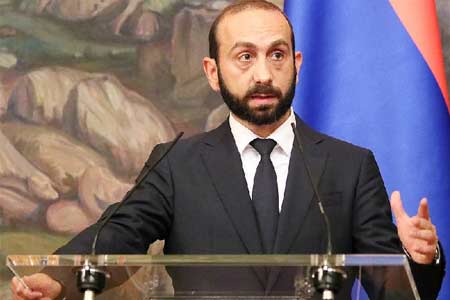 Armenian FM: Relations between Armenia and Russia need " a certain degree of healing"
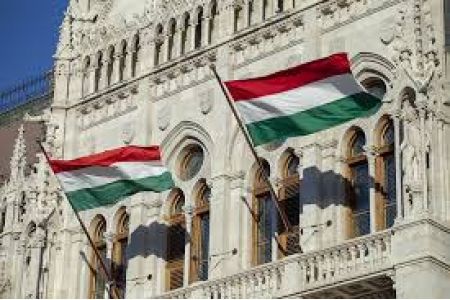 Hungary to stop issuing worker visas to citizens of the Philippines, Georgia, and Armenia
 Russia is counting on holding the next "3+3" meeting in Baku or Yerevan
 Robert Kocharyan: Peace treaty with Azerbaijan will include guarantees for peace
 Edmon Marukyan: 1.7mln people must go to polls, and this government will be crushed
 Armenian authorities have turned country into center of a geopolitical struggle - Samvel Karapetyan
  Expert: Pashinyan is finished if most voters go to polls