



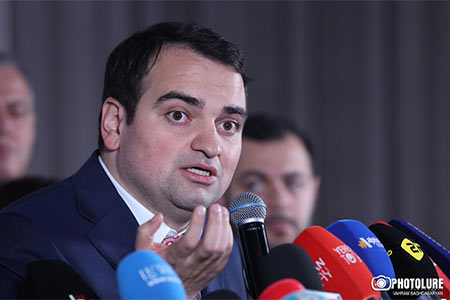
ArmInfo.One of the main concerns about the upcoming parliamentary elections in Armenia, scheduled for June 7, 2026, is the potential threat of foreign interference. Daniel Ioannisyan, founder of the "Union of Informed Citizens" NGO, made this statement at a press conference in Yerevan titled "What Prevents a Good Electoral Code from Ensuring Democratic Elections."
According to him, signs of this interference are already being observed in various formats. "We are concerned and assume that it will escalate ahead of the parliamentary elections," Ioannisyan noted. However, he did not provide any specific examples of such interference that his organization had documented, only making unfounded allegations. Speaking about the potential influence of administrative resources on election results, he emphasized that while current regulatory mechanisms are not perfect and some risks remain, observations of previous electoral processes have shown that the influence of administrative resources on voting results has decreased significantly compared to 2017 and, in some cases, was even insignificant.
"Of course, we continue to encounter abuses of administrative resources; this remains a problem, but its impact on election results is significantly less," Ioannisyan assured.
Earlier, Armenian media reported that Armenian Foreign Minister Ararat Mirzoyan had asked Brussels to "send a rapid response team to Yerevan to counter Kremlin disinformation and Russian interference in the Armenian parliamentary elections, and then, possibly, a more permanent civilian mission." The EU sent a similar team of about 20 people to Chisinau during last year's parliamentary elections "to help Moldovan authorities identify and counter disinformation emanating from Russia on social media."
It should be added that on December 15, 2025, the EU High Representative for Foreign Affairs and Security Policy and Vice-President of the European Commission, Kaja Kallas, told reporters that Armenia had asked the European Union for financial assistance to "prevent external interference ahead of the next parliamentary elections" scheduled for June 2026. Kallas also stated that in the run-up to the elections, Russia had allegedly intensified its disinformation campaign, and that the EU would provide Armenia with 15 million euros to counter external threats.
However, independent experts believe that in practice, this assistance would become a tool for limiting narratives politically undesirable for the government, rather than a means of combating false information.























 Political scientist: Real recount will deprive Pashinyan of any constitutional majority
 Expert: Even OSCE observers recorded numerous violations during elections in Armenia
  Armenia`s ex-minister of justice calls on opposition to honestly answer questions troubling Armenian citizens
 Elections in Armenia were accompanied by unprecedented pressure on opposition, RF MFA spokesperson claims
  Moscow to await official results of Armenian elections - Peskov
 Antonio Costa: EU to deepen its partnership with Armenia, expanding cooperation in energy, trade, and digitalization
 Israeli MFA congratulates Pashinyan
 Turkish MFA comments on results of Armenian elections
  Zakharova: International observers cannot ignore `flagrant violations` in Armenian elections
 Strong Armenia to issue statement after vote count completed - Narek Karapetyan
 Russian Senator: Opposition complaints regarding election violations by ruling party remain unanswered
 RA premier receiving congratulations on his victory in parliamentary elections
 Head of IPA CIS Council Secretariat: Extremely difficult atmosphere during parliamentary elections campaign in Armenia accompanied by mass arrests
 Pashinyan`s party leads with 51.13% based on vote counts from 533 polling stations
 Voting in parliamentary elections in Armenia ends
  Strong Armenia: Administrative Court not providing judicial decisions to citizens wishing to vote in parliamentary elections