
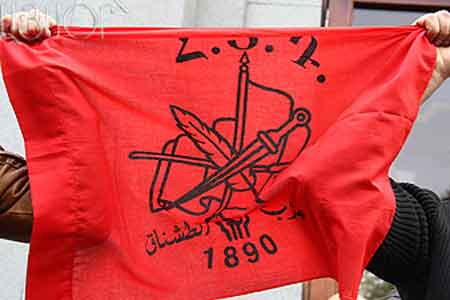
ArmInfo. On Saturday, February 28, 2026, the Armenian Youth Federation - Youth Organization of the Armenian Revolutionary Federation (AYF-YOARF) Washington D.C. "Ani" Chapter held a protest and commemoration outside the Embassy of Azerbaijan, marking the Sumgait, Baku, Kirovabad, and Maragha pogroms and condemning Azerbaijan's unbroken legacy of genocidal aggression against the Armenian people.
Armenian-American activists and allies gathered to demand justice for the victims of those massacres, accountability for Azerbaijan's 2023 genocidal ethnic cleansing of Artsakh, the immediate release of Armenian hostages, and a dignified, safe, and collective right of return for Artsakh's forcibly displaced Armenian population.
The protest took place as U.S. and Israeli forces launched major military strikes on Iran. AYF "Ani" Chapter member Galy Jackmakjian opened the program with a direct acknowledgment of the crisis before turning to the day's demands."Our hearts are with the Armenian community in Iran - and our eyes are on Baku and Ankara. Because we know what opportunity looks like to them," said Jackmakjian.
Jackmakjian then turned to the day's commemoration, naming the pattern of Azerbaijani violence without equivocation. "Thirty-eight years ago, in Sumgait, Armenians were hunted in the streets. Beaten. Tortured. Murdered. Sumgait was not an isolated incident. Neither was Baku. Neither was Kirovabad. Neither was Maragha. The pattern of erasure is clear," she said.
The protest came one week after Azerbaijani security officers attacked peaceful protesters in Washington outside the inaugural Board of Peace meeting - a reminder, speakers said, that Baku's contempt for democracy extends even to the streets of the U.S. capital.
"We remember our history because it contains lessons for the future. The massacre of 1988 - this unforgivable crime carried out in cold blood - must always remain a lesson for our Armenian nation. As we mourn the lives of our martyrs, as we remember the innocent Armenian souls stolen from this world by Azeri hands, let us honor the Armenians lost in Baku by promising always to uphold justice," said AYF Eastern Region Central Hai Tahd Council Chair U. Areni Hamparian, in remarks presented in Armenian.
Speakers were unsparing in their condemnation of Azerbaijan's decades-long pattern of denial. "Now, Azerbaijan blames Armenians for their own slaughter, in a trend of victim-blaming that unfortunately has carried over to today. This perversion of reality is not just offensive - it is very dangerous," remarked AYF "Ani" Chapter member Alek Tekeyan. "History has shown us a clear pattern: violence, followed by denial - suffering, followed by silence. Every time the world ignores the truth, the door is left wide open for Azerbaijan or anyone else to commit the next atrocity."
The event drew sharp attention to Azerbaijan's ongoing crimes: the illegal imprisonment of Artsakh's elected leadership, Armenian prisoners of war and civilian hostages; the systematic destruction of Armenian churches and cultural monuments in Artsakh; and Azerbaijan's continued occupation of sovereign Armenian territory. Speakers called on the United States to sanction the Azerbaijani regime and halt all military aid to Baku.
"The constant threat of erasure of an entire group of people should make us terrified that the events that happened in Sumgait, Kirovabad, and Baku could happen again - but this time, it could happen to you, it could happen to us," stated AYF "Ani" Chapter treasurer Arpa Shahnazarian. "If we do not demand justice for the crime of ripping Artsakhtsi's from their homes, then we will never earn justice for the crimes committed in 1988."
Armenian National Committee of America (ANCA) Government Affairs Director Tereza Yerimyan called on Armenian Americans to translate their community's grief into civic power. "Armenian Americans have power - not just sentimental power, but civic power. We vote. We advocate. We educate. We organize. We build coalitions. We demand that American leadership be measured not by speeches, but by deeds," stated Yerimyan. "Let our message be simple and unshakeable: we will not accept a future where Armenian survival is bargained away by the U.S. or by Armenia, where Artsakh is erased, where prisoners are forgotten, where sacred heritage is destroyed, and where Armenians are told to be quiet in exchange for 'stability.'"
Protesters called on the United States and international institutions to move beyond statements and deliver enforceable guarantees - rejecting any peace framework that leaves Armenian prisoners behind, legitimizes Azerbaijan's occupation of Armenian land, does not guarantee the right of return of Artsakh's Armenians, or allows the destruction of Artsakh's Christian heritage to continue unchecked.
The program closed with a prayer led by Fr. Sarkis Aktavoukian, pastor of Soorp Khatch Armenian Church, who honored the memory of all Armenians who have died defending the Armenian homeland against Azerbaijani aggression. Fr. Aktavoukian also offered prayers for the Armenian community in Iran amid the day's strikes, and called for peace to return to the region.
On February 20, 1988, an extraordinary session of the regional council of the Nagorno-Karabakh Autonomous Oblast resolved to appeal to the Supreme Soviets of the Azerbaijan SSR and the Armenian SSR to secede from Azerbaijan and join Soviet Armenia, and to petition the Supreme Soviet of the USSR for a positive resolution. A few days later, Azerbaijan "reacted" to this decision in the city of Sumgait, a symbol of the Soviet Union's internationalism. The right of Artsakh Armenians to self-determination and to a safe and dignified life in their homeland was being challenged by pogroms and violence committed on ethnic grounds.
On February 26, anti-Armenian demonstrations began in Sumgait, with slogans such as "Death to Armenians" and "Armenians, leave." To incite hatred against Armenians, special provocateurs posing as refugees from Kapan began operating in Sumgait, spreading false rumors about alleged crimes against Azerbaijanis in Armenia. On the evening of February 27, violent actions against the city's Armenian population began. Special pogrom groups broke into Armenian homes based on a pre-prepared list. During the massacres, telephones in many Armenian apartments were disconnected, and the police demonstrated criminal inaction, or, according to some accounts, even complicity. The methods of carrying out the massacres were characterized by inhuman cruelty. The Armenian population was exterminated, killed, beaten, tortured, set on fire, raped, and physically and psychologically harmed. On the evening of February 28, Soviet Army units entered Sumgait, initially under orders to use force and weapons against the pogromists. As a result, the Azerbaijani side attacked Soviet military units, resulting in 140 wounded Soviet soldiers. Only on the evening of February 29 did army units take decisive action, and the massacre of Armenians ceased.
According to official figures, 32 people (26 Armenians, 6 Azerbaijanis) were killed in the Sumgait pogroms, over 400 people suffered varying degrees of bodily injury, approximately 200 apartments and over 50 cultural buildings were attacked and looted, and over 100 vehicles were damaged. The organized trial of the Sumgait pogroms and its "impartiality" left a number of questions unanswered, one of which is the veracity of the death toll and injuries. There are reports and data on the number of casualties and injuries that contradict official figures.
The Sumgait pogroms resonated greatly with the Armenian public, primarily associating these events with the Armenian Genocide committed in the Ottoman Empire in the early 20th century. The pogroms against the Armenian population were genocidal in nature and aimed to halt the development of the Artsakh movement and suppress the right of Artsakh Armenians to self-determination. The Sumgait pogroms of 1988-1990 were the first in a chain of mass and large-scale crimes against Armenians in the Azerbaijan SSR. The central authorities failed to adequately assess the mass killings of the Armenian population of Sumgait, portraying them as the actions of "hooligan elements" and mass unrest. This was officially reflected in the trial of the Sumgait pogromists, resulting in the failure to identify and punish the organizers of the pogroms. This attitude toward Armenian-Azerbaijani interethnic violence and the resulting impunity played a significant role in the further expansion and continuation of anti-Armenian violence in Azerbaijan.
Modern Azerbaijan continues the anti-Armenian policy of Soviet Azerbaijan.
The most recent such manifestation was the attack on Artsakh and its complete de-Armenization in September 2023. This was preceded by a 10-month blockade of the NKR. As a result of the Azerbaijani aggression against Artsakh in 2020-2023, more than 150 thousand Artsakh residents were left without a home and homeland.








 Opinion: The development of the Amulsar mine near the resort town of Jermuk is the beginning of an environmental disaster in Armenia
 Expert: The arrest of opposition figures in Armenia for social media posts is a systematic attempt to intimidate the public and suppress dissent.
 Azerbaijani Studies Expert: While Azerbaijan Prepares Its Generation for War, Aliyev’s Aide Calls on Armenia to Prepare Armenian Society for “Peace”
 Turkologist: Azerbaijan will never, under any circumstances, stop pressuring the Armenian people
 Political scientist: We need to move away from the question of "when" and replace it with more important questions
 Lukashenko called for Armenia to assume the CIS presidency in 2029
 Dmitry Medvedev predicted a Ukrainian-like fate for Armenia amid the country`s shift in foreign policy
 Russian Security Council: In Armenia, they want to force Russian asset owners to dispose of their assets
 Zakharova: Russia ready to discuss with Armenia the prospects for expanding military cooperation as part of a review of bilateral ties
 Tevanyan: Armenia, like Ukraine and Moldova, is being drawn into the EU’s global war
 Yerevan City Hall is considering introducing a valet parking system in the city
 Expert: The circus surrounding the “Albanization” of Armenian culture in the presence of foreign ambassadors in occupied Artsakh is genocide
 Political scientist: If Russian-Armenian relations are destroyed, Turkey will take Russia`s place
 Political scientist: The Armenian public is simply obliged to significantly change the entire content of public discourse and struggle
 Cross tattoos are being removed from the skin of Christian prisoners in Azerbaijan by fire, according to a human rights activist.
 Zakharova: Armenia`s likely introduction of visas with Russia will be a step against Yerevan itself
 Putin: Armenia`s recognition of Karabakh as part of Azerbaijan in Prague has given Russia`s position on this issue an ambivalent character
 Putin: Armenia`s adoption of the law on EU accession means an announcement of its withdrawal from the Eurasian Economic Union
 Aram Vardevanyan: Public demands solutions, not apology scandals in Parliament