


ArmInfo.By concealing the devastating crimes of March 1, 2008, the current Armenian government is becoming just as criminal and responsible as those who initially organized and carried them out. This statement was issued by the Armenian National Congress (ANC), the party of Armenia's first president, Levon Ter-Petrosyan, on the anniversary of the March 1 events.
The ANC recalled that the presidential elections of February 19, 2008, were held amid gross violations of the Constitution and laws, mass violence, and large-scale fraud perpetrated by the ruling regime, leading to a nationwide uprising that culminated in peaceful, round-the-clock rallies in Yerevan's Freedom Square. It was during this period, the party recalled, that the campaign headquarters of first president Levon Ter- Petrosyan filed a lawsuit with the Constitutional Court of the Republic, along with compelling evidence declaring the election results illegal (Serzh Sargsyan won the election with 58.64% of the vote - ed.).
"To prevent the Constitutional Court's inevitable positive ruling on the lawsuit, armed groups in police uniforms attacked peaceful demonstrators sleeping in tents early in the morning of March 1. Ignoring offers of negotiations, they barbarously destroyed everything around them and turned everything upside down," the ANC recalled.
That day, the political party continued, several groups of demonstrators, driven from the square, gathered around the Alexander Myasnikyan monument in Yerevan. "The news of the regime's plot quickly spread, bringing tens of thousands of people there. Despite the horrific destruction, the protest remained peaceful and organized. However, under the cover of darkness, new police attacks began. Shots rang out, killing at least 10 people. The following day, a state of emergency was declared, in violation of the law, and mass arrests began. Thousands of movement participants were persecuted; criminal cases were fabricated, and more than 150 activists were arrested in illegal trials and sentenced to prison," the ANC noted.
Meanwhile, as the party recalled, Nikol Pashinyan came to power in Armenia in 2018 as a result of the "Velvet Revolution," but was imprisoned for the same crimes on March 1 (he was accused of organizing mass unrest - ed.). The ANC noted that upon coming to power, one of Pashinyan's first steps was to reopen the March 1 case, which seemed logical. Specifically, as the political party noted, numerous investigations were conducted and important testimonies were published, which, along with other existing documents, were more than sufficient to fully resolve the March 1 case and bring Armenia's second president, Robert Kocharyan, and others guilty of violating the constitutional order and instigating the coup d'etat to justice.
"However, the case, which was on the verge of a resolution, unexpectedly reached a dead end. Kocharyan was acquitted by Pashinyan's 'reorganized' Constitutional Court. The case was closed on March 1. The only tangible result of all this was the political revival of the long-suppressed, faded, and forgotten Kocharyan," the party noted.
Soon after, as the ANC continued, the Prosecutor General's Office of Armenia, which had been carrying out all of Pashinyan's orders, also suspended the process of judicial acquittal of those illegally convicted in the March 1, 2008 case. The party noted that as a result, more than seventy people illegally convicted remain unacquitted, while others on the same fabricated charges have been acquitted by both the Armenian and European Courts of Human Rights.
"Despite dozens of acquittals, not a single investigator or prosecutor who handled the fabricated cases in 2008, not a single judge who issued illegal decisions, has been punished. Moreover, many of them were promoted under Pashinyan as a reward. In other words, the latter used the case of the most high-profile crime in public opinion, March 1, solely to boost his own approval ratings. Even today, in this pre-election period (parliamentary elections in Armenia are scheduled for June 7, 2026 - ed.), Pashinyan, who has absolutely no moral compass, is resorting to yet another 'juggling act' for the same purpose, initiating pathetic cases related to the March 1 case against a few rank- and-file officials," the political force noted.
The ANC emphasized that the crimes of March 1, 1999, and October 27, 1999 (the terrorist attack on the Armenian parliament - ed.) "are a stigma on the forehead of Armenian statehood, and their failure to disclose them and the impunity of the perpetrators constitute a time bomb embedded in Armenian statehood, undermining citizens' faith and trust in the rule of law, justice, and the security of life in an independent state." "Consequently, today's authorities, by concealing these crimes, which are devastating to the state, are becoming just as criminal and responsible as those who once organized and carried them out," the ANC concluded.
It should be recalled that 15 years ago, following the February 19 presidential elections won by Serzh Sargsyan, unrest erupted in Yerevan, culminating in clashes with law enforcement. The Armenian opposition, led by first President Levon Ter-Petrosyan, who also ran in the election, held rallies in central Yerevan beginning February 20, expressing dissatisfaction with the vote results. The protests escalated into riots and clashes between protesters and law enforcement on March 1-2, resulting in 10 deaths, including police officers, and over 200 injuries of varying severity.
On August 17, 2018, Nikol Pashinyan declared that the case surrounding the events of March 1-2, 2008, in Yerevan had been fully resolved.









 Opinion: The development of the Amulsar mine near the resort town of Jermuk is the beginning of an environmental disaster in Armenia
 Expert: The arrest of opposition figures in Armenia for social media posts is a systematic attempt to intimidate the public and suppress dissent.
 Azerbaijani Studies Expert: While Azerbaijan Prepares Its Generation for War, Aliyev’s Aide Calls on Armenia to Prepare Armenian Society for “Peace”
 Lukashenko called for Armenia to assume the CIS presidency in 2029
 Dmitry Medvedev predicted a Ukrainian-like fate for Armenia amid the country`s shift in foreign policy
 Russian Security Council: In Armenia, they want to force Russian asset owners to dispose of their assets
 Zakharova: Russia ready to discuss with Armenia the prospects for expanding military cooperation as part of a review of bilateral ties
 Tevanyan: Armenia, like Ukraine and Moldova, is being drawn into the EU’s global war
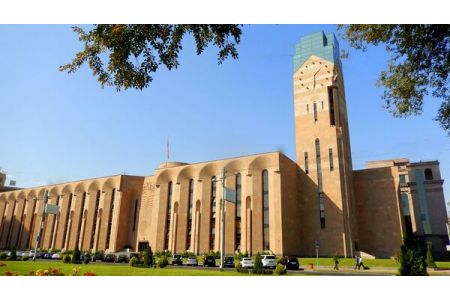 Yerevan City Hall is considering introducing a valet parking system in the city
 Expert: The circus surrounding the “Albanization” of Armenian culture in the presence of foreign ambassadors in occupied Artsakh is genocide
 Political scientist: If Russian-Armenian relations are destroyed, Turkey will take Russia`s place
 Political scientist: The Armenian public is simply obliged to significantly change the entire content of public discourse and struggle
 Cross tattoos are being removed from the skin of Christian prisoners in Azerbaijan by fire, according to a human rights activist.
 Zakharova: Armenia`s likely introduction of visas with Russia will be a step against Yerevan itself
 Putin: Armenia`s recognition of Karabakh as part of Azerbaijan in Prague has given Russia`s position on this issue an ambivalent character
 Putin: Armenia`s adoption of the law on EU accession means an announcement of its withdrawal from the Eurasian Economic Union