


ArmInfo. The only practical deterrent in international relations is the possession of nuclear weapons by countries. This opinion was expressed on his Facebook page by political scientist Suren Surenyants, leader of the Democratic Alternative party, in response to recent events surrounding Iran.
The political scientist recalled that Iran's Supreme Leader, Ayatollah Ali Khamenei, was killed in a US- Israeli strike, and two months earlier, the United States carried out an operation and kidnapped Venezuelan President Nicolas Maduro. According to Surenyants, these events indicate that international relations have entered a phase of systemic disintegration.
"Actions against the highest leaders of sovereign states, carried out without a UN mandate or any universal procedure of international law, are no longer perceived as extreme exceptions. They are gradually becoming a political tool within the logic of the open and vulgar use of force. This reality demonstrates that international law and the bodies designed to guarantee its observance have effectively ceased to function as real mechanisms of deterrence," the politician noted.
He noted that today the UN, international courts, and multilateral institutions limit themselves to mere statements that are incapable of entailing binding consequences. Thus, according to Sureniants, the law remains formal, while the use of force becomes part of practical policy, and actions against heads of state elevate conflicts to a qualitatively new level.
"This is no longer a question of physically or politically neutralizing the power of a sovereign state. When such actions are not accompanied by an adequate international response, it is tantamount to legitimizing the incident. Under these conditions, a bitter but obvious reality has emerged: the presence of nuclear weapons has become the only practical deterrent in international relations," the party leader believes.
Sureniants noted that today, states with nuclear potential enjoy a certain degree of de facto immunity, regardless of their political behavior. He cited the policy of the US President Donald Trump administration as an example, noting that despite its harsh rhetoric, Washington avoids direct military confrontation with North Korea, recognizing the consequences of nuclear escalation.
The politician explained that, by the same logic, the United States is forced to negotiate with Russia and China as strategic equal partners, as these countries are nuclear superpowers. "Thus, a world order is being formed in which states are effectively divided into two groups: those with a nuclear shield and those without. The sovereignty of the latter becomes relative, and their security conditional," the party leader noted.
Sureniants believes that this process is most dangerous for small and medium-sized states, as countries whose security was built on legal mechanisms, mediation, and the multilateral system find themselves in a vulnerable position.
"Under these conditions, rules don't apply; the balance of power determines state security, and sovereignty depends on the political calculations of external players. When the only real 'red line' is nuclear weapons, a dangerous status quo is established in the world, where peace is maintained not by rules, but by mutual fear. At the same time, such a situation could serve as an incentive for nuclear proliferation. If the only 'red line' is nuclear weapons, many states may conclude that they should develop them; for example, Saudi Arabia, Turkey, or Egypt may accelerate their programs. This will lead to further escalation and instability," the political scientist concluded.
On February 28, the United States and Israel launched an attack against Iran. This was the largest aggression in decades, resulting in the assassination of Supreme Leader Ali Khamenei. In retaliation, Iran struck American bases in Arab countries: the UAE, Qatar, Kuwait, Jordan, Bahrain, Oman, Iraq, and Syria. It also struck a British base in Cyprus and oil installations in Saudi Arabia. Saudi Arabia announced it was joining the US-Israeli campaign against Iran.
Trump stated that the operation, which is expected to last several weeks, is aimed at: depriving Iran of the ability to develop nuclear weapons; curbing its missile program; and eliminating threats to the United States and its allies. He also called on Iranians to rise up and overthrow the government. Democrats accused Trump of a "war of choice" and questioned his arguments for ending peace talks, which the Omani mediator believed still had a chance of success.
Trump claimed that Iran would soon be able to attack the United States with ballistic missiles, although sources say his claims are not supported by intelligence and appear exaggerated. According to US Central Command, the first American casualties were recorded on Sunday: three US service members were killed, five were seriously wounded, and several suffered minor shrapnel wounds and concussions. Today, it was reported that Iran shot down an American fighter jet over Kuwait.
Notably, the Pentagon acknowledged during a congressional briefing that they had no intelligence about Iran's intention to commit aggression against the United States. Today, Iranian Supreme National Security Council Secretary Ali Larijani announced that Iran is refusing to negotiate with the United States.
It is noteworthy that before the escalation of the conflict, Iran and the United States were negotiating the Iranian nuclear dossier, with Oman acting as a mediator.














 Expert: Economic pressure on Armenia may be virtually painless for other EAEU members, but not for Armenia itself
 Expert on protests in France: Civilizations fade when society loses a vision of the future
 Turkologist: Azerbaijan is not all-powerful—its vulnerabilities should become part of Armenia’s security strategy
 Opinion: The development of the Amulsar mine near the resort town of Jermuk is the beginning of an environmental disaster in Armenia
 Expert: The arrest of opposition figures in Armenia for social media posts is a systematic attempt to intimidate the public and suppress dissent.
 The Armenian Foreign Minister commented on the country`s return to work within the CSTO.
 The Artsakh Public Council expressed outrage at the UN Secretary-General`s behavior
 Lukashenko called for Armenia to assume the CIS presidency in 2029
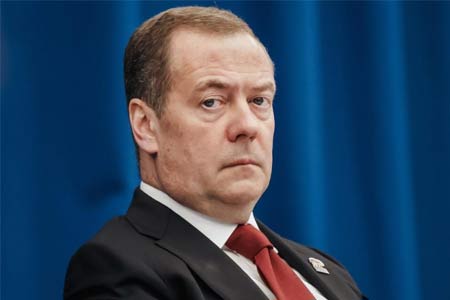 Dmitry Medvedev predicted a Ukrainian-like fate for Armenia amid the country`s shift in foreign policy
 Russian Security Council: In Armenia, they want to force Russian asset owners to dispose of their assets
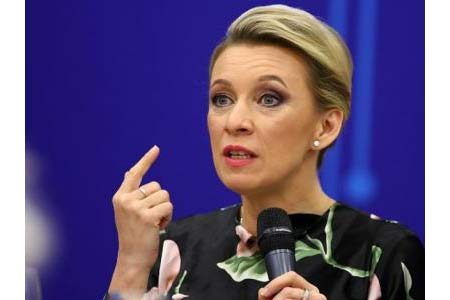 Zakharova: Russia ready to discuss with Armenia the prospects for expanding military cooperation as part of a review of bilateral ties
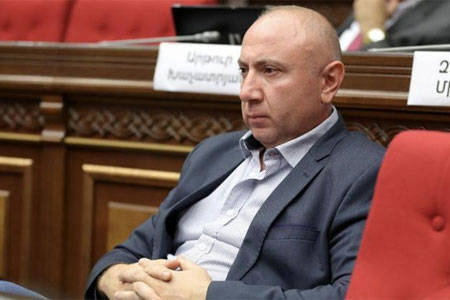 Tevanyan: Armenia, like Ukraine and Moldova, is being drawn into the EU’s global war
 Yerevan City Hall is considering introducing a valet parking system in the city
 Expert: The circus surrounding the “Albanization” of Armenian culture in the presence of foreign ambassadors in occupied Artsakh is genocide
 Political scientist: If Russian-Armenian relations are destroyed, Turkey will take Russia`s place
 Political scientist: The Armenian public is simply obliged to significantly change the entire content of public discourse and struggle
 Cross tattoos are being removed from the skin of Christian prisoners in Azerbaijan by fire, according to a human rights activist.
 Zakharova: Armenia`s likely introduction of visas with Russia will be a step against Yerevan itself
 Putin: Armenia`s recognition of Karabakh as part of Azerbaijan in Prague has given Russia`s position on this issue an ambivalent character
 Putin: Armenia`s adoption of the law on EU accession means an announcement of its withdrawal from the Eurasian Economic Union
