
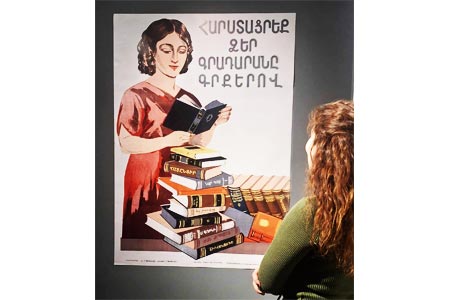
ArmInfo. To mark Book Giving Day in Armenia, the Museum of Russian Art ( the collection of Prof.A.Ya. abrahamyan) has launched an exceptional exhibition titled "Love Books," showcasing a unique collection of Armenian poster art from the Soviet era.
The exhibition features posters from the late 1940s and early 1950s-the period of post-war reconstruction, when books were seen as a vital tool for public enlightenment and ideological work. This is the first time the works have been presented to the general public: previously, they were held in the collections of the National Library of Armenia, which houses one of the largest collections of Soviet posters in the country. The curator of the project is art historian Artur Atayan. Back in 2019, he began researching Armenian poster art using the National Library's archives, and the current exhibition is the culmination of many years of research. Speaking at the opening ceremony, Atayan noted that the 1960s are considered the "golden age" of the Armenian poster school. The works on display, however, date back to an earlier period and, according to him, are inferior in artistic expressiveness to the posters of the 1960s. Nevertheless, they serve as visual documents of the era, primarily due to their pronounced propaganda nature and calls to literacy and reading.
The art historian emphasized that book-themed posters were published in enormous print runs during those years, attesting to a large-scale state campaign to popularize books. However, there was also the issue of selling the published products. Book print runs in the early 1950s were record-breaking for Armenia: in just one year, approximately 6 million copies were published-an average of five books per capita. A significant portion of the collection consisted of textbooks, but 20-30% was fiction, more than half of featured Armenian authors.
According to the study, in the post-war period, the Soviet government aimed to restore the economy and cultural life to pre-war levels. Of the roughly 50 million posters produced during the post-war period, nearly 20% were dedicated to advocacy and advertising, making them the most effective tools for mass communication. The circulation of books during the Soviet period amounted to approximately 1.5 billion.
"I wanted us to know what our people in the 1940s and 1950s saw in houses of culture, at the entrances of libraries, on the streets- to understand, and what messages they received," Atayan said, noting that there are still many gaps in the study of Armenian poster art. "I hope that further research will help fill these gaps," he concluded. Note, the exhibition will run until March 25th.













 Azerbaijani Studies Expert: While Azerbaijan Prepares Its Generation for War, Aliyev’s Aide Calls on Armenia to Prepare Armenian Society for “Peace”
 Turkologist: Azerbaijan will never, under any circumstances, stop pressuring the Armenian people
 Political scientist: We need to move away from the question of "when" and replace it with more important questions
 International Law Specialist: Azerbaijan intends to initiate legal proceedings against Armenia by sentencing Armenian prisoners
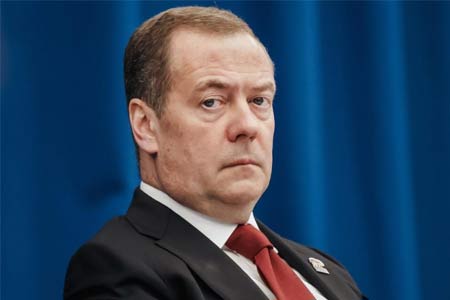 Dmitry Medvedev predicted a Ukrainian-like fate for Armenia amid the country`s shift in foreign policy
 Russian Security Council: In Armenia, they want to force Russian asset owners to dispose of their assets
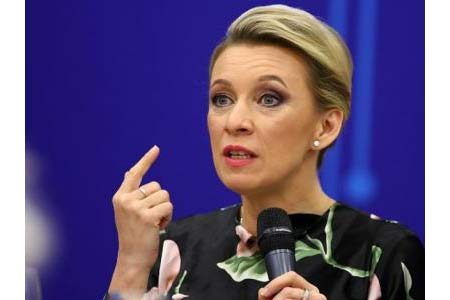 Zakharova: Russia ready to discuss with Armenia the prospects for expanding military cooperation as part of a review of bilateral ties
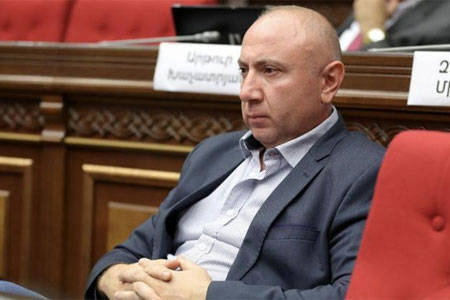 Tevanyan: Armenia, like Ukraine and Moldova, is being drawn into the EU’s global war
 Yerevan City Hall is considering introducing a valet parking system in the city
 Expert: The circus surrounding the “Albanization” of Armenian culture in the presence of foreign ambassadors in occupied Artsakh is genocide
 Political scientist: If Russian-Armenian relations are destroyed, Turkey will take Russia`s place
 Political scientist: The Armenian public is simply obliged to significantly change the entire content of public discourse and struggle
 Cross tattoos are being removed from the skin of Christian prisoners in Azerbaijan by fire, according to a human rights activist.
 Zakharova: Armenia`s likely introduction of visas with Russia will be a step against Yerevan itself
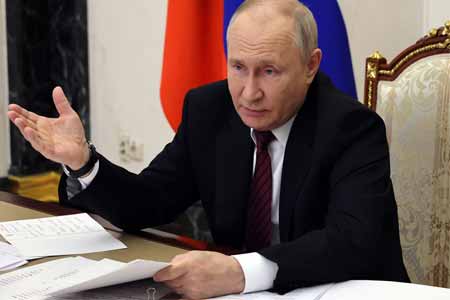 Putin: Armenia`s recognition of Karabakh as part of Azerbaijan in Prague has given Russia`s position on this issue an ambivalent character
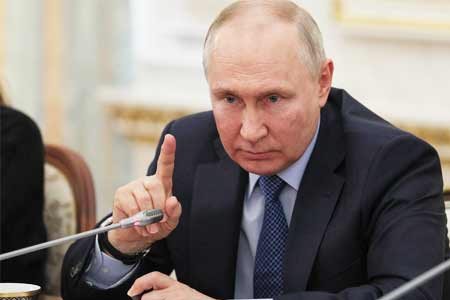 Putin: Armenia`s adoption of the law on EU accession means an announcement of its withdrawal from the Eurasian Economic Union
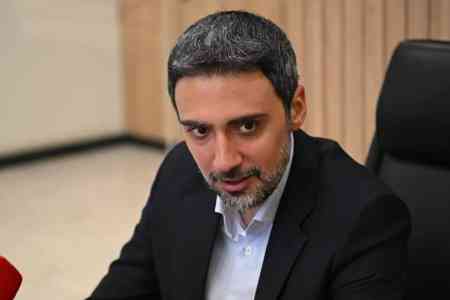 Aram Vardevanyan: Public demands solutions, not apology scandals in Parliament
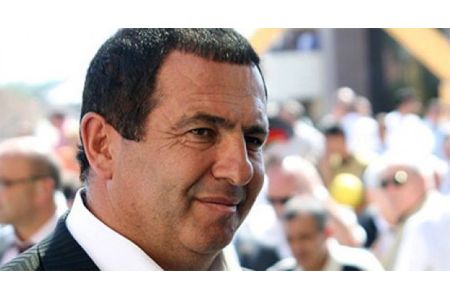 Arrested Armenian oligarch on economy and new jobs